Slatine Beach Čiovo Island: Authentic Village Shore Split
Profile
Slatine Beach, Čiovo Island: The Authentic Village Shore Across the Water from Split
Croatia | Dalmatia | Split Region Beaches
The ferry from Split to Slatine takes approximately twenty minutes, and the distance it covers is considerably greater than the water between them suggests.
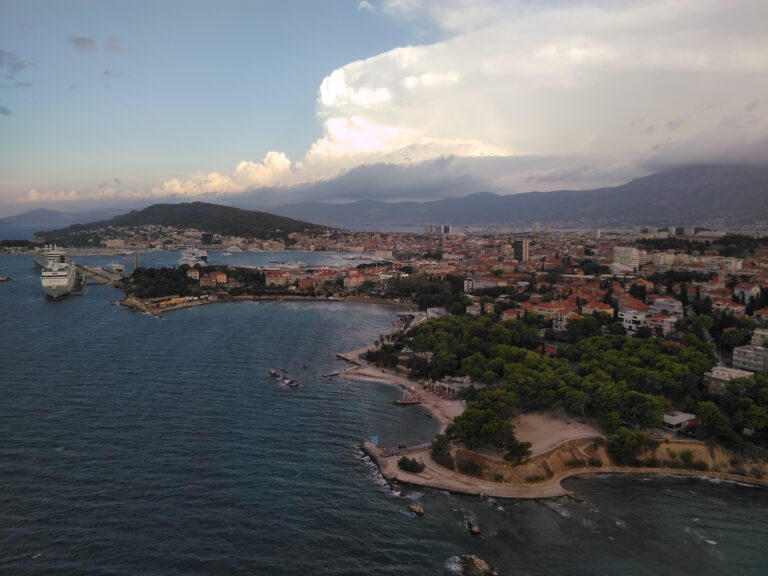
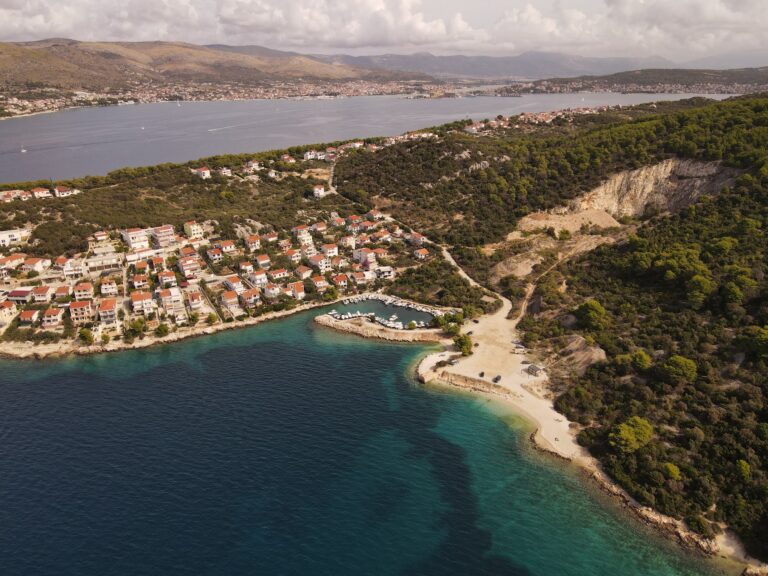
On one side: the urban density of Split, the Diocletian’s Palace complex visible from the Riva, the noise and momentum of a city that functions year-round and reaches full summer intensity in July. On the other: a small harbour on the northeastern tip of Čiovo Island, tamarisk trees leaning over the waterfront, a modest collection of stone houses arranged around the bay, and a beach that has been used by the same families for generations without apparent need of reinvention or improvement.
I made the crossing on the Bura Line ferry on a Thursday morning and stepped off at Slatine harbour into the particular quiet of a place that knows exactly what it is and has no interest in being anything else. The contrast with the city behind me was immediate and complete. It took perhaps ten minutes on the warm pebbles before the residual noise of Split had entirely left my nervous system, and another ten before I had settled into the rhythm that the place imposes on anyone willing to accept it.
Getting There: The Ferry as Part of the Experience
How to get to Slatine Beach from Split is a question with a clear best answer and two reasonable alternatives.
The Bura Line ferry from Split Riva runs multiple times daily throughout the summer, departing from the main waterfront and docking at Slatine harbour approximately twenty minutes later. It is the approach I would recommend without reservation to anyone visiting for the first time — not merely as a transport option but as an experience that frames the beach correctly. The crossing gives you twenty minutes on the water with the Split skyline receding behind you and Čiovo Island approaching, the shoreline of Slatine becoming gradually more distinct as you near the dock. Arriving at a village harbour by boat, on a small ferry in the early morning with the sun on the water, is a beginning to a beach day that no car park can replicate.
By car, the route from Split toward Trogir followed by the Čiovo bridge crossing and then eastward along the island road reaches Slatine in approximately fifteen minutes. Public parking is available along the road and near the village centre. This is the practical option for families with significant equipment or for those arriving from directions other than Split, though the drive along the island’s northern coast is pleasant enough in its own right.
The Promet bus line connecting Trogir with Slatine provides a public transport option for visitors without a car who are not positioned for the ferry crossing — a less scenic but entirely functional alternative.
The Shore and Setting
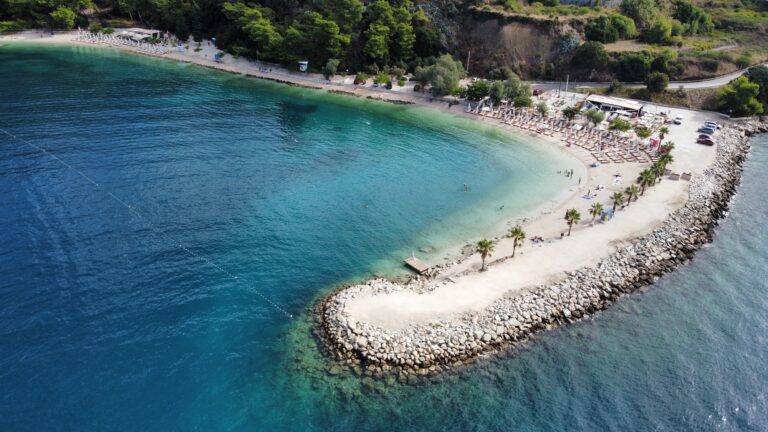
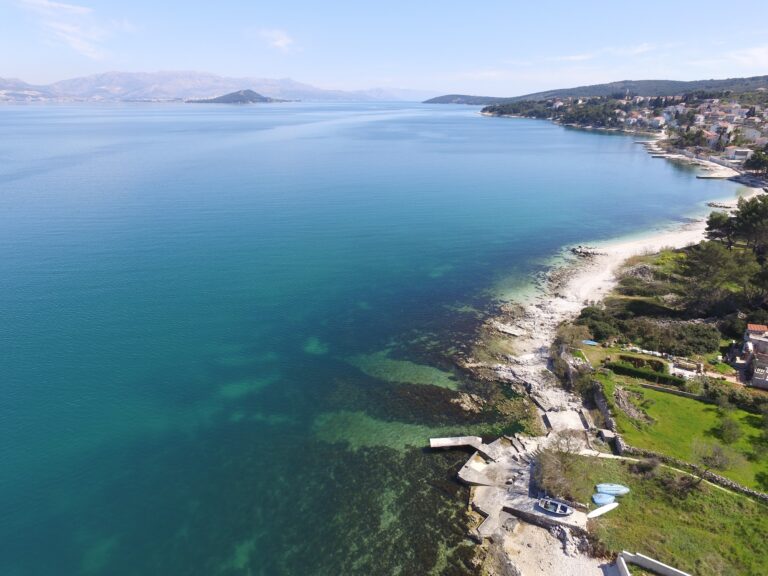
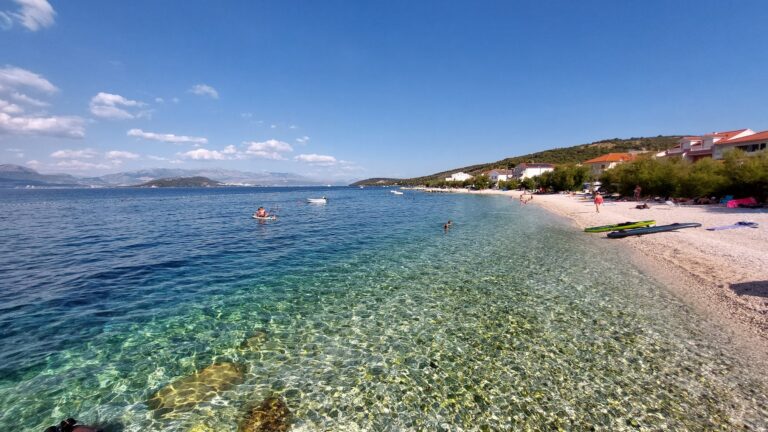
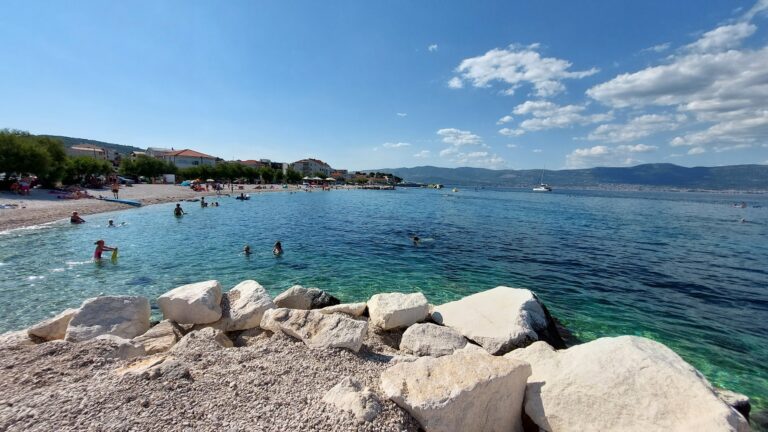
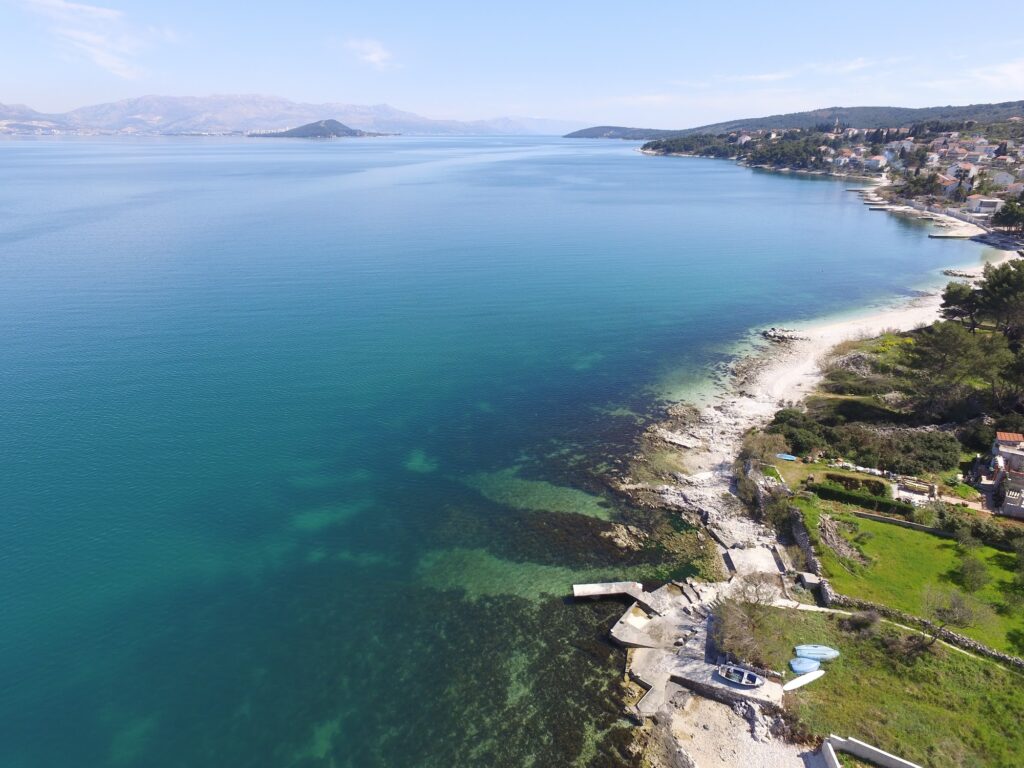
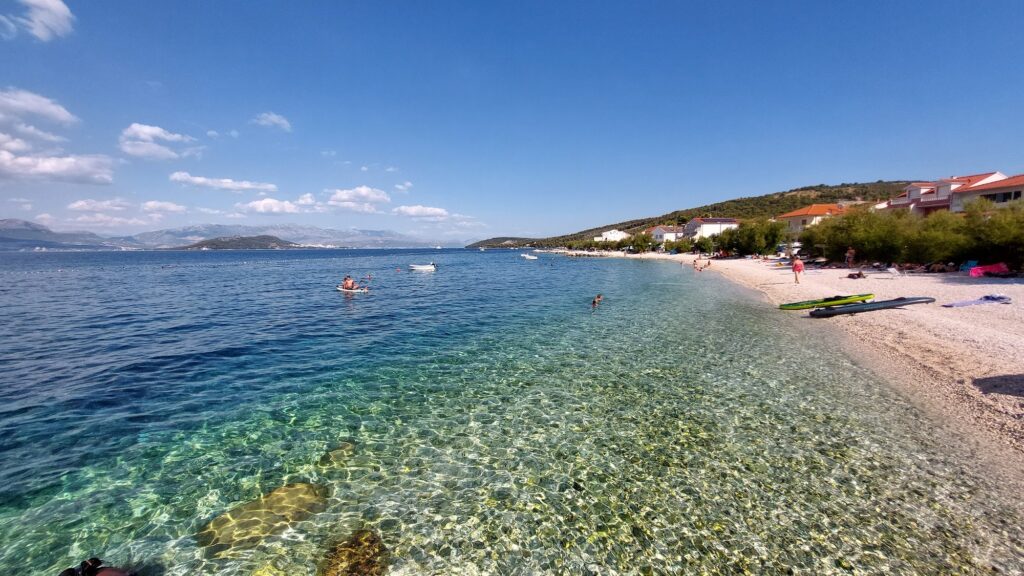
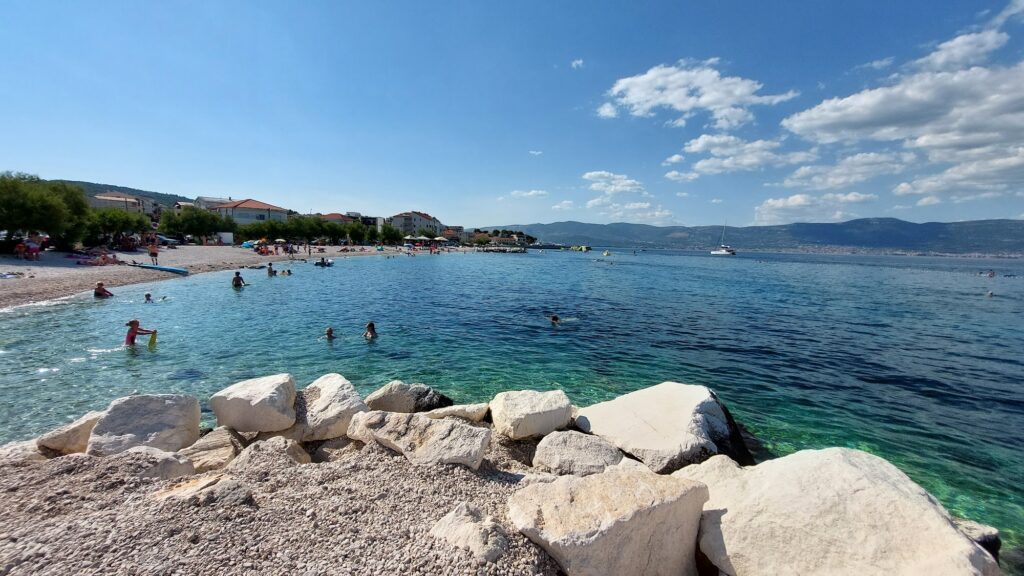
Slatine Beach is a pebble and fine gravel shore — light-coloured stones that reflect the Mediterranean light with that particular luminosity that white and pale pebble beaches produce at their best. The beach runs along the northeastern facing side of the village, looking directly across the water toward the Split mainland and the distinctive profile of Marjan Hill — the pine-covered promontory that rises above the western edge of the city.
That view is the defining visual quality of Slatine beach Čiovo Island and one of its genuine distinctions among the beaches of the broader Split region. Lying on the pebbles or floating in the bay with the Split skyline and Marjan Hill across the water is a perspective on the city that most people who visit Split never obtain — the reverse view, from the island looking back, that shows the relationship between the urban coast and the island archipelago in front of it with a clarity that the city side of that relationship does not provide.
The tamarisk trees that line sections of the beach — lower and less dramatic in shade than the Aleppo pine forests of beaches further up the coast, but characterful in a different way, their fine foliage casting a dappled, shifting shade onto the pebbles beneath — give the shore a texture that is specific to this stretch of the Dalmatian coast and that contributes to the overall sense of a place with its own established identity.
The Water
The water quality at Slatine Beach is consistently excellent — transparent in the characteristic Adriatic manner, the seabed clearly readable from the surface, the colour in the shallows a clear turquoise that deepens to blue with increasing depth. The bay’s northeastern orientation, facing the mainland rather than the open Adriatic, keeps the water calmer through most conditions than the more exposed southern shores of Čiovo Island experience, and the result is a swimming environment that is generally smooth and settled — well-suited to long, unhurried swims and to less confident swimmers who find choppier conditions uncomfortable.
I snorkeled along the margins of the beach on my first morning at Slatine — working through the sections where the pebble bottom gives way to the rocky substrate that supports more varied marine life. Sea bream moved through the underwater vegetation with the unhurried confidence of fish in genuinely undisturbed water, and the visibility throughout the session was sharp enough to follow their movement in detail without effort. Snorkeling at Slatine Beach is not the dramatic underwater topography of a cliff-enclosed cove, but the quality of the water and the undisturbed character of the marine environment make it consistently rewarding for anyone with a mask and a patient approach.
Kayaking and SUP at Slatine are the water activities that the bay’s conditions most naturally support. The calm, clear water, the harbour to explore, and the adjacent sections of Čiovo Island’s northeastern coastline — with its smaller coves and rocky points accessible by paddle — make the beach an excellent base for a few hours of independent coastal exploration at water level. Equipment rental is available at the beach, and the morning hours in particular, before any wind has developed, offer the flat water that makes paddling genuinely pleasurable.
Facilities
Slatine Beach facilities reflect the scale and character of a village beach rather than a major resort destination — present, functional, and appropriately modest without being inadequate for a full day.
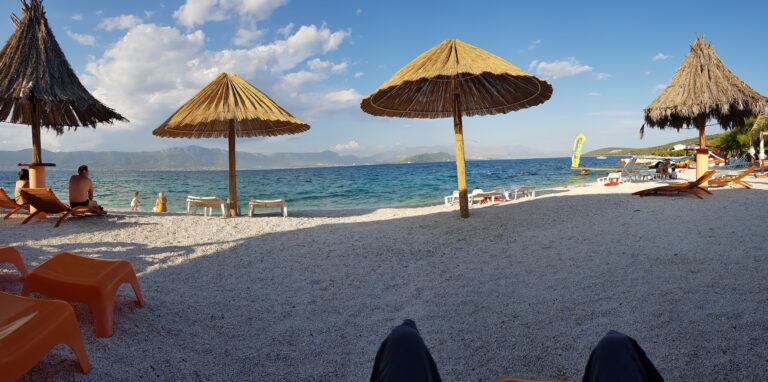
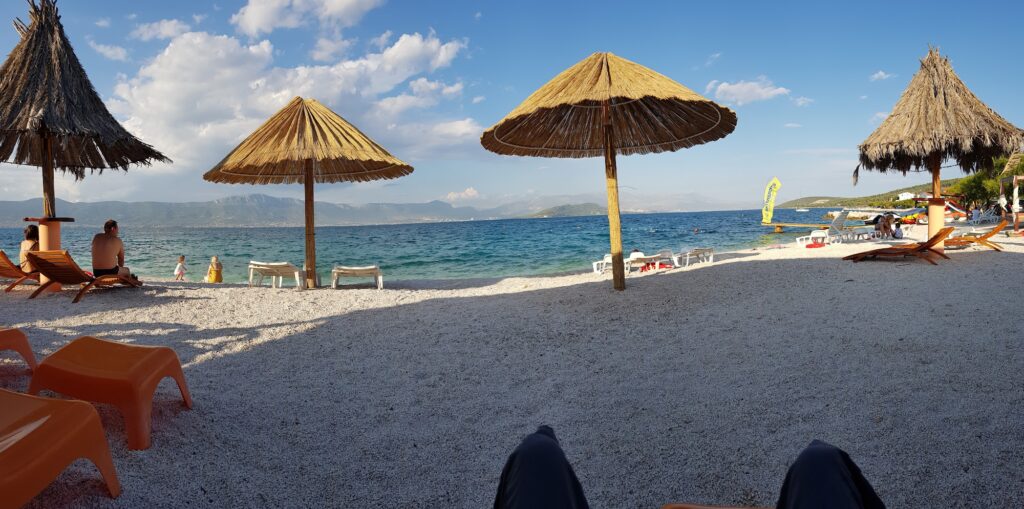
Freshwater showers and changing cabins are positioned along the main beach stretch. Sunbed and umbrella rental is available at beach clubs along the waterfront for visitors who want organised comfort. The lifeguard service at Slatine operates during peak summer months, monitoring the buoy-marked swimming zones and providing the formal supervision that transforms a pleasant beach into a reliably safe one. Beach volleyball courts and a children’s playground behind the beach line provide supplementary activity for visitors whose day extends beyond swimming.
What the beach lacks relative to larger, more developed destinations like Copacabana in Okrug Gornji on the same island — the aqua park, the jet ski fleet, the extensive water sports infrastructure — it compensates for in atmosphere and in the specific quality of a beach that functions as part of a living village rather than as a standalone tourism product. These are different goods rather than comparable ones, and knowing which you are looking for determines whether Slatine or the island’s more energetic options is the right choice for a given day.
The Atmosphere: Village Life and the Water
The atmosphere at Slatine is the quality that distinguishes it most clearly from the resort beaches of the broader Split region and that most consistently generates the specific satisfaction of having found somewhere that operates on its own terms.
This is a village that happens to have an excellent beach, rather than a beach that has generated a village around it — and the distinction shows in everything from the pace of the morning to the character of the people sharing the shore. Local families arrive with the ease of habit. The harbour behind the beach carries the activity of a working fishing community rather than a purely tourist infrastructure. The konobas along the waterfront are the restaurants of a village rather than the restaurants of a beach resort, and the cooking reflects that difference in the most positive way.
The view of Split across the water adds a dimension to the day that most Croatian beaches cannot offer — the awareness of the city visible in the distance, its noise and momentum entirely absent, its skyline providing a satisfying backdrop to the specific and self-contained peace of the island shore. It is the pleasure of proximity without presence, of being close enough to return easily but far enough that the return feels like a choice rather than an inevitability.
For Families
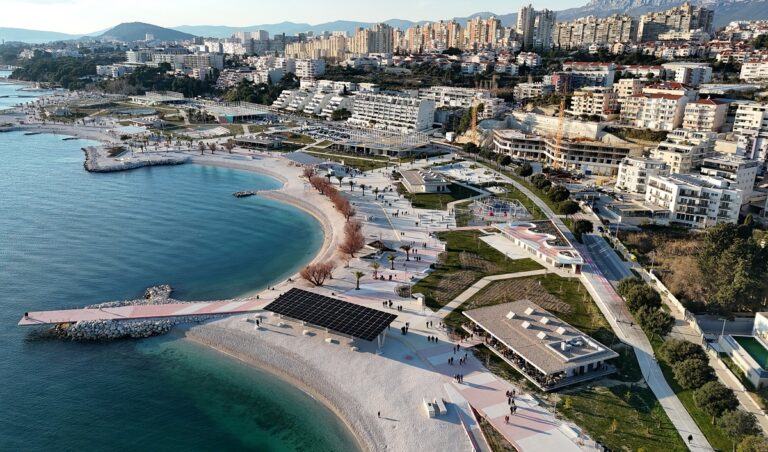
Slatine Beach with children works well for families who find the energy and commercial density of Split’s city beaches — Bačvice, Kaštelet, the urban waterfront stretches — too compressed for a comfortable full day with young swimmers, and who want the accessibility of a short crossing rather than the longer logistics of a more distant destination.
The gradual seabed slope and calm bay water make the shallows safe and comfortable for young children. The playground behind the beach provides supplementary activity for the hours when interest in the water has temporarily run its course. The village proximity to basic supplies — snacks, cold drinks, ice cream — means that the practical needs of a day with young children are met without difficulty.
The tamarisk shade, while less extensive than the pine forests of more heavily wooded beach destinations, provides sufficient cooling at the right hours of the day for families who position themselves at the treeline. The ferry connection to Split is a genuine practical advantage for families based in the city — the crossing is short, the boat is child-friendly, and the departure point on the Split Riva is central enough to be easily reached from most city accommodation.
Food and Drink
The waterfront at Slatine handles food and drink with the unselfconscious competence of a village that cooks primarily for itself and extends that cooking to visitors without adapting it to tourist expectations.
The konobas along the shore serve Dalmatian coastal cooking in its most straightforward and honest form — fresh calamari, grilled fish, local white wine, the cooking of a community that has access to the same ingredients it has always had and has been preparing them the same way for as long as anyone can remember. I ate on the waterfront terrace on both evenings of my time in Slatine, looking across the water at the lights of Split coming on as the sky darkened, and found both meals entirely satisfying in the specific way that unpretentious, honest cooking at a good location produces.
The beach bars handle coffee and cold drinks through the day with the relaxed, unhurried service that the atmosphere of the place invites and that the pace of a village beach makes natural. Morning coffee at a table on the waterfront, watching the ferry approach from Split, is a pleasure simple enough to resist description but not recommendation.
Slatine Beach on Čiovo Island is the answer to a question that visitors to Split frequently ask without quite articulating it: where do I go to find the Dalmatian island atmosphere without spending a day on a ferry or a significant amount of money on accommodation? The answer is twenty minutes across the bay on a small ferry from the Riva, and it costs very little to find out.
What you find at Slatine is not the dramatic geology of Zlatni Rat, the resort energy of Copacabana in Okrug Gornji, or the ecological distinction of the more celebrated beaches further north. What you find is something harder to manufacture and increasingly harder to find on a coastline as popular as this one — a village beach that has retained its character because the village around it has retained its character, and that offers a quality of day shaped by authenticity rather than by tourism infrastructure.
Take the ferry in the morning. Swim, eat, watch the Split skyline across the water. Take the ferry back in the evening.
It is, in the best and most direct sense, exactly enough.
Map
Sorry, no records were found. Please adjust your search criteria and try again.
Sorry, unable to load the Maps API.
Near by places: