
Petra Beach Patmos: Ancient Rock, Clear Water
Profile
Petra Beach: The Rock That Used to Be a Girl
Greece | Patmos | Dodecanese | Aegean Coast
There’s a version of this beach’s history that a local told me over dinner in Grikos, and I’ve thought about it more than I expected to since. A young girl, the story goes, wanted to swim in the sea right after taking Holy Communion. Her mother told her not to, warned she’d turn to stone if she tried. She went anyway, and the massive rock standing at the edge of Petra Beach is supposedly what became of her, frozen at the water’s edge, forever unable to finish the swim she started.
Patmos trades heavily on its religious weight, the monastery and the cave where John is said to have written Revelation drawing most of the island’s attention. Petra Beach sits apart from that, a quieter kind of significance built around a single rock formation that predates Christianity on this island by a considerable margin.
The Rock of Kalikatsou, Older Than the Monastery Above It
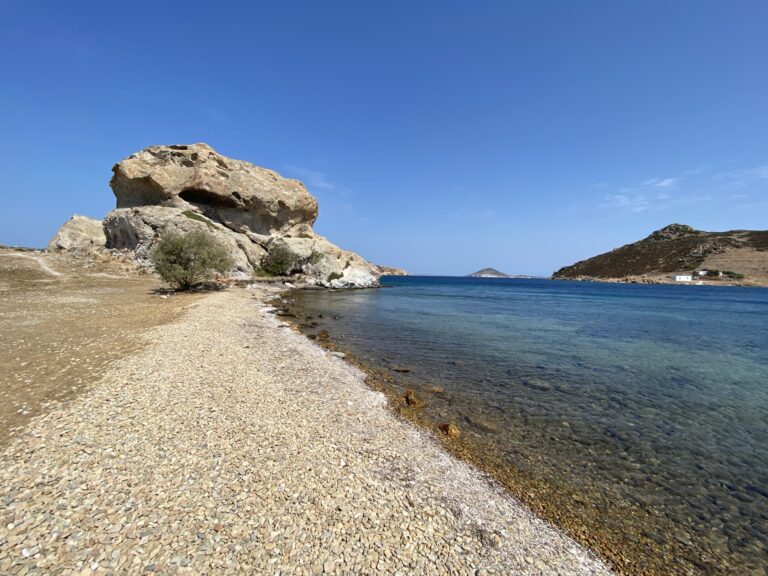
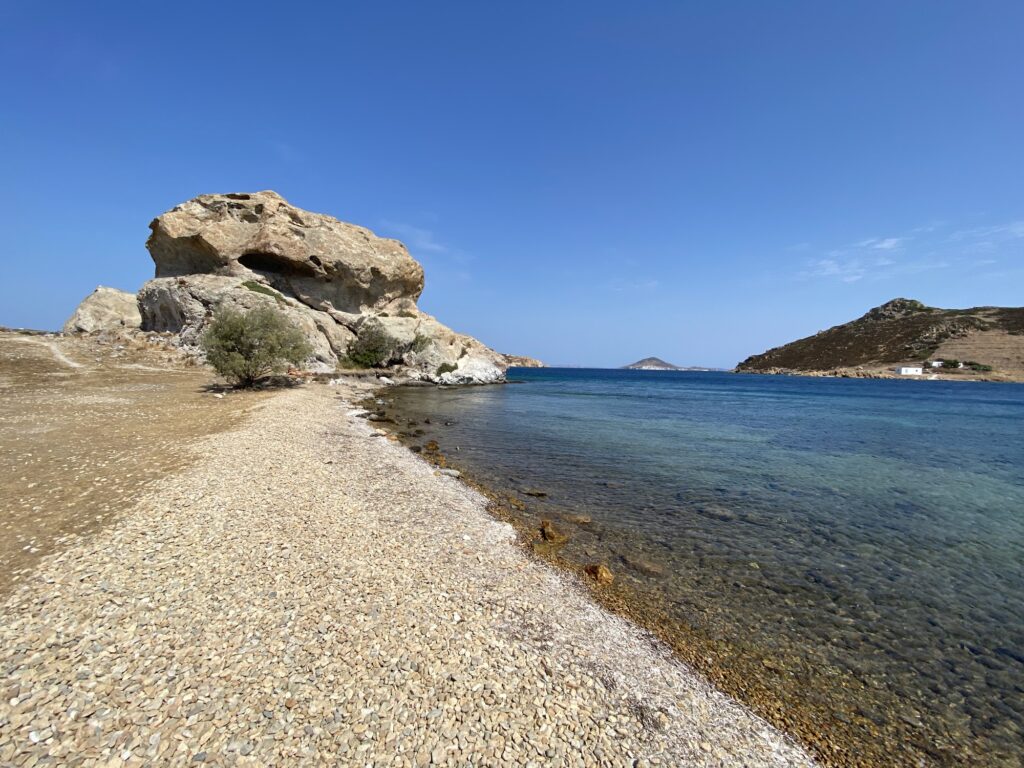
The Rock of Kalikatsou dominates Petra Beach in a way that’s hard to overstate until you’re standing in front of it. Archaeological evidence places human use of the site as far back as the late Bronze Age, somewhere around 1100 BC, and several researchers believe it functioned as a sanctuary, possibly dedicated to Aphrodite, long before anyone on Patmos had heard of Saint John.
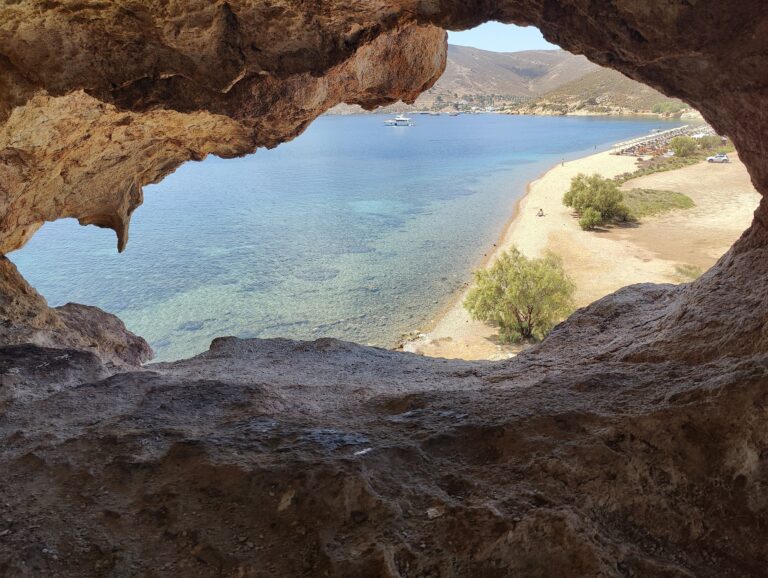
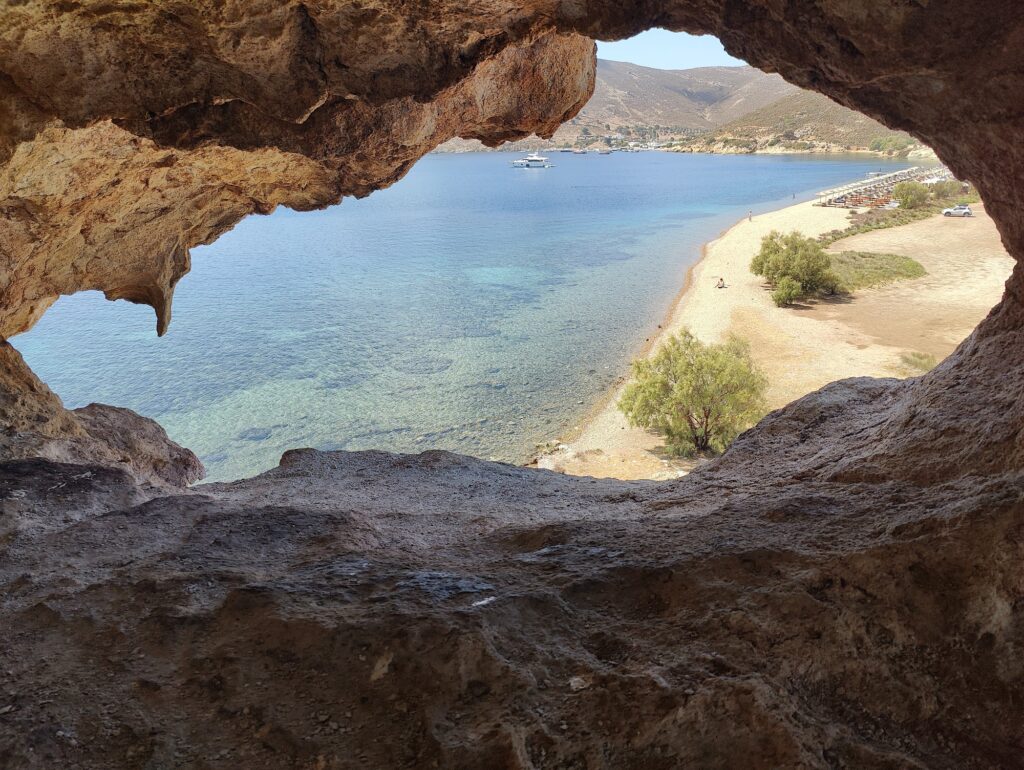
What struck me most, climbing the worn steps cut into the rock’s surface, was how much later history layered on top of that older one. Hermit monks eventually took up residence in small caves carved into the stone, building a stone staircase, a cistern for water, and small niches for candles, all of which are still visible today. That hermitage apparently lasted until sometime in the fourteenth century, when it was abandoned, leaving the rock to sit largely as it does now, an odd honeycomb of carved recesses facing out toward the sea.
Two Beaches Divided by a Narrow Strip of Land
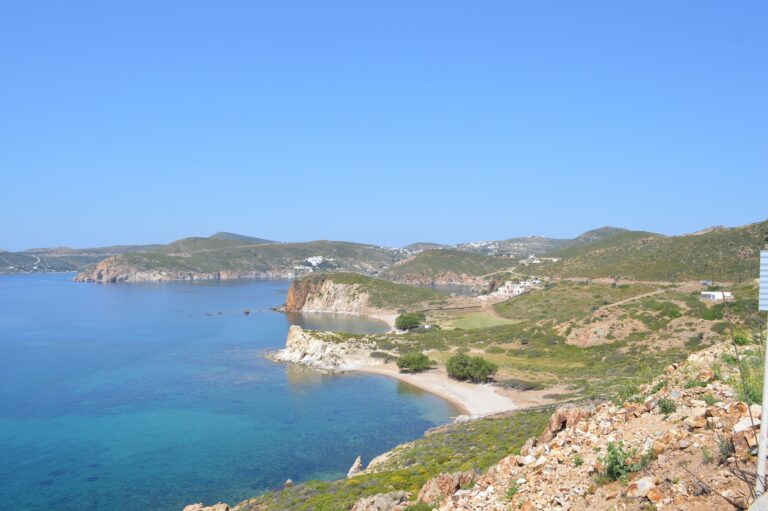
Petra Beach itself splits into two distinct stretches, separated by a narrow spit of land that runs out toward the water. I spent my first morning on the side facing Grikos, where the pebbles run large and smooth underfoot, and the afternoon exploring the quieter stretch on the rock’s far side, where the shoreline felt considerably more exposed and windswept.
The water on both sides stays remarkably clear, a product partly of the pebble seabed and partly of the bay’s exposure to open sea on the eastern side, which keeps the water circulating rather than sitting still and warming through the day. I found the swimming here more bracing than the sheltered coves I’d visited elsewhere in the Dodecanese, a wide-awake kind of cold that suited a morning swim better than an afternoon one.
A Legend About a Hidden Tunnel to the Monastery
Beyond the petrified-girl story, I heard a second legend tied to Kalikatsou during my stay, this one involving a supposed secret tunnel connecting the rock to the Monastery of Saint John up in Chora. According to the version told locally, the tunnel was carved so that monks could carry sacred relics down to Petra’s sheltered bay and hide them here during pirate raids on the island. I couldn’t find any archaeological confirmation of an actual tunnel during my visit, and I’d treat it as folklore rather than fact, but the story fits the rock’s layered history well enough that it’s easy to see why it’s stuck around.
Goat Cheese and a View Toward Tragonisi
A single taverna sits just above the sand at Petra, and I ate there twice, drawn back mainly by the kalathaki, a firm local goat cheese that showed up grilled alongside the fresh seafood on both visits. The tables face out toward Tragonisi, a small islet visible from the beach, and I spent one long lunch simply watching a handful of small boats move around its shoreline while I finished a plate of grilled fish.
For anyone who prefers to skip the organized section entirely, saltcedar trees further along the beach provide natural shade, and I noticed a fair number of visitors bringing their own umbrellas and towels rather than renting sunbeds, treating this stretch as the unplugged alternative to the busier setup near the taverna.
Getting There: South From Skala Through Grikos
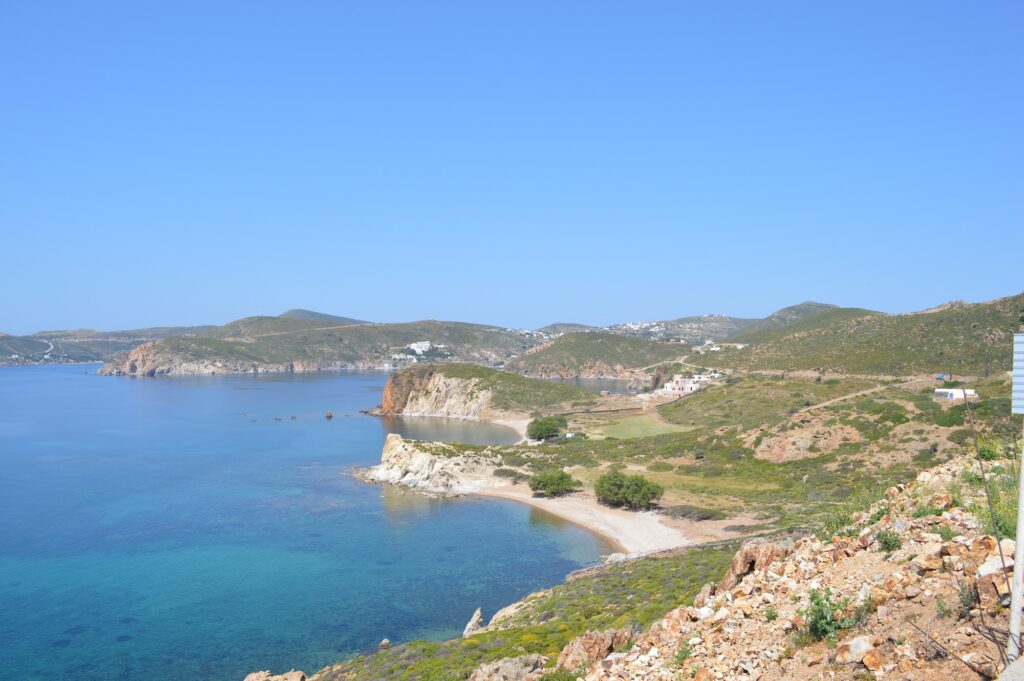
Petra Beach sits roughly 5 kilometers from Skala, the island’s main port, a drive of about twelve minutes along the coastal road heading south. I made this drive several times over my stay, and the route through Grikos is worth taking slowly rather than rushing, since the road offers steady views out toward Tragonisi as it curves along the coast.
Past Grikos, the road continues for another couple of minutes before reaching Petra directly, fully paved the entire way, which surprised me slightly given how remote the beach feels once you’ve arrived.
Buses and Taxis During the Summer Season
During high season, a local bus runs frequently between Skala and Grikos, continuing on to Petra, and I used it once when I hadn’t arranged a rental car, finding the schedule reliable enough not to require much planning around it. Taxis are also easy to arrange from Skala for a more direct, private trip, and given the modest distance involved, the fare never struck me as unreasonable.
Parking and the Best Window for a Quiet Swim
Parking sits in open lots directly behind the beach and the taverna, and I never had serious trouble finding space, even arriving mid-morning. That said, arriving before eleven gave me both an easier choice of parking and calmer water, before the day’s wind picked up and before the taverna’s lunch crowd filled the tables closest to the shore.
Comparing Petra to the Rest of Patmos’ Coastline
Patmos offers a range of beaches quieter and more remote than Petra, coves reachable only by boat or a longer hike that trade convenience for solitude. Petra sits somewhere in between, close enough to Skala for an easy day trip, but carrying enough historical weight in Kalikatsou’s carved steps and cisterns to reward more than a passing visit.
Elsewhere in the Dodecanese, Mandraki Beach Nisyros offers a useful point of comparison, another beach defined by a single dominant rock formation with its own layered religious history, though Mandraki’s story centers on a seventeenth-century monastery rather than a Bronze Age sanctuary. If volcanic and ancient rock formations are a particular interest, both are worth building a visit around. Closer in spirit to Petra’s split geography, Vlychadia Beach Kalymnos divides into two distinct shores around a working pier rather than a spiritual landmark, though the instinct to offer visitors a choice of environments feels similar.
An Afternoon Spent Climbing the Old Hermit Steps
By my last afternoon at Petra, I’d stopped treating the rock as a backdrop and started treating it as the actual destination, climbing back up the worn steps a second time just to sit in one of the carved recesses where a monk once kept a candle burning centuries ago. From up there, the two halves of the beach spread out below on either side, the taverna’s tables filling in slowly for the evening, and Tragonisi sitting quiet on the horizon exactly where it had been the whole time I’d been looking at it from the sand.
Map
Sorry, no records were found. Please adjust your search criteria and try again.
Sorry, unable to load the Maps API.