
Agios Konstantinos Beach Astypalea: The Castle View
Profile
Agios Konstantinos Beach Astypalea Greece: The Castle That Took Two Centuries to Build Looks Down on This Bay
Greece | Agios Konstantinos | Astypalea, Dodecanese
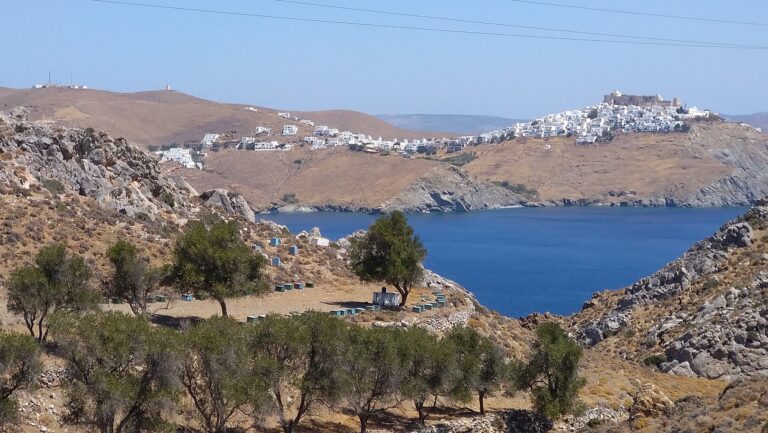
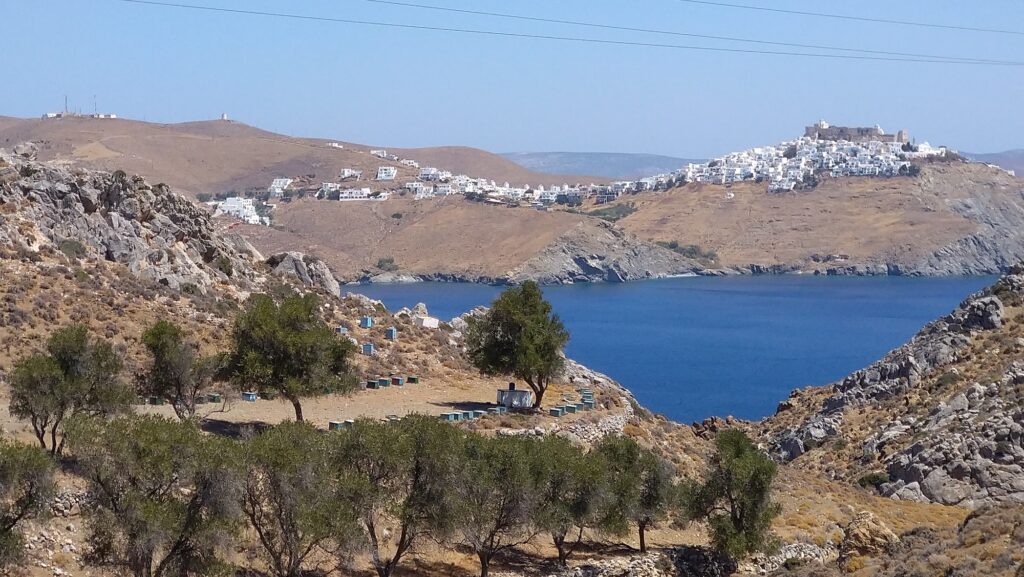
The Querini Castle above Chora took two centuries to finish. Giovanni I Querini began it in 1207, and it was Giovanni IV Zanachi Querini who completed it in 1413 — a span of construction that outlasted multiple generations of the same Venetian family holding this island at the far edge of their maritime reach. The castle’s size, the six centuries of Venetian, Ottoman, and Italian rule that followed its completion, and the 1956 earthquake that brought down most of the houses inside its walls have left it as it stands today: stone walls intact on the perimeter, two churches still standing within, the white houses of modern Chora arranged on the hillside below it like a slow spill. From Agios Konstantinos Beach, looking back across the bay toward the Chora headland, the whole shape of this history is visible in a single frame — the white settlement rising toward the grey stone above it, the castle at the top still reading as a fortification even without its original function.
Astypalea is called the butterfly of the Aegean for its shape: two roughly oval landmasses connected by an isthmus barely 126 metres wide at the narrowest point. Agios Konstantinos sits on the southeastern section of that shape, south of Livadi and just past Tzanakia, at a point where the road from Chora reaches its natural end rather than continuing further. The beach is the destination rather than a stop along the way to somewhere else.
Getting to Agios Konstantinos Beach Astypalea Greece: South from Livadi, Through Tzanakia
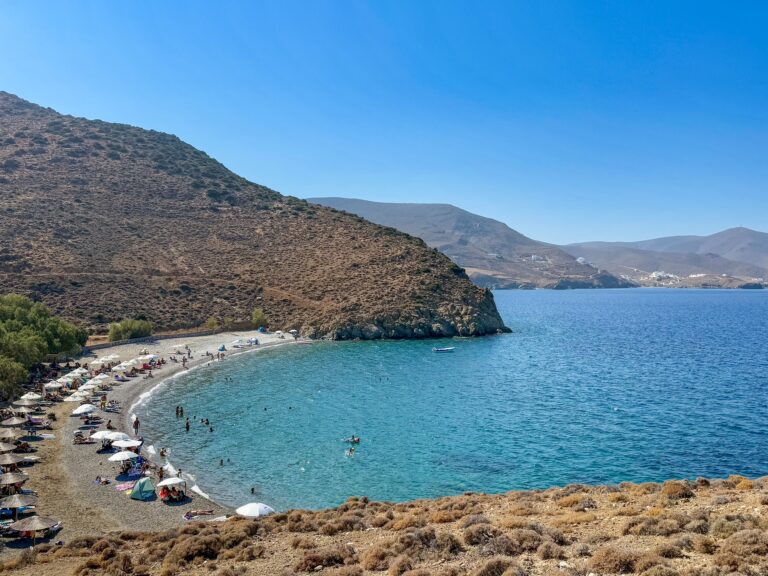
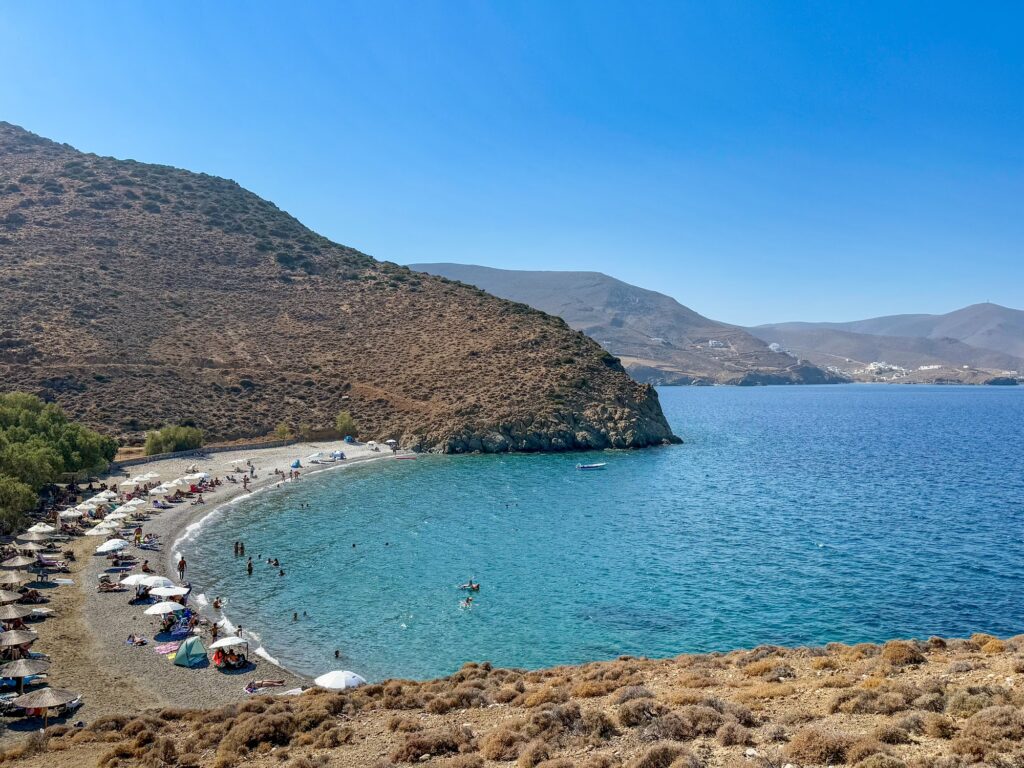
The drive from Chora covers approximately seven kilometres and takes around fifteen minutes, following the asphalt road south toward Livadi before continuing along the coastal track. The final section turns to a maintained dirt road for the last couple of kilometres. The descent toward the beach reveals the bay from above, the whitewashed chapel visible on the hill at the eastern end and the water below it shifting between pale turquoise and a deeper blue depending on the depth over the pebbled seabed.
A summer bus service connects Chora and Livadi to Agios Konstantinos, making the beach accessible without a vehicle for anyone based in town. The alternative is by sea: small excursion boats depart from the port of Pera Gialos, and the approach from the water shows the island’s cliffs from an angle the road cannot replicate. Parking at the beach is informal, in the natural open area behind the taverna and beach bar. Arriving before eleven in the morning secures a position close to the water entry before the afternoon crowds.
Agios Konstantinos Beach Astypalea Greece: Pebble and Sand, the Chapel on the Hill, a View Back to Chora
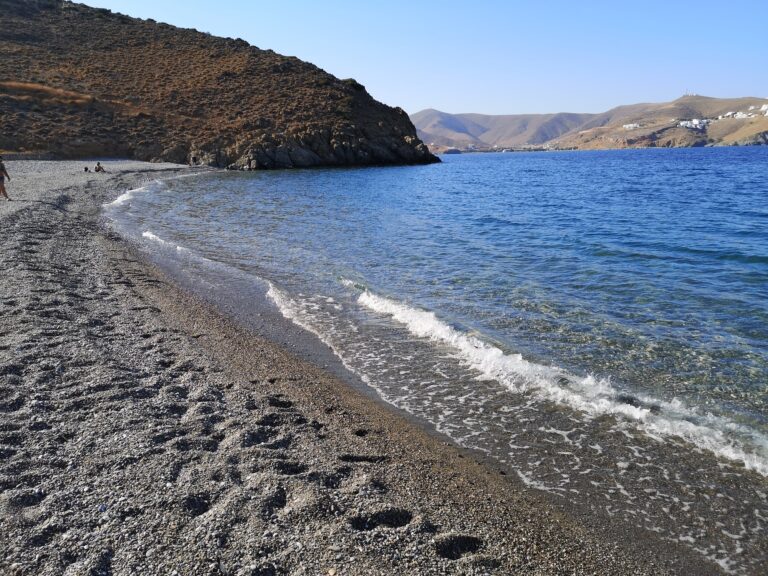
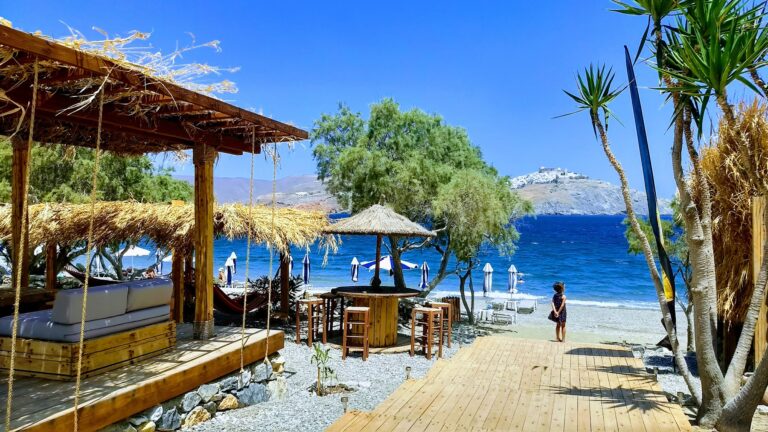
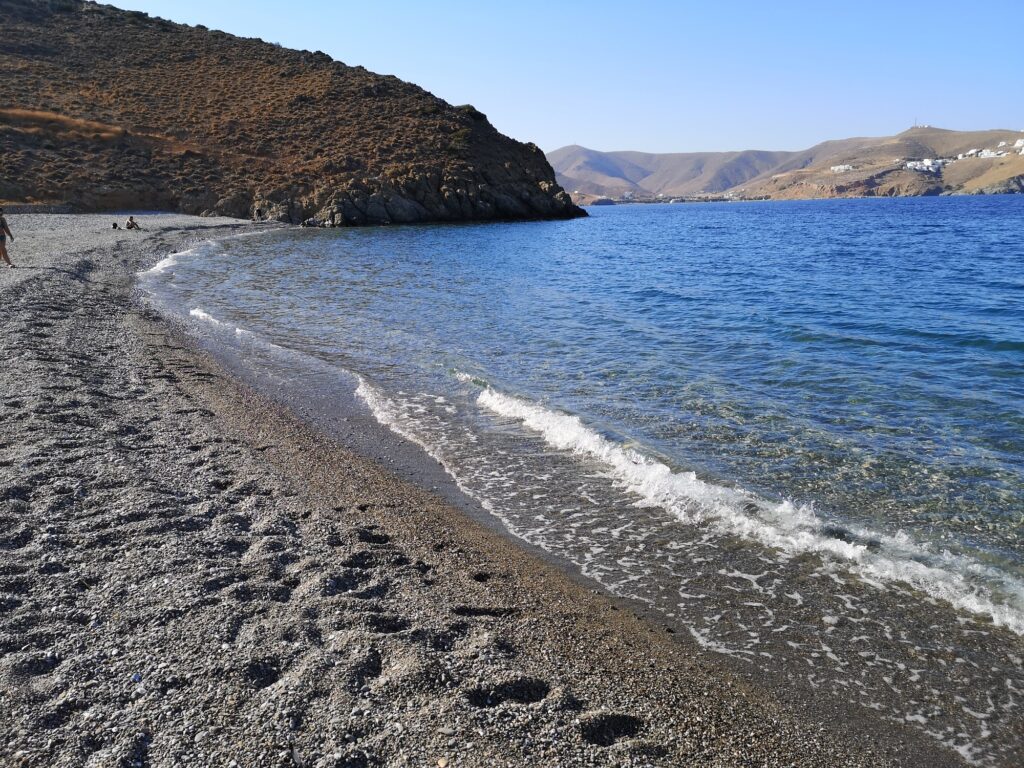
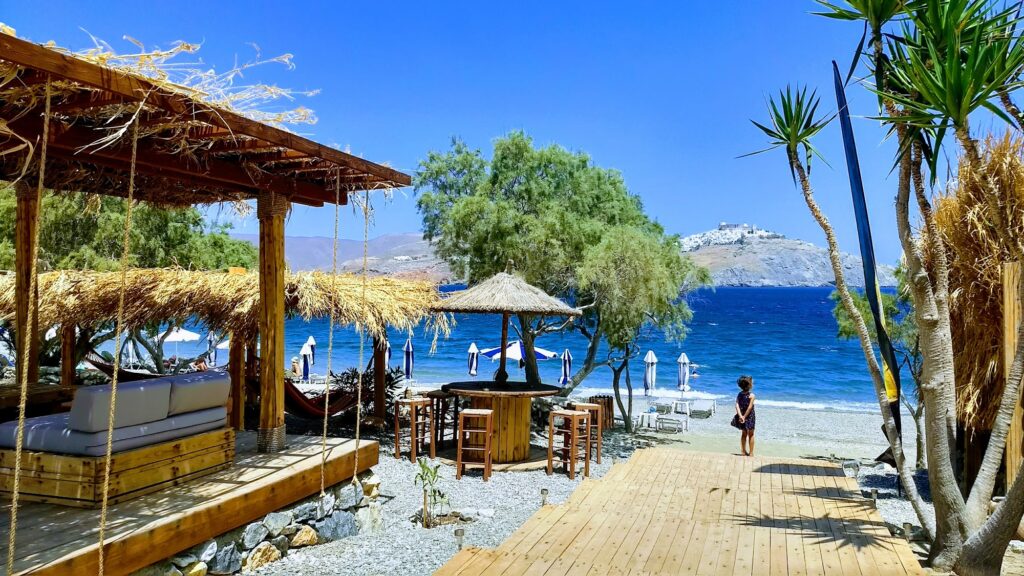
The beach is part sand, part smooth grey pebbles, the waterline particularly stony in places. Natural shade from a group of trees at the northwestern end provides an alternative to renting a sunbed, which runs ten euros for two beds and an umbrella — a reasonable rate for the level of organisation on offer, which is modest: a beach bar serving cold drinks, coffee, and snacks, and a small taverna serving fresh fish and local produce including chlori, the soft goat cheese particular to Astypalea. The beach is large enough and quiet enough in character that it never feels crowded even when the sunbeds are occupied.
The chapel of Agios Konstantinos sits on a hill at the eastern end, a short walk up a path from the beach. The view from the chapel back toward the beach and across the full width of the bay toward Chora is one of the clearer vantage points on this part of the island — the settlement and castle visible at a distance that compresses the landscape without losing the detail of the white houses and the stone walls above them. The chapel is used occasionally for small island weddings, the combination of sea view and white-walled architecture making it a specific and considered choice.
From the water, looking back toward the shore and beyond it to Chora, the view operates in reverse: the beach small and pale at the bottom, the white settlement on the hill, the castle above that, and the sky above the castle. The island’s entire vertical range visible at once.
The Wider Context: The Infant Cemetery, the Butterfly Shape, and Getting to Astypalea
The beach is reached from an island whose wider history rewards attention beyond the obvious focus on the Venetian castle. At Kylindra, on the western flank of the castle hill in Chora, archaeologists excavated a graveyard of at least 2,700 newborns and small children, buried in ceramic vessels between approximately 750 BC and Roman times. It is the largest ancient infant cemetery known anywhere in the world — a fact that sits in unusual proximity to the picturesque white settlement and the castle above it. The Archaeological Museum at Pera Gialos holds material from this site alongside finds from Mycenaean tombs excavated at Armenochori, including intact pottery, bronze weapons, and stone tools.
Reaching Astypalea from Athens means a ferry from Piraeus, a journey that takes between eight and twelve hours depending on the route and the season. The island’s small airport serves domestic flights from Athens during summer months. The ferry passes through other Dodecanese and Cyclades islands depending on the route, making Astypalea a natural stop on a wider itinerary through the southern Aegean rather than requiring a separate trip from the mainland.
Mouros Beach Kato Meria Amorgos Greece, on the neighbouring island of Amorgos, shares something of Agios Konstantinos’s character — a dark-pebble, unorganised cove reached by a path rather than a road, with sea caves at one end and limited facilities — and the ferry connections between Astypalea and Amorgos make the two worth considering in combination. Agia Anna Beach Amorgos Greece on the same island offers a different, more dramatic approach to the relationship between ancient settlement and accessible beach that Agios Konstantinos represents in its own quieter way.
The Coastal Loop: Tzanakia, Pappos, and the Path Between Beaches
The beach connects to a wider walking circuit that links Agios Konstantinos northward through smaller coves and the nudist beach at Tzanakia to Livadi and Chora — a loop of roughly 12.6 kilometres that the municipality has mapped and described. The full walk takes around three and a half to four hours at a steady pace, with swimming stops possible at the beaches along the route. The coastal path from Agios Konstantinos toward the chapel of Landes and the chapel of Agios Savvas is a shorter alternative of around 3.2 kilometres, climbing inland from the beach before returning to the coast. For anyone spending more than a single afternoon at the beach, the path context is worth knowing — the beach sits within a walking network rather than at a dead end.
Arrive before the afternoon sun is directly overhead, when the light on the water is at its most useful for the view toward Chora — the castle reads differently depending on the angle of light, and the morning hours before midday give the white Chora buildings and the grey stone of the Querini walls a contrast that flattens out later in the day. Walk up to the chapel if the beach has settled. The taverna serves chlori alongside the fresh fish; ordering both is not excessive.
Map
Sorry, no records were found. Please adjust your search criteria and try again.
Sorry, unable to load the Maps API.