Pesja Beach Omišalj: Blue Flag Cove North Krk Island
Profile
Pesja Beach, Omišalj: The Blue Flag Cove That Rewards Stopping at the First Exit off the Krk Bridge
Croatia | Krk Island | Kvarner Gulf
Almost everyone who crosses the Krk Bridge keeps driving. The first exit leads to Omišalj — a medieval hilltop town perched above the northern tip of the island — and most visitors pass it without consideration, committed to the southern beaches that the island’s reputation centres on. I was one of those drivers for longer than I should have been before a local in a Rijeka café mentioned Pesja Beach in the kind of offhand, matter-of-fact way that people describe places they assume everyone already knows about.
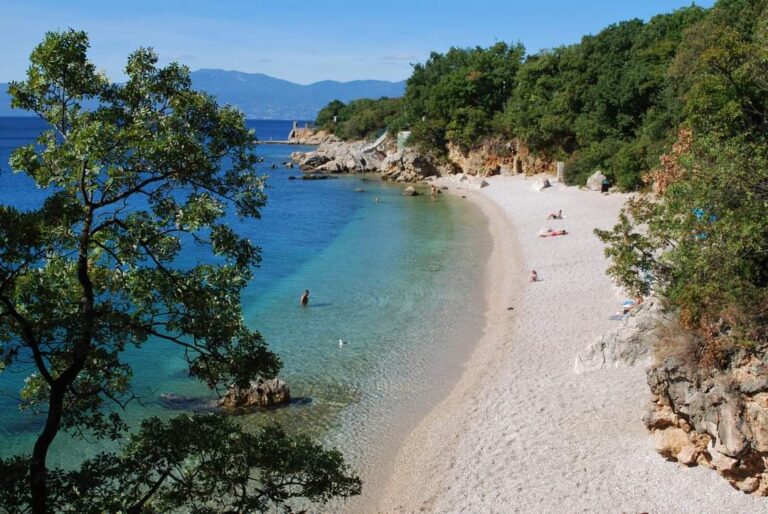
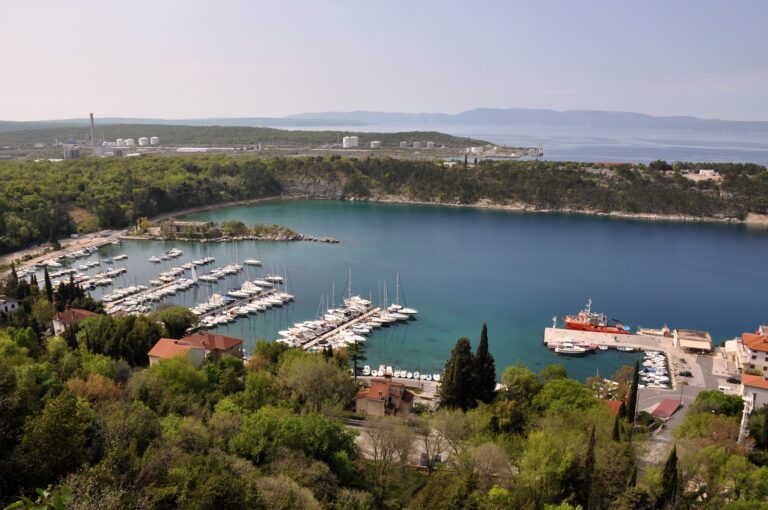
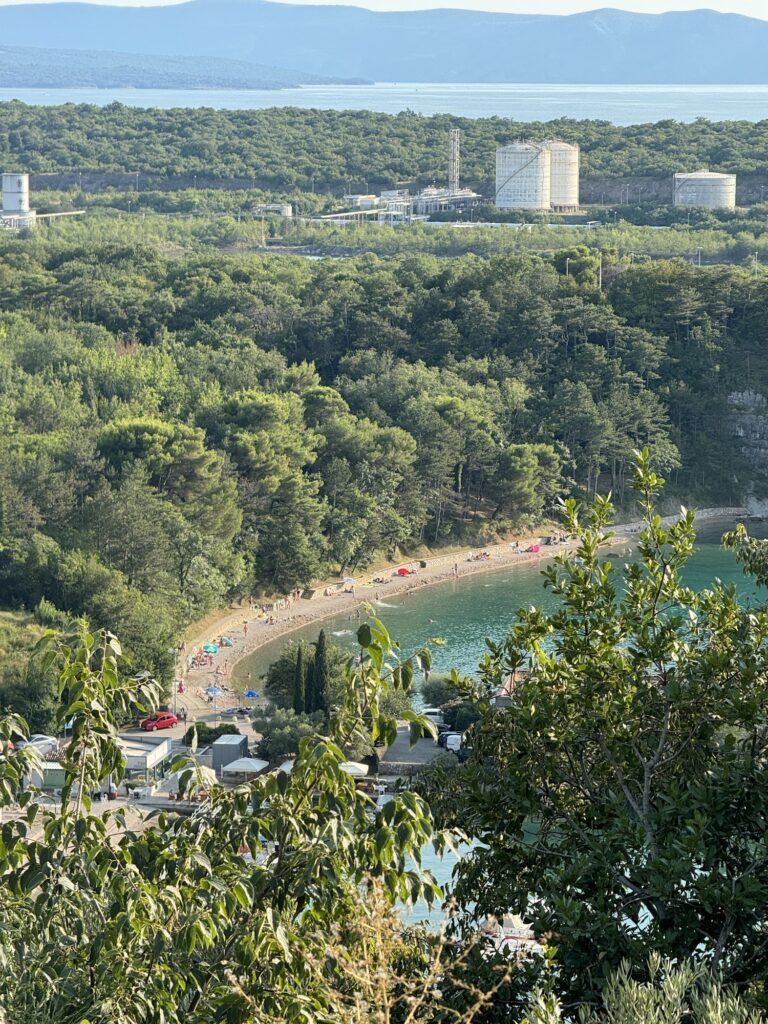
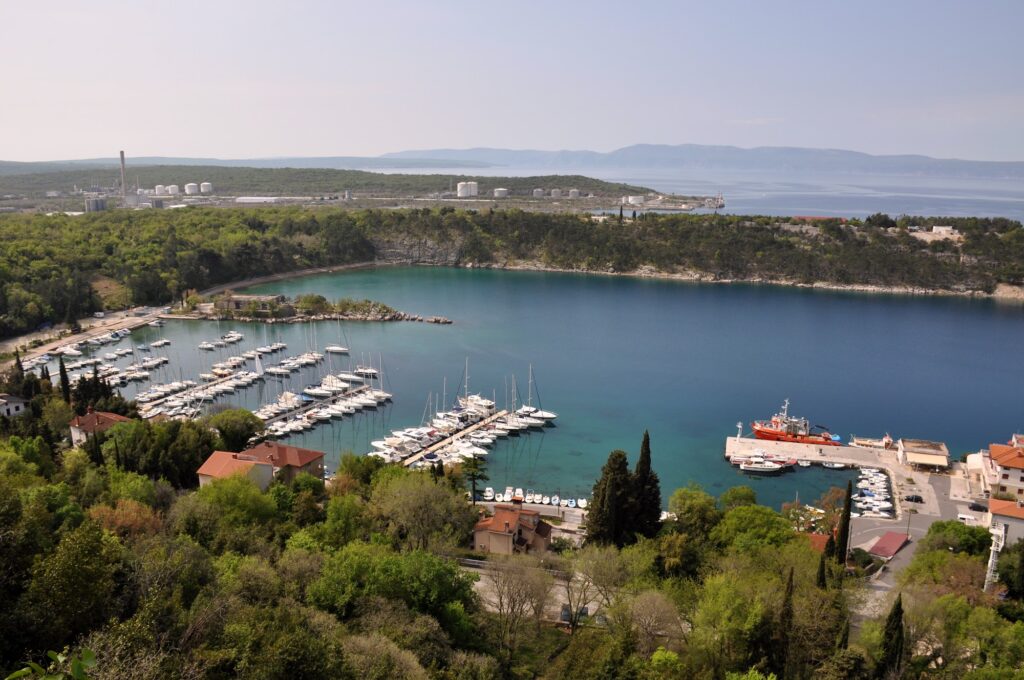
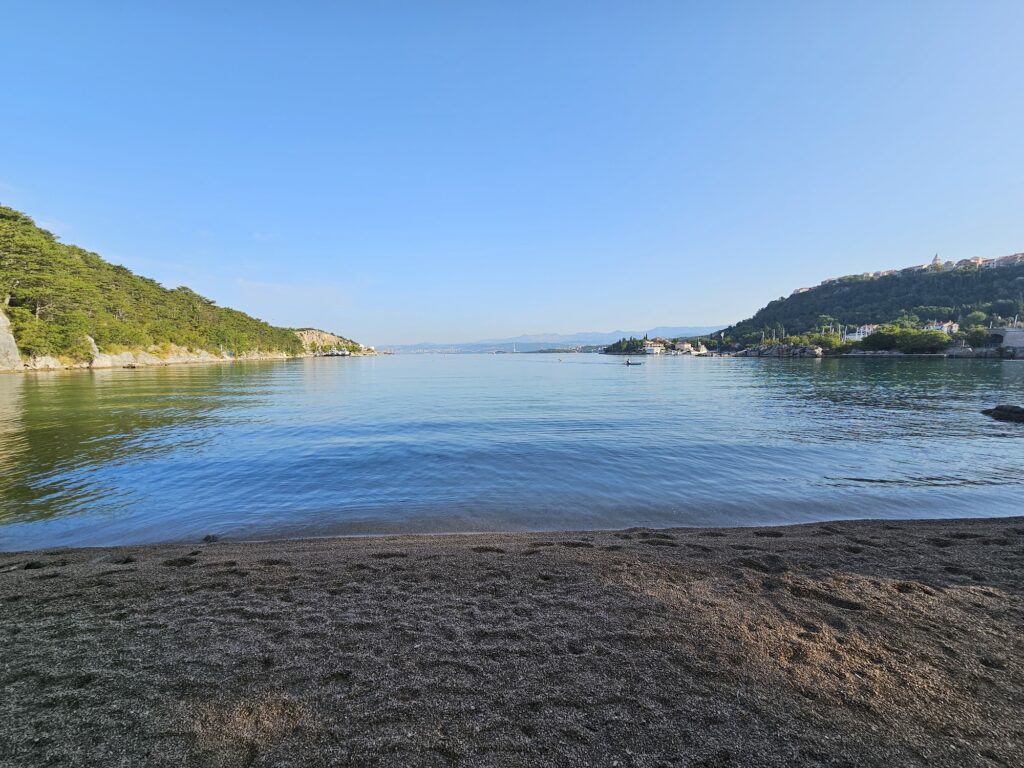
Pesja Beach sits at the foot of Omišalj, in a deep, pine-backed cove that opens onto the Kvarner Gulf with a quality of shelter and a standard of water that the beach’s obscurity relative to the island’s southern destinations makes genuinely puzzling once you are standing in it. The Blue Flag designation it holds is not a marketing accessory — it reflects a measurable and consistently maintained ecological standard that the cove’s geography and the evident care of its management combine to sustain. The pine forest behind the beach is large and established. The water is the colour of the photographs you take and then don’t post because you assume no one will believe them unfiltered.
Getting There: The Exit Most Drivers Miss
How to get to Pesja Beach from Rijeka is the most straightforward journey in this part of the Kvarner Gulf — a fact that makes the beach’s relative obscurity all the more difficult to explain.
From Rijeka, cross the Krk Bridge and take the first exit, following the signs toward Omišalj and continuing down toward the sea and the local marina. The drive from the bridge to the beach parking area takes under ten minutes. A dedicated parking area sits in the shade of the pine forest a short distance from the beach entrance — shaded parking being a detail that improves significantly the quality of returning to your car at the end of a long summer afternoon.
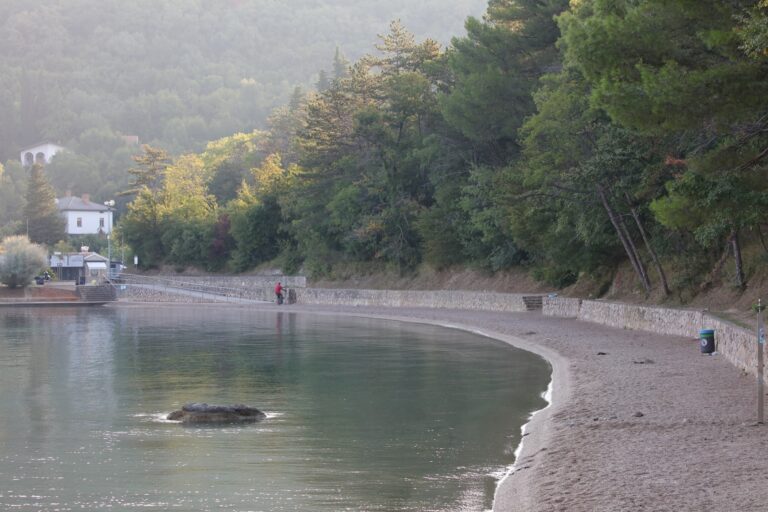
For those staying in Omišalj old town — the medieval settlement on the cliff above the beach whose stone lanes and elevated position above the Kvarner make it one of the more characterful small towns on the island — a winding path descends directly from the town centre through the pine forest to the shore. The walk takes perhaps fifteen minutes and functions as a gradual and pleasant transition from the historical architecture of the hilltop to the natural environment of the cove below. It is the approach I would recommend to anyone staying in the town, both for the quality of the path itself and for the perspective it gives on the relationship between Omišalj and its beach.
From the mainland, the accessibility of Pesja is among the best of any notable beach on Krk Island — a direct consequence of its position at the northern end of the island, minutes from the bridge that connects it to the mainland road network.
The Cove and Its Pine Forest
The geography of Pesja Beach is the foundation of everything the place offers, and understanding it is essential to appreciating why the beach performs as well as it does on the qualities that matter most.
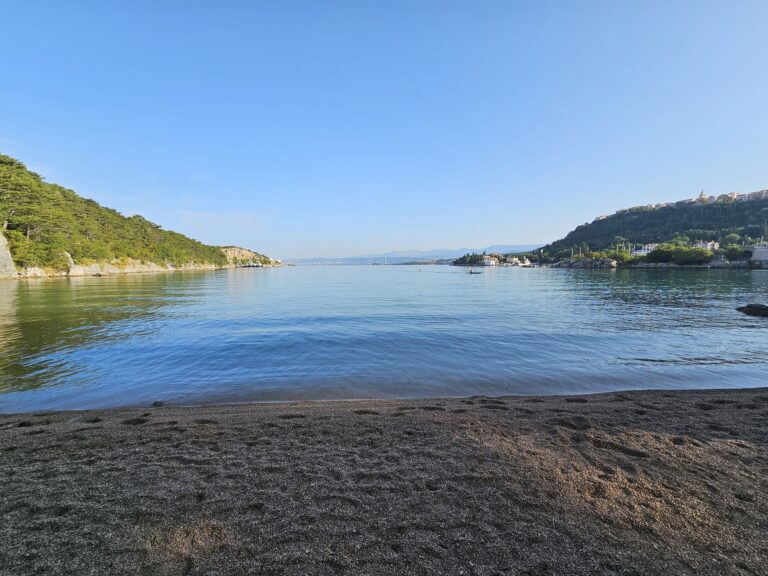
The cove is deeply recessed into the northern coastline of Krk Island, its entrance narrow relative to the protected interior — a configuration that produces the same practical consequences that sheltered bays elsewhere on the Croatian coast deliver: dramatically reduced wind exposure, consistently calm water, and the particular warmth that shallow, enclosed water accumulates through the summer months.
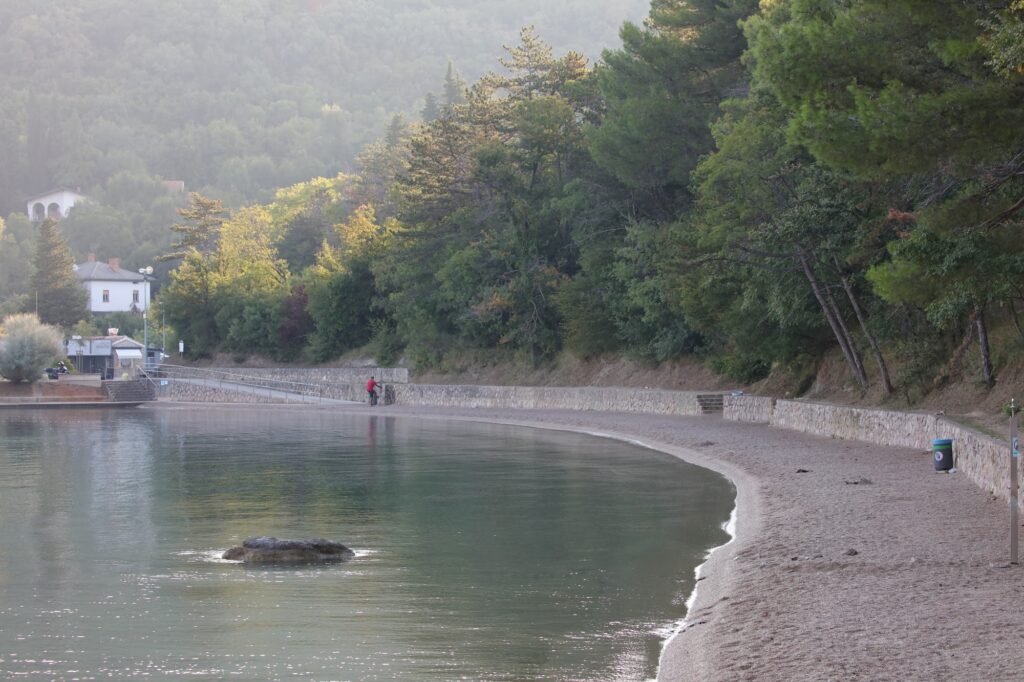
The Aleppo pine forest that occupies the hillside behind and above the beach is old and dense — the trees large enough and the canopy high enough to create a genuine interior environment beneath them, cooler by a meaningful temperature difference from the open pebbles, scented with the resinous warmth that these trees produce on hot afternoons. The forest presses close enough to the beach that its shade extends onto the rear sections of the shore for most of the day, providing the kind of natural cooling that makes the difference between a beach day that remains comfortable through the full afternoon and one that becomes an exercise in heat management from noon onward.
The combination of the enclosed cove geography and the pine forest behind it gives Pesja Beach Omišalj a quality of shelter and comfort that is relatively rare among northern Adriatic beaches of this natural character — and that the Blue Flag water quality within the cove makes considerably more than merely comfortable.
The Shore and Water Quality
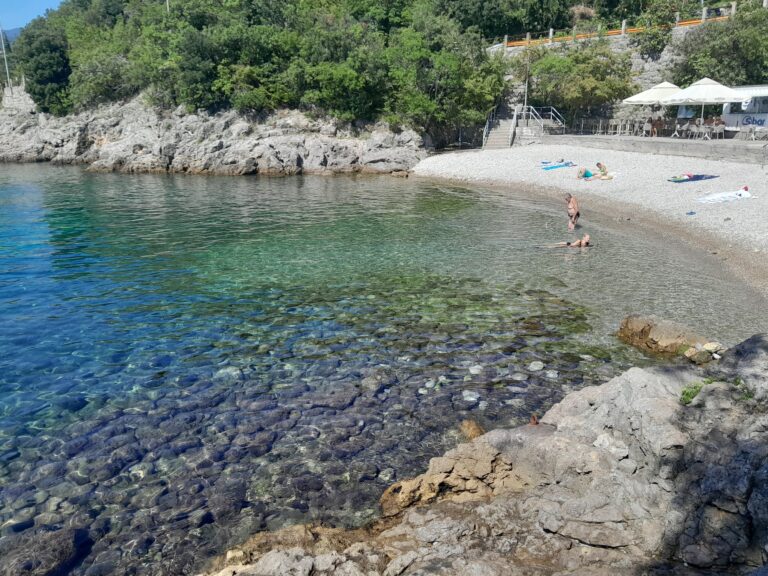
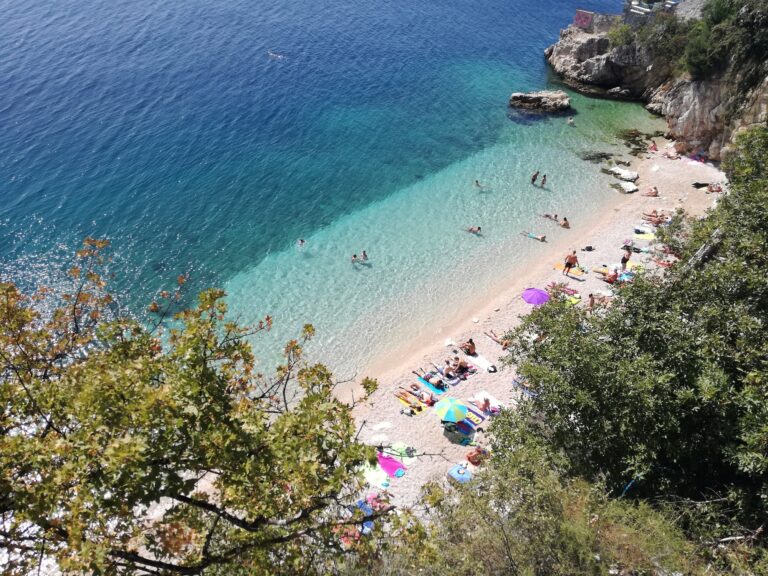
The shoreline at Pesja Beach is fine, sun-bleached pebbles and shingles — clean, well-maintained, and giving the water in front of them the reflected brightness that pale pebble shores produce at their characteristic best. The beach is not large in absolute terms, but its enclosed cove setting gives it a sense of intimacy and definition that larger, more open beaches do not achieve — you are aware of the space you are in rather than at the edge of an undifferentiated expanse.
The water quality at Pesja Beach Krk holds a Blue Flag designation that is immediately and consistently credible on entry. The enclosed bay position keeps the sea clean and well-oxygenated, and the transparency is the kind that makes the underwater detail of the seabed — the pebble patterns, the rocky formations, the small fish moving through the clear water — clearly legible from the surface. The colour shifts from pale neon turquoise in the shallows to deep cobalt further out, the transition visible with the sharpness that only genuinely clean Adriatic water produces.
I spent a long morning snorkeling at Pesja Beach along the rocky margins of the cove, working through the sections where the pebble bottom gives way to the limestone formations that support more varied marine life. The visibility throughout was excellent — silver fish moving through the oxygenated water with the ease of a genuinely undisturbed environment, the rocky formations providing the structural variety that makes the underwater landscape interesting rather than merely clear. For a snorkeling destination near Rijeka on Krk Island, Pesja offers quality that the beach’s accessibility would not lead you to expect.
The bay’s sheltered position keeps the water calm through most conditions — a pool-like stillness in the early morning and a gently animated surface through the afternoon that never develops the choppiness that more exposed locations experience. The entry is gentle and predictable, the depth increasing gradually from the shore.
Facilities
Pesja Beach facilities reflect a considered and well-maintained approach to hosting visitors at a Blue Flag location — comprehensive without overwhelming the natural character of the cove.
Freshwater showers and changing cabins are positioned accessibly along the pebble line. Sunbeds and umbrellas are available for hire, though the pine shade — which covers a significant portion of the rear beach and extends further as the afternoon progresses — is the preferred alternative for a large proportion of visitors who arrive early enough to position themselves beneath it. A certified lifeguard monitors the swimming zone from a dedicated tower during peak summer months, a provision that the beach’s popularity with families makes appropriately present rather than merely nominal.
A beach volleyball court at Pesja — sand-surfaced and well-maintained — sits adjacent to the beach and generates the kind of regular use that a facility embedded in a local community, rather than merely a tourist resort, tends to produce. On both days I visited, the court was occupied from mid-morning through the afternoon by groups that clearly knew each other and had established patterns of use that suggested a long-standing arrangement.
The beach bar at Pesja is positioned under the pine canopy at the back of the beach — a placement that combines the shade of the forest with the view of the water in a way that makes it one of the more naturally pleasant spots to sit and drink coffee on the northern Adriatic coast. I spent two late afternoons there, watching the light change over the bay, and found both sessions equally difficult to leave.
For Families
Pesja Beach with children is among the best family beach experiences on Krk Island and represents a particularly strong option for families based in or passing through Rijeka who want a full beach day without the drive to the island’s southern beaches.
The pine shade is the primary practical advantage — extensive, genuine, and requiring no umbrella management. The sheltered cove water is calm enough for very young children to move freely in the shallows without concern about wave energy. The gradual entry and the predictable depth increase make the sea accessible for early-stage swimmers. The lifeguard presence during peak season provides formal supervision. The volleyball court provides supplementary activity for older children and teenagers.
The proximity of Omišalj old town on the cliff above the beach adds a dimension available at very few Croatian family beach destinations — the possibility of combining a morning at the beach with an afternoon exploring one of the Kvarner Gulf’s most genuinely atmospheric small medieval towns, connected by a pine forest path that is itself worth the walk. For families with children old enough to enjoy a historical setting alongside the beach, this combination makes a day at Pesja considerably richer than a day at a more isolated location.
Food and Drink
The beach bar beneath the pines handles coffee and cold drinks with the relaxed competence of a place that serves a local community as much as a tourist one — a quality that tends to produce better coffee and more honest prices than a purely tourist-oriented establishment achieves. Morning coffee under the pine canopy before the beach fills is, as a ritual, one of the more quietly satisfying this part of the coast offers.
For a full meal, the short uphill walk to Omišalj old town is the obvious and rewarding option. The restaurants in the historic centre serve the food that the Kvarner Gulf does with particular distinction — fresh Kvarner scampi, local šurlice pasta with lamb, the straightforward and ingredient-led cooking of a community that has access to excellent produce and the good sense not to complicate it. Eating on a terrace in the old town with the bay visible below and the late afternoon light on the Kvarner Gulf is a combination of view and food and hour that the short walk up from the beach earns entirely.
The descent back to the shore after dinner, through the pine forest path in the cooling evening air, is one of those minor pleasures that add up to make a day feel more complete than the sum of its activities.
Omišalj: The Town Above the Beach
Omišalj old town deserves more than a passing mention as context for the beach below it, because the relationship between the two is one of the more interesting pairings available on Krk Island and one that most visitors who come purely for the beach miss entirely.
The town is medieval in the fullest sense — a compact settlement of stone lanes, Romanesque church architecture, and the particular spatial quality of a hilltop community that was designed for defence rather than for views, yet produces extraordinary views as a consequence of its elevation. The cliff edge above the town looks north across the Kvarner Gulf toward the mainland with a clarity that makes the scale of the gulf properly comprehensible. The Krk Bridge is visible from certain points along the cliff, which gives the elevated view a contemporary infrastructure dimension that the medieval stone around you makes strikingly incongruous.
For visitors spending more than a single day in the Omišalj area, the combination of beach and town across a full day — morning at Pesja, afternoon in the old town, dinner on a terrace, evening descent through the pines — is a complete and varied programme that neither the beach nor the town alone provides.
Pesja Beach Omišalj is the beach that most drivers on the Krk Bridge pass without stopping, and it is one of the better arguments this coast offers for the habit of taking the first exit rather than the obvious one. The Blue Flag water, the pine forest shade, the enclosed cove calm, the accessibility from the mainland, the medieval town on the cliff above — all of it assembles into a day of unusual quality and range that the beach’s position at the unfashionable northern end of the island consistently prevents it from receiving the attention it deserves.
Take the first exit. Park in the shade. Find a position at the pine margin before it fills.
Everything else follows naturally.
Map
Sorry, no records were found. Please adjust your search criteria and try again.
Sorry, unable to load the Maps API.
Near by places: