Plaža Baška Krk Island: Croatia's Most Iconic Beach
Profile
Plaža Baška, Krk Island: A Personal Account of Croatia’s Most Celebrated Beach
Croatia | Krk Island | Kvarner Gulf
Certain destinations arrive with a weight of expectation that almost nothing can satisfy. Plaža Baška — or Vela Plaža as locals have always called it — is one of the most photographed and most discussed beaches in Croatia, and I will confess that this reputation made me approach my first visit with a degree of scepticism. Places celebrated at that scale tend to disappoint on contact, their reality diminished by the accumulated imagery that precedes them.
Baška did not disappoint. What I found at the southern end of Krk Island on a clear morning in July was a beach that earns its standing not through marketing or accident of geography, but through a combination of natural qualities that are genuinely difficult to find assembled in a single location anywhere on this coast. The scale, the mountain backdrop, the water, the texture of the shore — each element would be remarkable in isolation. Together, they produce something that justifies the journey from anywhere in Croatia and several places considerably further away.
The Drive Into the Baška Valley
The approach to Baška from the Krk Bridge deserves its own mention because it prepares you for the beach in a way that no other route I know quite replicates. The main island road south runs for approximately forty-five minutes through Krk’s distinctive interior — a landscape of dry stone walls, sparse Mediterranean scrub, and that particular quality of island light that seems to intensify as you move further from the mainland.
Then the road begins to descend, and the Baška valley opens below you without warning. The bay appears first as a distant crescent of pale shore between mountains, the water behind it a band of vivid blue against the grey limestone of the Velebit range on the opposite coast. By the time you reach the village and park at one of the public lots behind the beach, the anticipation built by that descent has done exactly what good topography should do — it has made arrival feel like something earned.
Arriving early on summer days is not merely advisable but genuinely necessary. The parking fills with a speed that reflects how well-known Plaža Baška has become, and the difference between an eight o’clock arrival and a ten o’clock one on a peak July weekend is the difference between a relaxed morning and a frustrating circuit of the surrounding streets.
The Shore: A Natural Crescent Shaped by the Adriatic
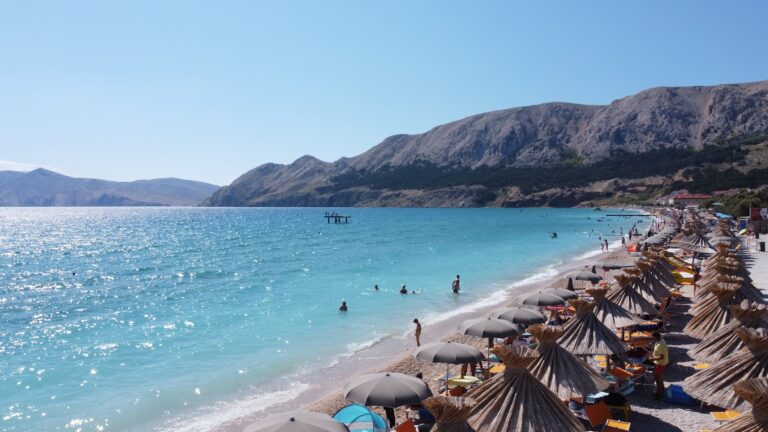
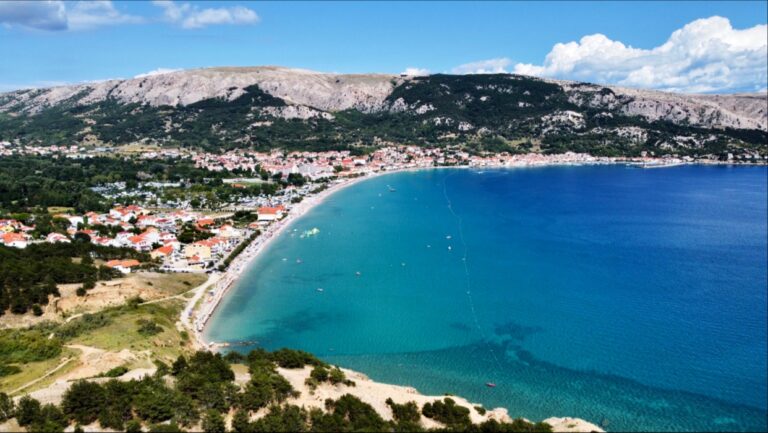
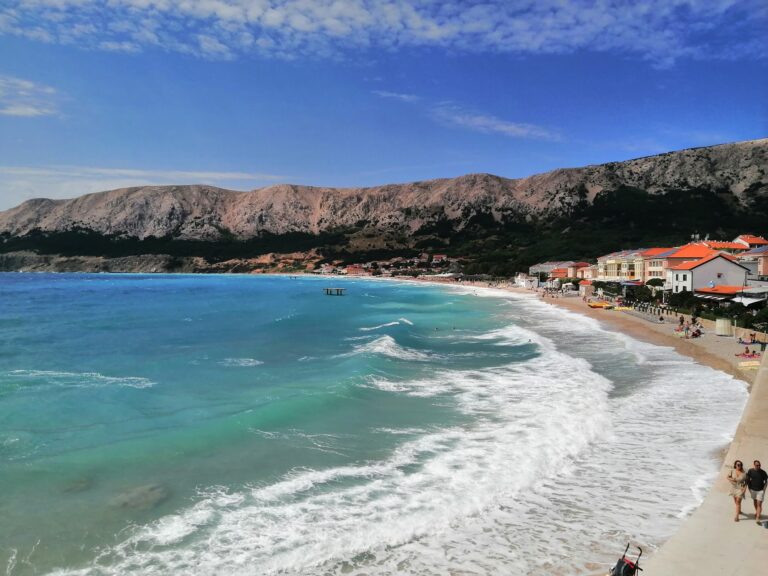
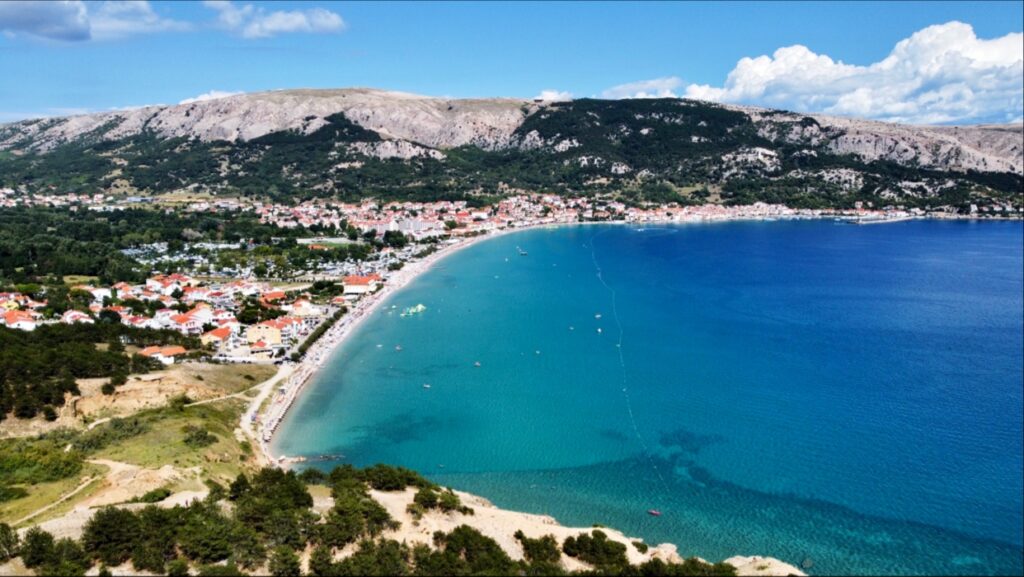
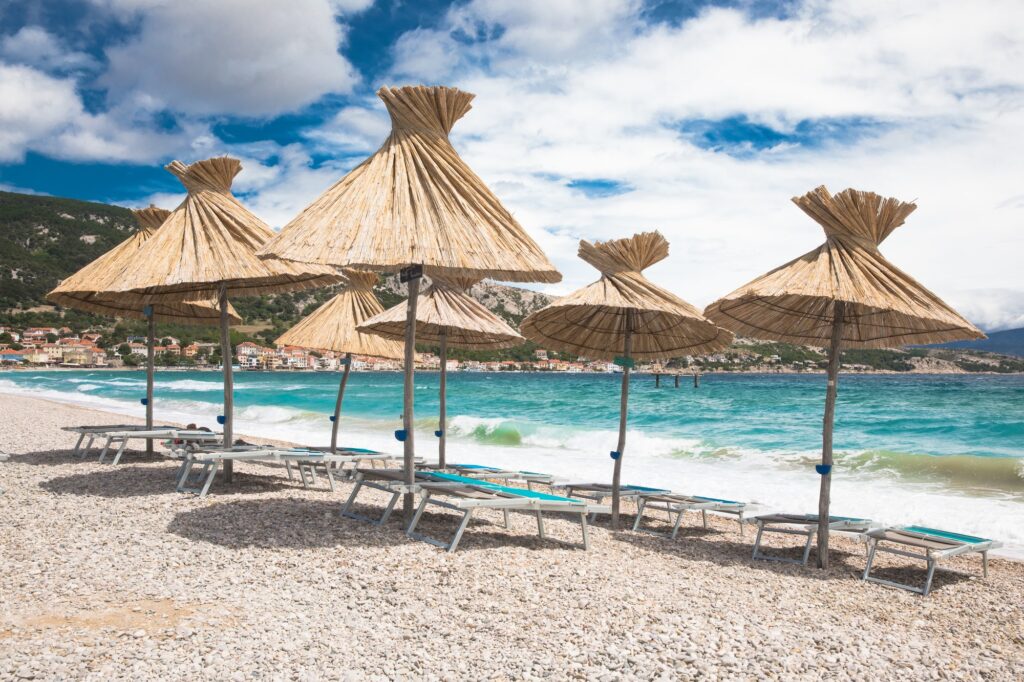
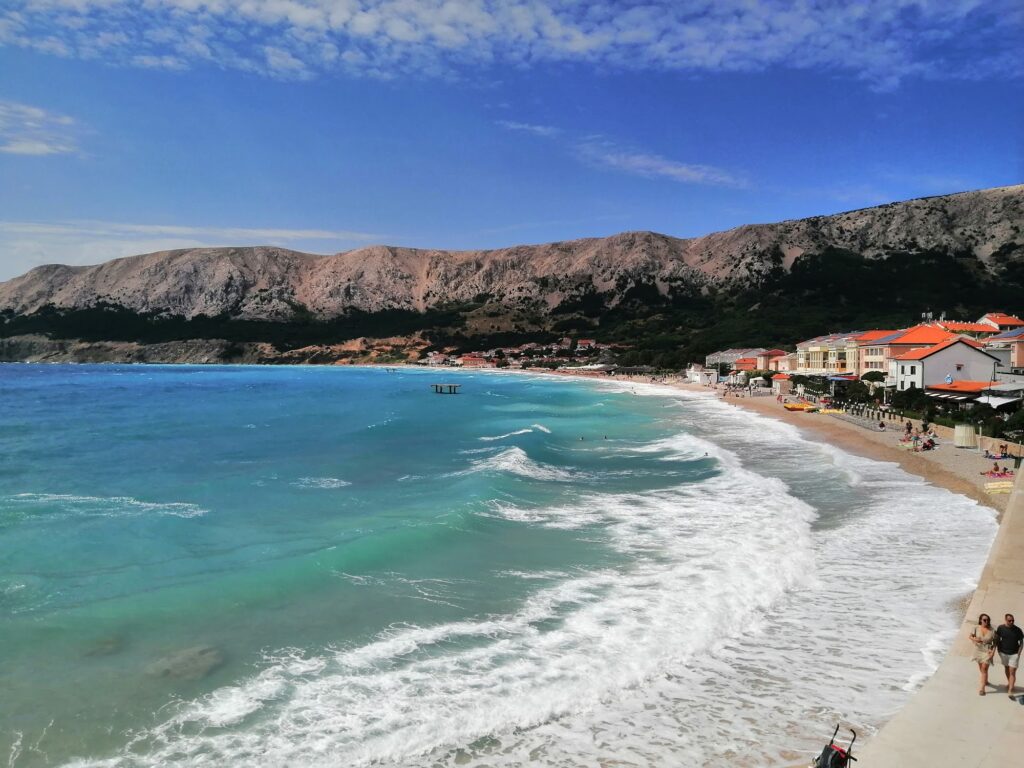
The physical character of Baška beach is immediately distinctive and worth understanding before you arrive. The 1,800-metre crescent is neither purely pebble nor purely sand — it is a natural mixture of both, the precise composition shifting along its length and changing subtly from season to season as the Adriatic currents redistribute the material. This gives the shoreline a texture that is softer and more varied than a conventional pebble beach, comfortable for children and adults alike without the artificial uniformity of a constructed shore.
The mountains that frame the bay on three sides — pale, almost entirely bare limestone that catches the light differently at every hour of the day — give Vela Plaža Baška a drama that photographs consistently understate. In the early morning, before the beach fills and before the sun has cleared the ridge, the combination of still water and shadowed mountain face produces a quality of silence and scale that is genuinely affecting. I arrived before eight on my first visit and stood at the water’s edge for some time before doing anything else, simply absorbing a landscape that operates at a different register from most of what the Croatian coast offers.
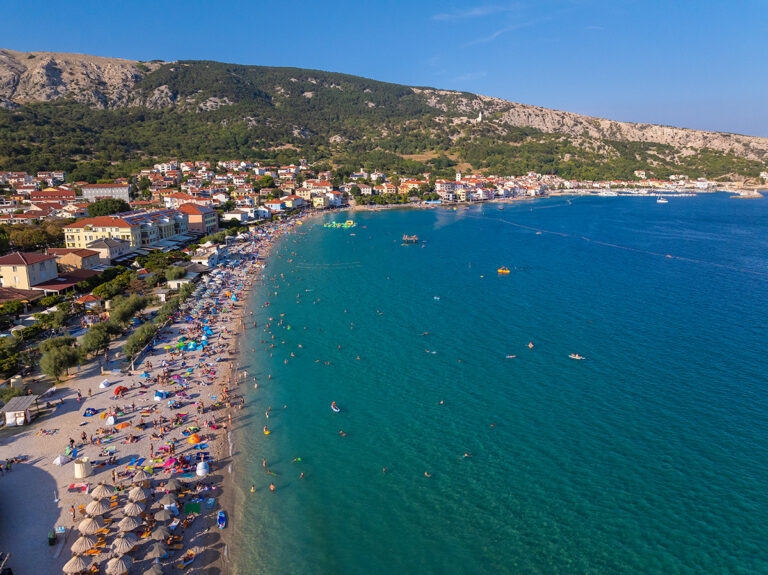
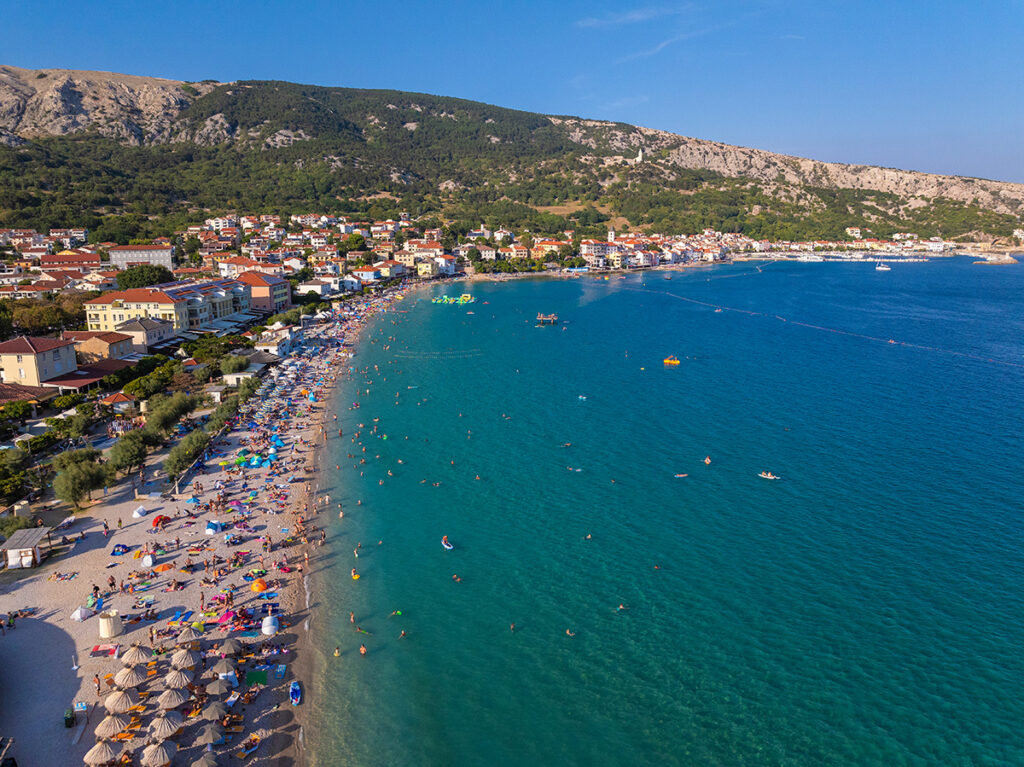
By midday the character shifts entirely — the beach is full, the water is busy with swimmers and water sports, the promenade behind is lively with the commerce of a high summer beach day. Both versions of Baška are worth experiencing, and they require nothing more than a willingness to stay long enough for the day to turn.
Water Quality and Swimming
Baška beach water quality has held a Blue Flag designation for over two decades — a record that reflects genuine and consistently maintained environmental standards rather than a single fortunate assessment. The bay opens to the Velebit Channel, and the circulation this provides keeps the sea exceptionally clean and well-oxygenated throughout the season.
The water is transparent in a way that is immediately apparent from the shore — colours shifting from pale turquoise over the sandy shallows to a progressively deeper blue as the bottom drops away. The sandy seabed extending from the shoreline makes the entry comfortable and the shallows genuinely shallow, which has practical implications for families and less confident swimmers. I swam the full length of the bay on my second visit, staying close to the shore on the outward leg and moving further out on the return, and the quality of the water held consistently throughout.
Snorkeling at Plaža Baška is most rewarding along the rocky edges at either end of the bay, where the sandy bottom gives way to limestone formations that support more varied marine life. The central section of the beach, while excellent for swimming, offers less underwater interest than the margins.
Facilities and Water Sports
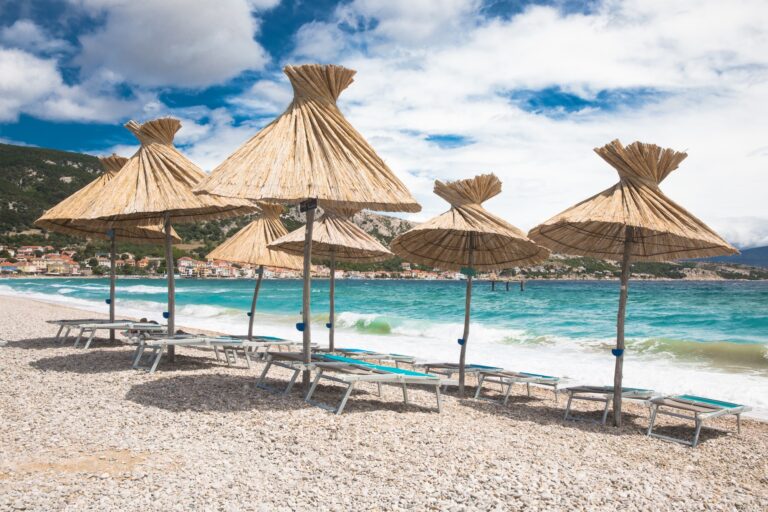
Baška beach facilities are extensive and well-organised in a manner appropriate to one of Croatia’s most visited coastal destinations. Sunbeds and straw umbrellas are available across multiple designated zones, freshwater showers and changing cabins are positioned at regular intervals along the promenade, and certified lifeguards monitor the full length of the beach from elevated stations throughout the season. Public restrooms are well-maintained and straightforward to locate.
The water sports at Baška beach Krk are among the most comprehensive available anywhere on the island. Parasailing, jet skiing, pedalo and boat rentals, and an aqua park with water slides operate from the beach during peak season, giving the central sections of the bay an energetic, lively character that is genuinely enjoyable if you are in the right frame of mind for it and easy enough to move away from if you are not. The beach is long enough that the quieter stretches toward either end of the crescent exist in a meaningfully different atmosphere from the organised water sports zones in the middle.
The hiking trails above Baška are worth noting for visitors with any interest in the island’s landscape. Several well-marked paths ascend from the village into the limestone hills above the bay, offering panoramic views of the Velebit Channel and the surrounding coastline that reward the climb generously. I spent a morning on one of these trails on my most recent visit and came back to the beach in the early afternoon with a perspective on the bay from above that made the scale of it properly comprehensible for the first time.
For Families
Plaža Baška with children represents, by most practical measures, the best-equipped family beach on Krk Island and one of the strongest options in the entire Kvarner Gulf. The gently sloping sandy and pebble shore allows young children to enter the water gradually and play in genuinely shallow water for a considerable distance from the shore. The aqua park provides the kind of sustained entertainment for older children and teenagers that parents of energetic swimmers will recognise as invaluable.
The flat, well-maintained promenade running the full length of the beach behind the shore is navigable by pushchair without difficulty and keeps all practical necessities — cafés, ice cream, pharmacies, mini-markets — within a very short walk from any point on the beach. The pedestrianised waterfront eliminates vehicle traffic from the immediate beach environment entirely. The lifeguard coverage across the full 1,800 metres is among the most comprehensive of any beach on this coast.
Food and Drink: The Baška Promenade
The promenade at Baška village is one of the more genuinely satisfying seaside dining environments on Krk Island, and it benefits from a culinary identity that is specific to the location rather than generic to Croatian beach tourism. Krk lamb — raised on the island’s dry limestone pasture and with a flavour profile that reflects that environment distinctly — appears on menus alongside handmade šurlice pasta, the traditional egg noodle of Krk that is made differently here than anywhere else. Adriatic seafood is present throughout, but the island-specific dishes are what distinguish a meal on this promenade from one at any other beach in the region.
The beach bars handle the rest of the day well. Coffee on a terrace before the beach fills, cold drinks through the afternoon heat, cocktails as the sun descends behind the mountains and the light on the water shifts to something considerably more golden than anything the midday hours produce — the rhythm of a full day at Baška beach Croatia is one that the promenade supports without effort at every stage.
How to Get to Plaža Baška
Getting to Plaža Baška from the mainland involves crossing to Krk Island via the Krk Bridge from the mainland motorway, then following the main island road south for approximately forty-five minutes. The drive is scenic and straightforward. Public parking is available in several lots immediately behind the beach, with the caveat that peak summer arrival times require early morning planning.
During summer, taxi boats from Baška connect the main beach with smaller nearby coves including Vela Luka and Mala Luka — a worthwhile option for a half-day exploration of the surrounding coastline that provides a very different perspective on the bay and the mountains above it.
There is no direct bus connection from the mainland, but island bus services connect Baška with the town of Krk and the bridge road for visitors travelling without a car.
Plaža Baška on Krk Island has earned its reputation through qualities that hold up on repeated visits and in different conditions — the scale of the bay, the clarity of the water, the drama of the limestone mountains, the practical thoroughness of its facilities. It is a beach that works at eight in the morning and at eight in the evening, in high summer and in the quieter shoulder season, for solo travelers and for families with young children.
The scepticism I brought on my first visit did not survive contact with the place. Whatever your expectations are when you make the descent into the Baška valley for the first time, I would be surprised if the reality fails to meet them — and quietly confident that it will exceed them.
Map
Sorry, no records were found. Please adjust your search criteria and try again.
Sorry, unable to load the Maps API.
Near by places: