Baška Beach Krk Island: Vela Plaža Blue Flag Kvarner
Profile
Baška Beach, Krk Island: A Personal Account of the Kvarner Gulf’s Most Magnificent Shore
Croatia | Krk Island | Kvarner Gulf
I want to address something directly before describing the beach, because it is relevant to how you arrive and what you find when you do.
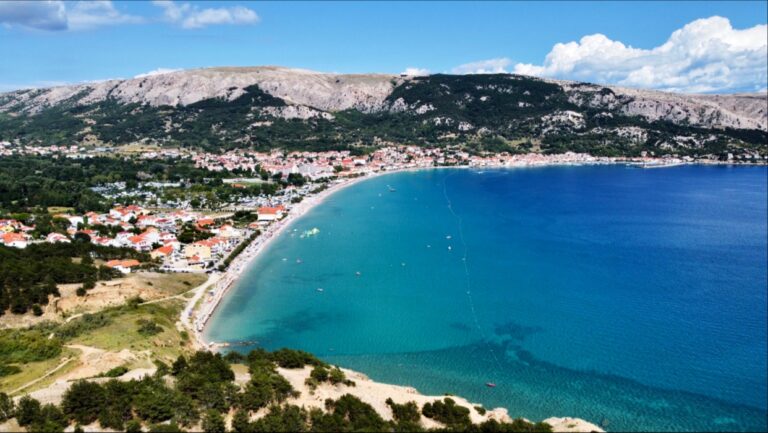
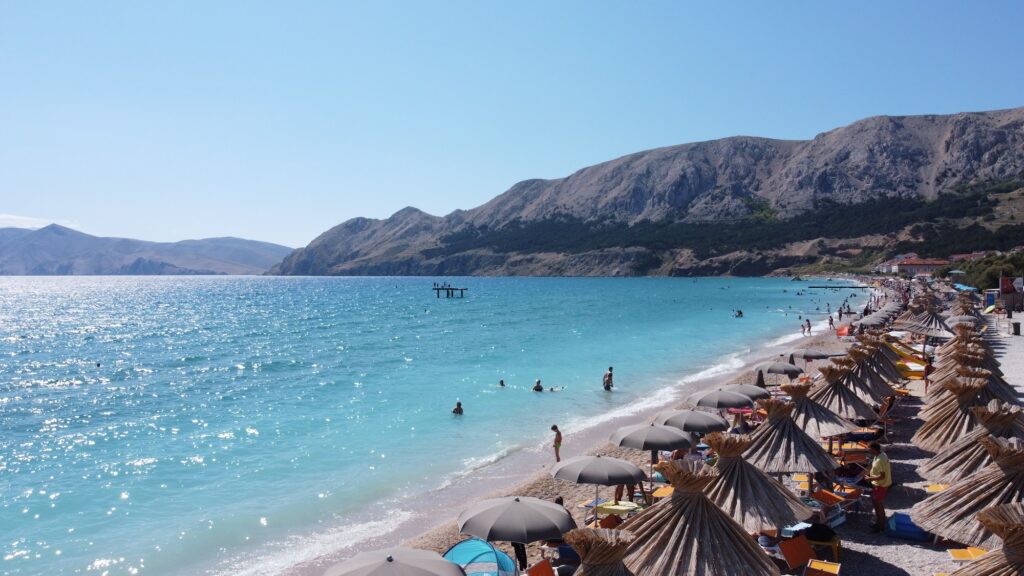
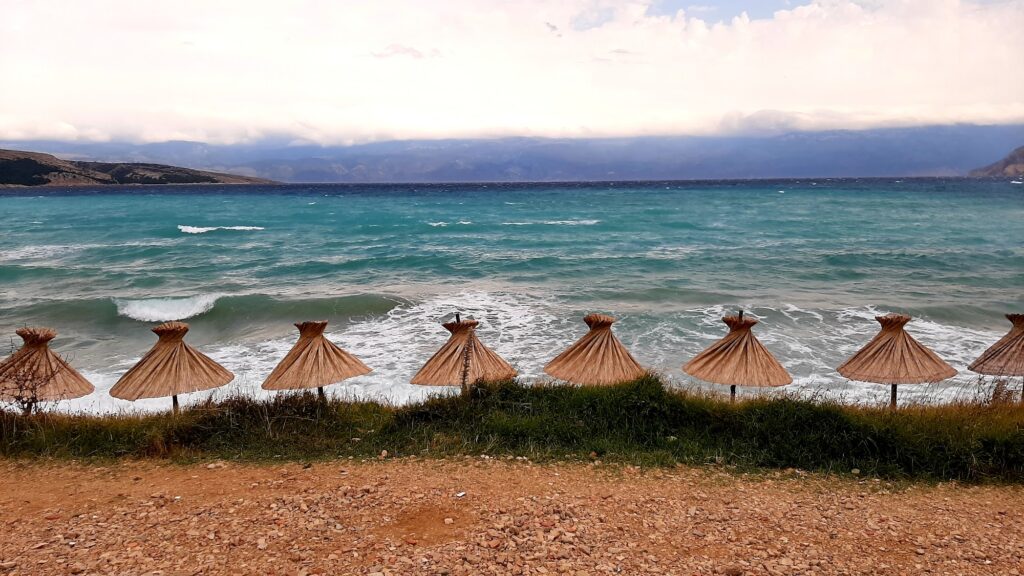
Baška Beach — Vela Plaža — is one of the most photographed beaches in Croatia. It appears on the covers of travel guides, on the homepages of tourism websites, in the social media feeds of anyone who has ever spent a summer on Krk Island. The images are, without exception, beautiful. They show two kilometres of pale crescent shore, mountains rising dramatically behind the village, water in a shade of turquoise that looks enhanced even when it is not.
All of that is accurate. The photographs do not lie. What they fail to convey — what I have found, across several visits over several years, that no image manages to communicate — is the scale. The mountains behind Baška are not a backdrop in the decorative sense; they are a physical presence, bare limestone rising several hundred metres above the village with an immediacy that makes the beach below feel held rather than merely framed. The bay is genuinely two kilometres wide. The water genuinely is that colour.
The experience of being there is categorically larger than any image of it suggests, and that gap — between the photographed version and the physical reality — is the most important thing I can tell you about Vela Plaža before anything else.
The Drive Into the Baška Valley
The approach to Baška from the Krk Bridge is one of the more cinematically structured drives on the island, and it prepares you for the beach in a way that the beach itself then either confirms or exceeds. The main island road south from the bridge follows Krk’s interior for approximately forty-five minutes — a landscape of dry stone walls, exposed limestone, and the particular spare beauty of an island that wears its geology openly.
Then the road begins to descend, and the Baška valley opens without warning. The bay appears below as a pale arc between mountains, the water behind it visible even from this distance as a band of vivid colour. By the time the road reaches the village and the full extent of the beach becomes visible ahead, the descent has done exactly what good topography should — built anticipation to a point where arrival feels like something earned.
By car from Rijeka, the journey crosses the Krk Bridge and follows the island road south — approximately forty-five minutes under normal conditions with ample public parking available at the village entrance. The Arriva bus from Rijeka and from Krk town connects to Baška terminal, positioned three hundred metres from the water and a short walk along the promenade. During summer, excursion boats from the mainland and neighbouring islands arrive directly into the bay — an approach that gives you the full visual sweep of the mountains and the shore from the water before you set foot on the pebbles.
The Shore: White Pebbles, Sandy Shallows, and Two Kilometres of Room
The physical character of Baška Beach — Vela Plaža Krk — is the product of a specific and unusual geological combination that gives it a texture unlike most pebble beaches on the Croatian coast.
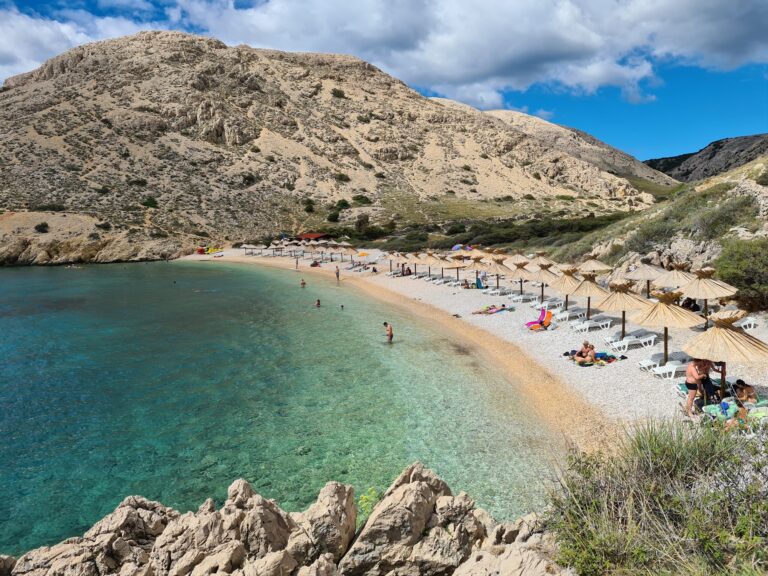
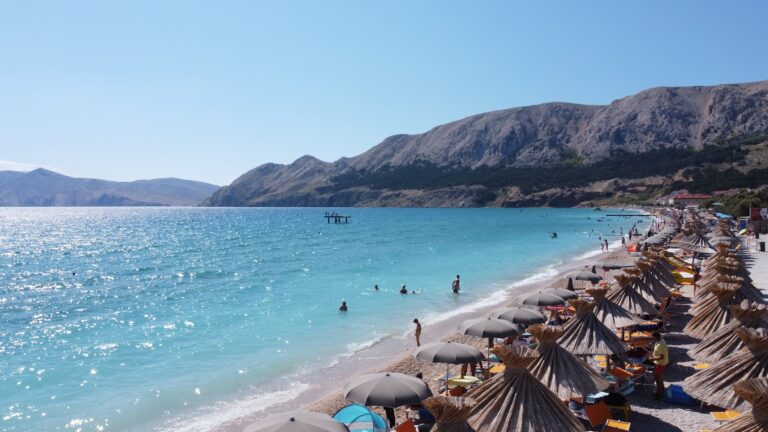
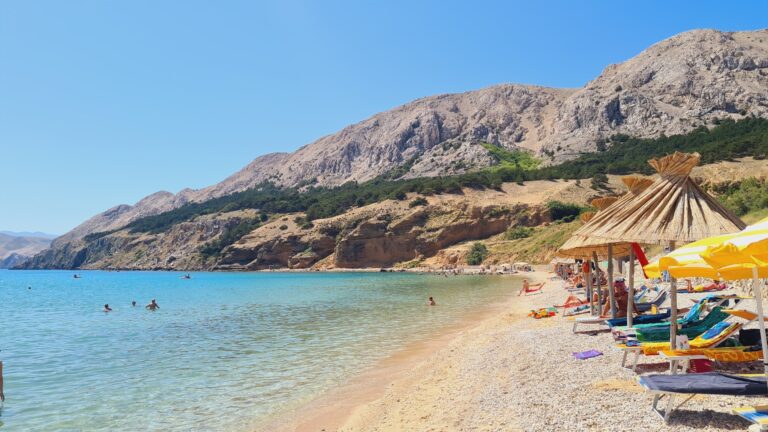
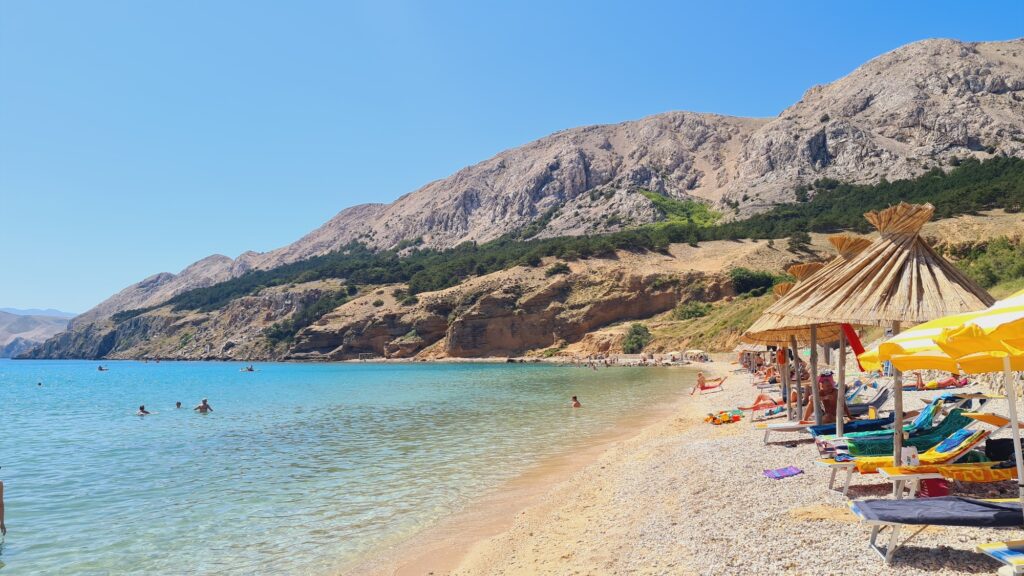
The upper shore is fine, sun-bleached pebbles and shingles, pale and almost luminous in direct light. Moving into the water, the seabed transitions from pebble to a softer sandy material — the sandy composition extending far enough into the shallow zone to create a genuinely comfortable entry and a wide area of soft-bottomed shallows. The result is a beach that has the visual quality of a white pebble shore and the entry comfort of a sandy one, a combination that the long arc of the bay sustains across its full two-kilometre length.
That length is the other defining physical fact. Two kilometres of beach distributes its visitors differently from a cove or a short stretch — families tend to concentrate toward the central sections near the promenade, swimmers and snorkelers gravitate toward the quieter reaches near the rocky edges at either end, and the beach absorbs peak season numbers without generating the compression that shorter beaches experience. On every visit I have made to Baška, I have found the space I needed regardless of the time of day or the season.
The Mountains: The Feature That No Beach Guide Adequately Describes
The Baška valley mountains deserve more attention than they typically receive in descriptions of the beach, because they are as much the defining quality of the experience as the water or the shore.
The limestone massif that rises behind the village is bare, steep, and close — the kind of geological presence that makes you aware of the scale of the landscape you are sitting in rather than merely the immediate pleasantness of the shore. The rock face catches the light differently at every hour of the day: pale grey in the morning, bleached almost white at midday, warming through amber as the afternoon progresses, and in the final thirty minutes before the sun drops behind the ridge, briefly and dramatically golden — the colour that gives the bay its most celebrated quality of late afternoon light and that every visitor who stays long enough experiences.
The contrast between the bare, almost lunar character of the Velebit mountains visible across the Velebit Channel on the southern horizon and the vivid turquoise of the bay in the foreground is the visual composition that the bay’s photographic reputation rests on. In person, with the full depth of field available to human vision rather than a camera lens, the effect is considerably more powerful than any image suggests.
Water Quality and Swimming
Baška Beach water quality has held a Blue Flag designation for decades — a record that reflects genuine and consistently maintained ecological standards rather than promotional convenience. The bay opens southward to the Velebit Channel, and the circulation this provides keeps the sea clean, well-oxygenated, and at the standard of transparency that the bay’s reputation promises and consistently delivers.
The water in the shallows — over the sandy seabed that extends from the shoreline — is warm, clear, and shallow enough to make the entry comfortable and safe for young children. Further out, where the depth increases and the bottom transitions from sand to the rocky formations that support more varied marine life, the transparency remains exceptional — the seabed clearly legible at depth, the colour deepening from turquoise to cobalt in the clean progression that only well-circulated Adriatic water produces.
Snorkeling at Vela Plaža Baška is most rewarding along the rocky edges at either end of the bay, where the sandy central seabed gives way to limestone formations that support fish populations and underwater topography complex enough to hold interest through a sustained session. The central swimming zone, while excellent for open-water swimming, offers less underwater variety — though the quality of the visibility throughout makes even the sandy seabed sections more engaging than equivalent depth at murkier locations.
Facilities: Comprehensive and Well-Organised
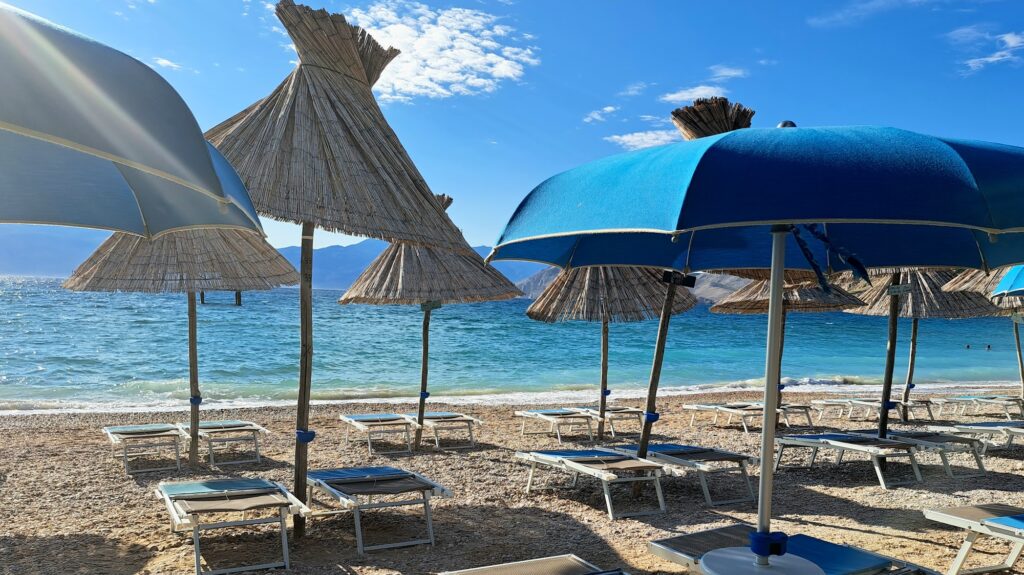
Baška Beach facilities are as extensive as the scale of the bay warrants and as well-organised as a destination that has been receiving large numbers of visitors for generations tends to become. Freshwater showers and changing cabins are distributed at regular intervals along the full two-kilometre length. Sunbeds and umbrellas are available across multiple rental zones, their arrangement considered enough to maximise available space without generating the sense of compression that poor sunbed organisation produces. Certified lifeguards monitor the beach from elevated towers throughout the peak season.
Water sports at Baška Beach Krk cover the full active range — parasailing, jet skiing, pedalo rentals, and professional diving services are all available from the beach, along with the inflatable aqua park anchored in the bay that provides the sustained active entertainment for older children and teenagers that conventional swimming eventually exhausts. The flat, paved promenade running the length of the beach behind the shore is stroller-friendly throughout and keeps all practical amenities — cafés, pharmacies, ice cream, mini-markets — within a very short walk from any point on the beach.
The hiking trails above Baška merit a specific mention for visitors with any inclination toward the dramatic views the surrounding landscape provides. Several well-marked paths ascend from the village into the limestone hills, offering perspectives on the bay, the valley, and the Velebit Channel that the beach-level view does not prepare you for. I have spent a morning on one of these trails on each of my last two visits to Baška and descended in the early afternoon with a significantly enriched understanding of the geography I had been lying on the shore looking at — which made the afternoon swim, oddly, more satisfying rather than less.
For Families
Baška Beach with children is the strongest family beach on Krk Island by most practical measures, and the case rests on specifics rather than generalities.
The sandy, shallow seabed extending from the shore allows very young children to move in the water with genuine independence and safety for a considerable distance. The paved, flat promenade running the length of the beach is pushchair-navigable throughout and keeps all practical necessities within a minute’s walk. The aqua park provides sustained active entertainment for older children and teenagers through the full middle arc of a beach day. The lifeguard coverage across the full two kilometres is among the most comprehensive of any beach in the Kvarner Gulf. The village itself — pharmacies, toy shops, ice cream, medical services — is immediately adjacent.
The one limitation for families with very young children is natural shade — the beach itself has limited tree cover, which makes midday sun management an active consideration. The promenade’s café terraces and the village’s shaded spaces provide the practical solution without requiring departure from the immediate beach environment.
Food and Drink: The Baška Promenade
The promenade at Baška village is one of the more satisfying seaside dining environments on Krk Island, and its culinary identity is specific enough to the location to reward genuine engagement rather than defaulting to generic resort food.
Krk lamb — raised on the island’s dry limestone pasture and with a flavour that reflects that specific terrain — appears alongside handmade šurlice pasta and fresh Adriatic scampi on menus along the promenade. The island’s gold-medal olive oil, pressed from groves that occupy the hillsides above the bay, features throughout. The cooking is honest and ingredient-led in the way that the best Croatian coastal cooking always is — confident in the quality of what it is working with and disinclined to obscure it.
The beach bars handle the bookend hours of the day well. Coffee in the early morning before the beach fills, cold drinks through the afternoon heat, and the particular pleasure of sitting on a promenade terrace as the sun descends behind the mountains and the light on the water shifts to the warmer register of the late Baška afternoon — this sequence, repeated across two or three days, produces the rhythm that makes the village as memorable as the beach.
Baška Beach on Krk Island earns its standing in the Croatian coastal hierarchy through qualities that hold up across repeated visits and in different conditions. The scale of the bay, the mountain backdrop, the quality of the water, the comprehensiveness of the facilities, the specific and genuine culinary identity of the promenade — none of these diminishes with familiarity, and several of them deepen.
It is the kind of beach that justifies the drive across the island’s interior, the forty-five minutes of limestone landscape and dry stone walls, precisely because what waits at the end of that drive is disproportionate to the effort required to reach it. The valley opens, the bay appears, and the photographs that preceded the visit are revealed as accurate but insufficient.
They always are, with Vela Plaža.
Map
Sorry, no records were found. Please adjust your search criteria and try again.
Sorry, unable to load the Maps API.
Near by places: