Zaljev Oprna Krk Island: Croatia's Most Secluded Bay
Profile
Zaljev Oprna, Krk Island: The Secluded Bay That Rewards the Effort of Finding It
Croatia | Krk Island | Hidden Beaches Adriatic
I almost turned back on the descent.
The path down to Zaljev Oprna from the cliffside road above Stara Baška is steep, narrow, and entirely without shade in the midday heat of a Croatian July. Carrying a bag heavy with water, food, and snorkeling gear, negotiating loose stone in the full force of the afternoon sun, I remember questioning — with some seriousness — whether any beach could justify this level of effort. The answer, visible the moment the cliff path opened onto the shore below, was immediate and unambiguous.
Yes. Unquestionably yes.
Oprna Bay on Krk Island is the kind of place that recalibrates your standard for what a beach can be. Not through grand spectacle or superlative statistics, but through a quality of stillness and natural integrity that is increasingly rare along any popular coastline. I stayed for six hours on that first visit. I have returned twice since. The descent gets easier when you know what is waiting at the bottom.
Getting There: Two Routes, One Destination
How to get to Zaljev Oprna is the question that shapes the entire experience, and the answer you choose determines the kind of day you will have.
The overland route from Punat toward Stara Baška follows the road along the southern cliff edge of Krk until the tarmac narrows and the verge begins to fill with parked cars — an informal signal, well understood by anyone who has made this journey before, that the bay is below. From the road, a series of steep footpaths descend through scrub and exposed limestone to the shore. The gradient is genuine and the surface is uneven; sturdy footwear is not a precaution but a requirement, and carrying less rather than more is advice I offer from direct experience. Arriving early is essential — not merely to secure a parking space along the roadside, but because the descent in the cooler air of the morning is a categorically more pleasant undertaking than the same path at noon.
The alternative is the one I now recommend unreservedly to anyone making their first visit: arriving by taxi boat from Punat or Baška. The journey takes perhaps twenty minutes and approaches the bay from the sea, which means you see the cliff formations, the colour of the water deepening from pale green to an extraordinary saturated turquoise, and the scale of the cove as a whole before you set foot on the shore. It is, objectively, the better introduction to the place — and it eliminates the descent entirely for the outward journey, which is worth something on a hot day.
The Bay and Its Shore
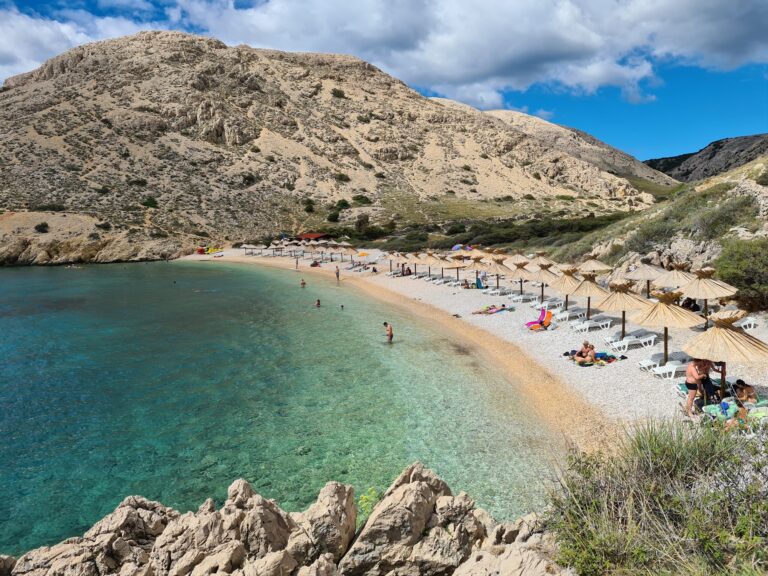
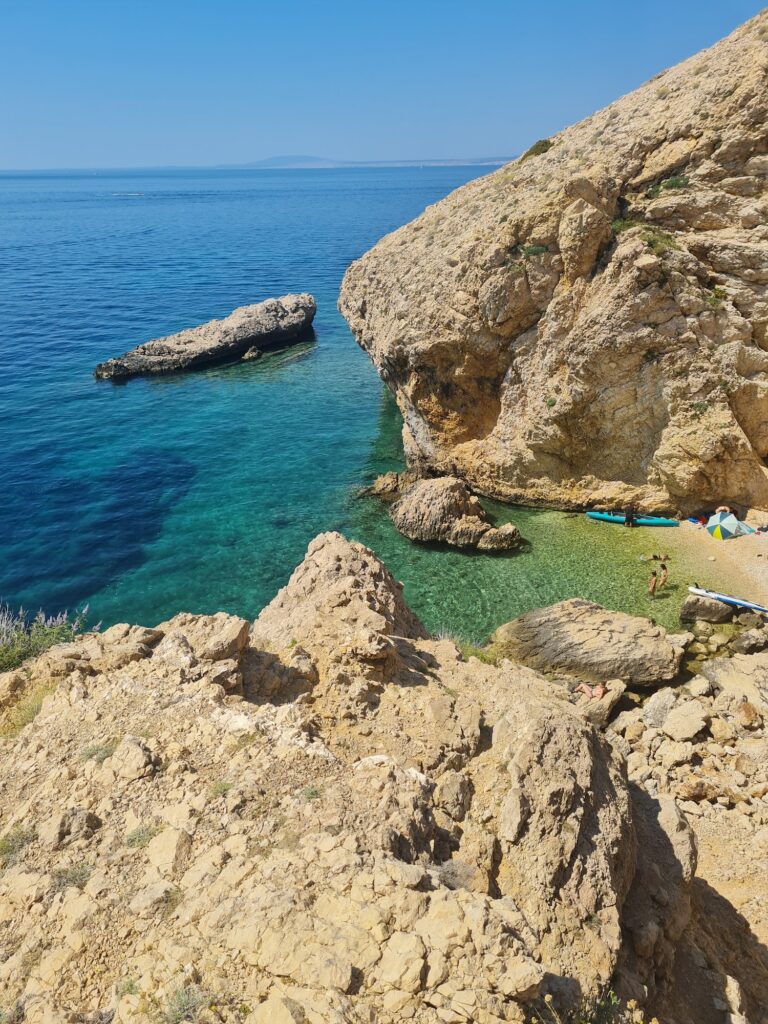
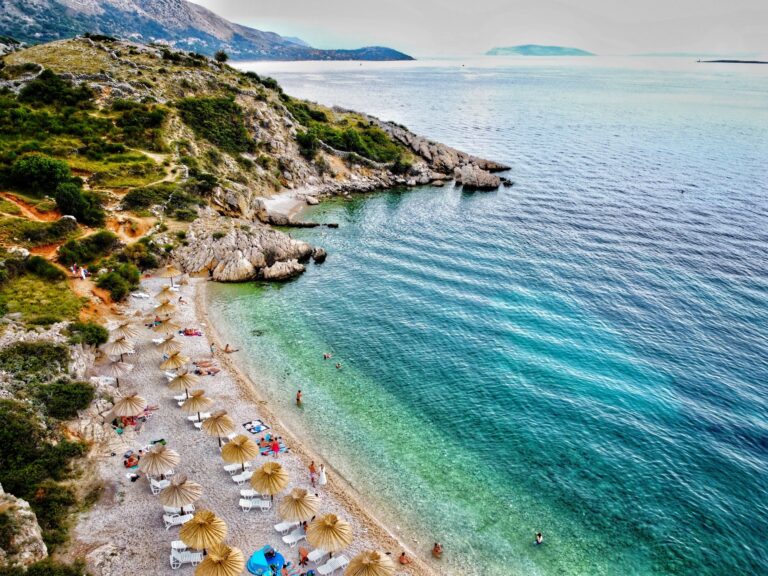
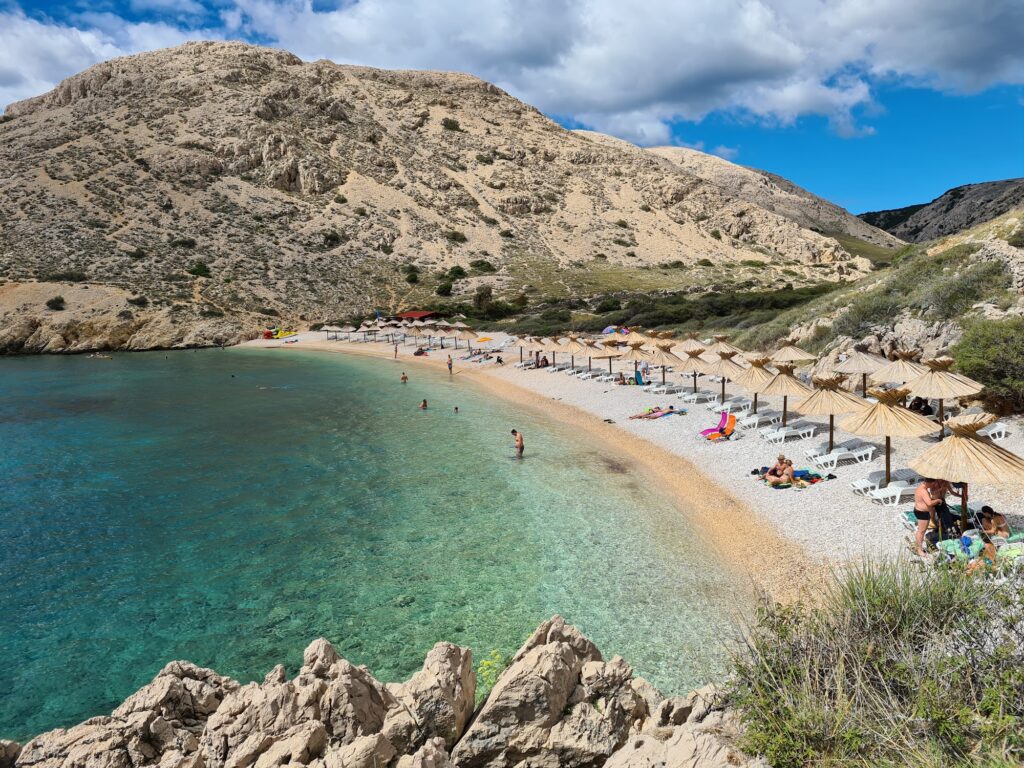
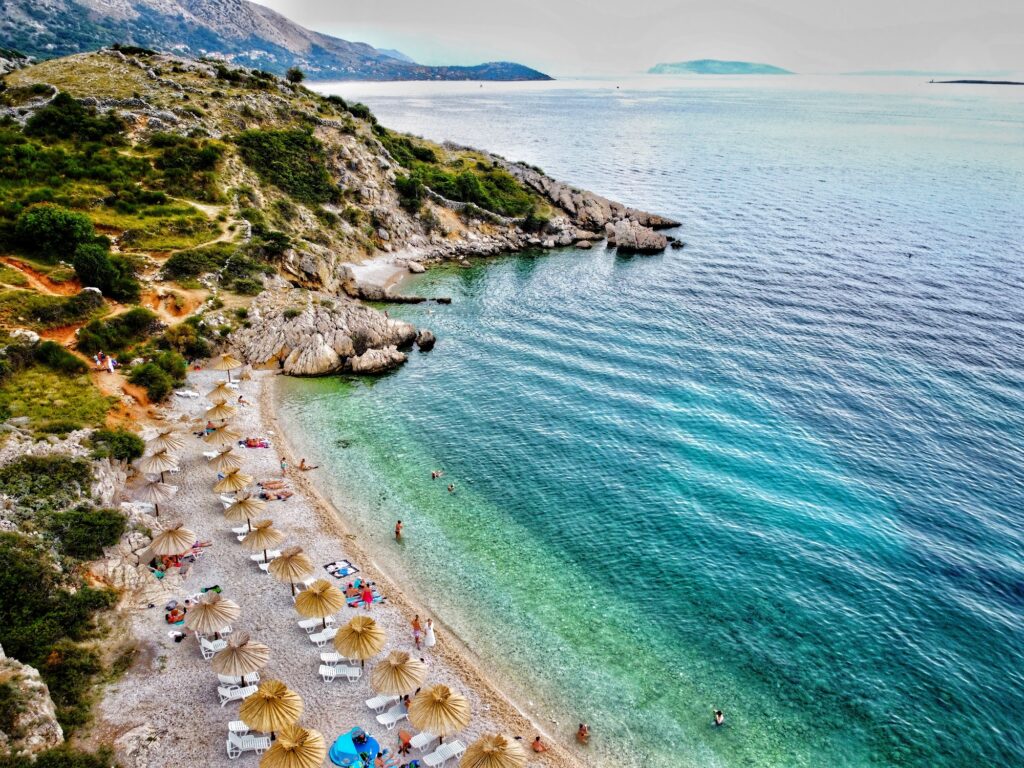
Oprna Bay sits in a deep natural cove on the southern coast of Krk Island, enclosed by sun-bleached limestone cliffs that drop steeply to the water on three sides. The protection this geometry provides is considerable — the bay is sheltered from the winds that periodically make swimming difficult elsewhere on the island, and the result is water that remains calm and clear even on days when the open coast is uncomfortable.
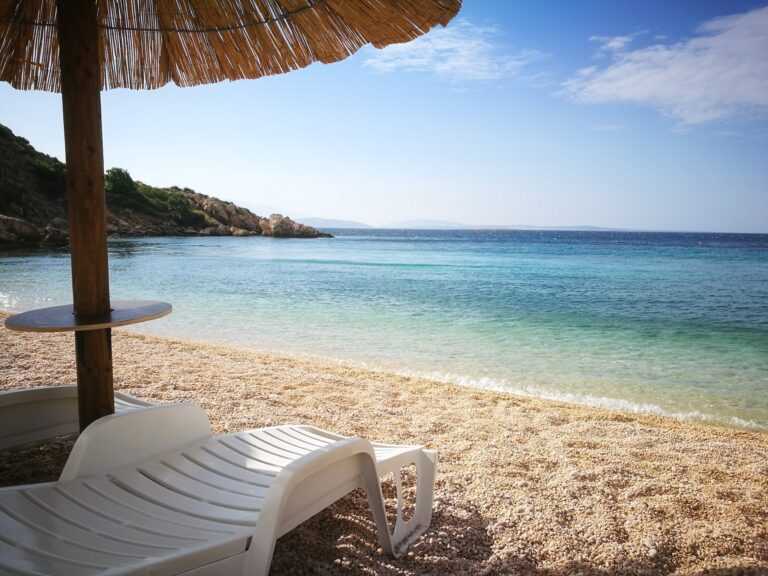
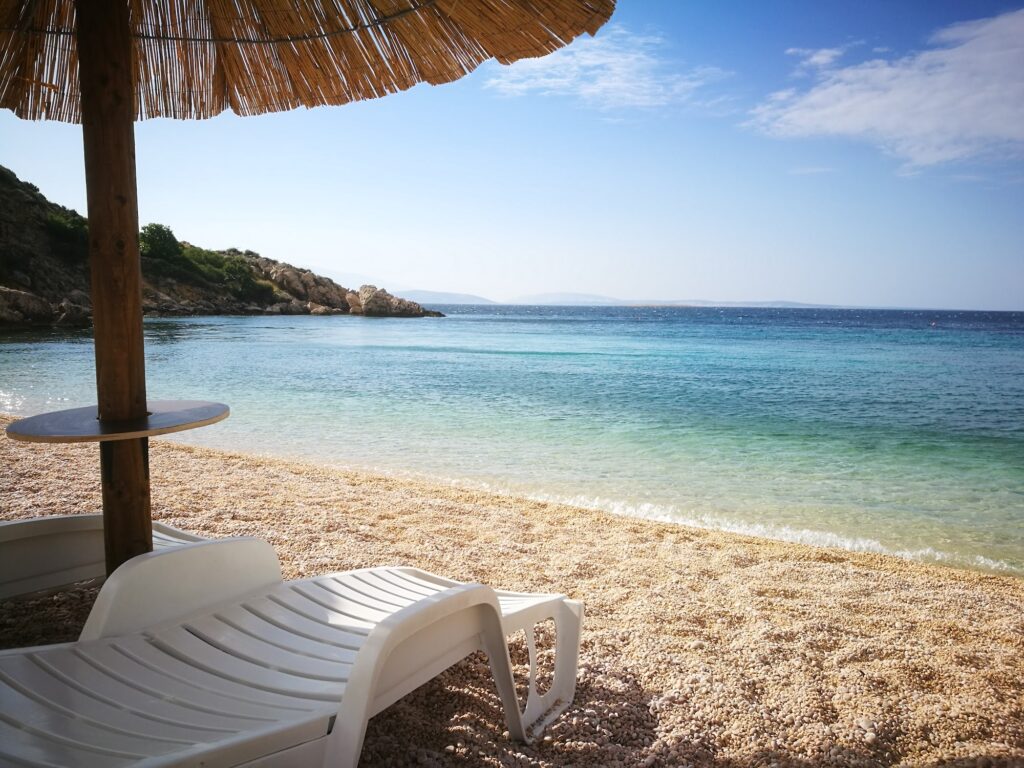
The shore is a mixture of fine golden shingle and smooth white pebbles, the precise balance shifting along the length of the beach and giving the shoreline a natural, undesigned quality that immediately distinguishes it from anything constructed or maintained by human intervention. There are no sunbed grids, no organised zones, no geometry imposed on the space. People find a patch of shore that suits them and arrange themselves accordingly, and the informality of it is part of what makes the atmosphere at Zaljev Oprna so genuinely restoring.
The cliffs above cast natural shade across portions of the beach in the late afternoon — not predictably or uniformly, but in the shifting, organic way that only real topography produces. On my most recent visit I spent the hottest hours of the day in one of these shadow patches, reading, and emerged into the late afternoon light to find the water had taken on a quality that the midday sun, for all its intensity, had not quite achieved: a depth of colour and stillness that made the next swim the best of the day.
The Water and Snorkeling
There is a specific moment, unique to certain beaches, when you put on a mask and lower your face into the water for the first time and understand immediately that you are somewhere exceptional. Snorkeling at Zaljev Oprna produces that moment reliably.
The water clarity at Oprna Bay is among the finest I have experienced on Krk Island — and Krk, to be clear, sets a high standard for this. The seabed is a varied composition of sand, smooth rock, and submerged limestone formations, and the visibility through the exceptionally clean water allows you to read all of it in detail from the surface. The underwater landscape along the cliff bases is where the real rewards are concentrated: cavities and small sea caves worn into the limestone, rock faces colonised by sea anemones and urchins, the occasional octopus occupying a crevice with the proprietorial stillness that octopuses seem to specialise in.
I spent the better part of two hours underwater on my first visit, working methodically along the cliff edges in both directions from the beach. The marine environment here has the character of somewhere that receives careful visitors rather than careless ones — which reflects, I think, the self-selecting quality of a beach that requires genuine effort to reach. The people who find their way to Oprna tend to be the kind of people who treat it well.
Sea kayaking at Oprna Bay is the other activity worth building your day around. The cove opens onto a stretch of coastline with rock formations, small caves, and adjacent inlets that reward exploration from the water. Paddleboards are also well-suited to the calm conditions inside the bay. Neither involves motorised equipment, which is consistent with the overall character of the place — active, human-powered, quiet.
Facilities: What to Expect and How to Prepare
Zaljev Oprna facilities are minimal by design and by circumstance, and understanding this before you arrive is the difference between a day that works and one that doesn’t.
During the peak summer season, a small beach bar operates on the shore — serving cold drinks, coffee, and light snacks to visitors who have made the journey. It is a modest but genuinely welcome presence, particularly late in the afternoon when water supplies brought from the road above have been thoroughly depleted. A limited number of sunbeds and umbrellas are available for hire and integrate into the natural setting without the visual intrusion that organised beach equipment tends to produce at wilder locations.
Beyond this, there is nothing. No freshwater showers, no changing rooms, no public restrooms, no infrastructure of any kind. This is not an oversight — it is precisely what keeps the water as clean as it is and the atmosphere as undisturbed as it feels. Preparation is essential: sufficient water for the full duration of your visit, food if you plan to stay through the day, sun protection applied before descending the path rather than after, and footwear that can manage both the descent and the rocky sections of the shoreline.
There is no lifeguard at Oprna. The bay’s sheltered geography makes swimming conditions generally safe, but the remoteness of the location and the lack of monitoring mean that visitors should exercise sound judgment, particularly when snorkeling in the deeper water along the cliff edges.
For Families
Oprna Bay with children is an experience I would recommend selectively. For families with older children and teenagers who are confident in the water, enthusiastic about snorkeling, and unbothered by a demanding descent, the bay offers exactly the kind of adventure and natural quality that is genuinely difficult to find at more accessible locations. The calm water, the underwater life, the sea caves accessible by swimming — these are things that engage curious young people with sustained rather than passing enthusiasm.
For families with toddlers, pushchairs, or children who require consistent shade and immediate access to restroom facilities, Zaljev Oprna is not the right destination. The logistics work against it at every point, and there are excellent beaches on Krk Island better matched to those needs. Knowing which category your family falls into before you commit to the descent is the most useful piece of advice I can offer on this particular question.
Dining After the Beach
There is something about a full day at Oprna — the descent, the hours in the water, the climb back up in the early evening — that produces an appetite of a particular and satisfying quality. The village of Stara Baška and the town of Punat are both within short driving distance of the cliffside road, and both offer the kind of cooking that Krk Island does distinctively well.
Krk lamb — raised on the island’s dry limestone pasture and with a flavour that reflects that environment in ways that are difficult to achieve anywhere else — appears alongside handmade šurlice pasta and fresh Adriatic scampi on menus in both locations. Eating in a stone tavern in Stara Baška after a day at Oprna, with the particular tiredness of a full day in the sea and the sun, is a combination I have repeated without any diminishing of its appeal.
Zaljev Oprna on Krk Island asks more of you than most beaches. It asks for physical effort, advance preparation, and a willingness to spend a day somewhere that provides no safety net of commercial convenience. What it offers in return is proportionate to those demands: water of extraordinary clarity, an underwater environment of genuine richness, a quality of silence and natural integrity that is becoming increasingly rare on any popular Adriatic island, and the particular satisfaction of a place discovered rather than simply arrived at.
The path down is steep. Bring enough water. Go early. Bring a mask.
It is worth every step of the descent.
Map
Sorry, no records were found. Please adjust your search criteria and try again.
Sorry, unable to load the Maps API.
Near by places: