Mogren 2 Beach Budva: The Quieter Twin Cove in Montenegro
Profile
Mogren 2 Beach, Budva: The Quieter Twin Cove Named After a Shipwrecked Spanish Sailor
Montenegro | Budva | Budva Riviera
The name Mogren belongs to a shipwrecked Spanish sailor. One day, a sailor was shipwrecked on the beach — the only survivor from a Spanish galley sunk by pirates. The sailor’s name was Mogren. On the beach, he built a Church of St. Anthony of Padua as a sign of gratitude. On June 13, St. Anthony’s feast day, a mass was regularly celebrated in the church, attended by people from Budva who would come by boat. Even today, some people from Budva follow the old custom and do not go bathing in the sea before June 13. The beach bears the sailor’s name — Mogren.
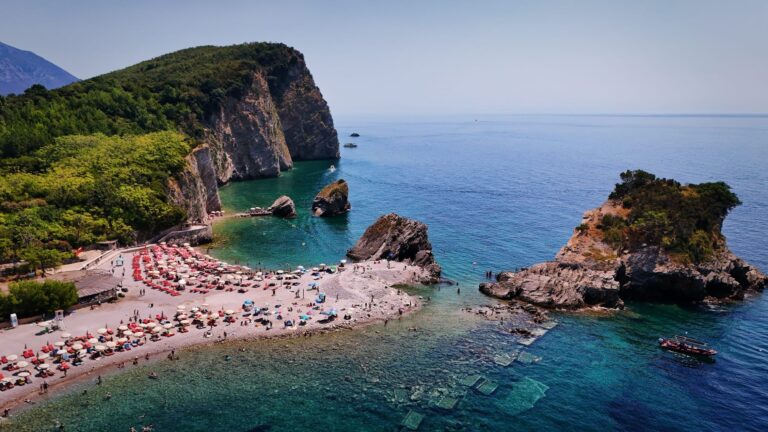
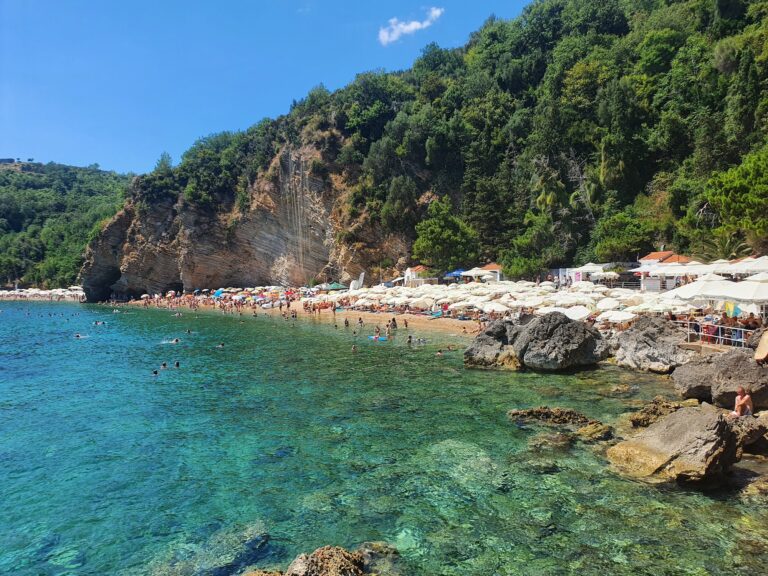
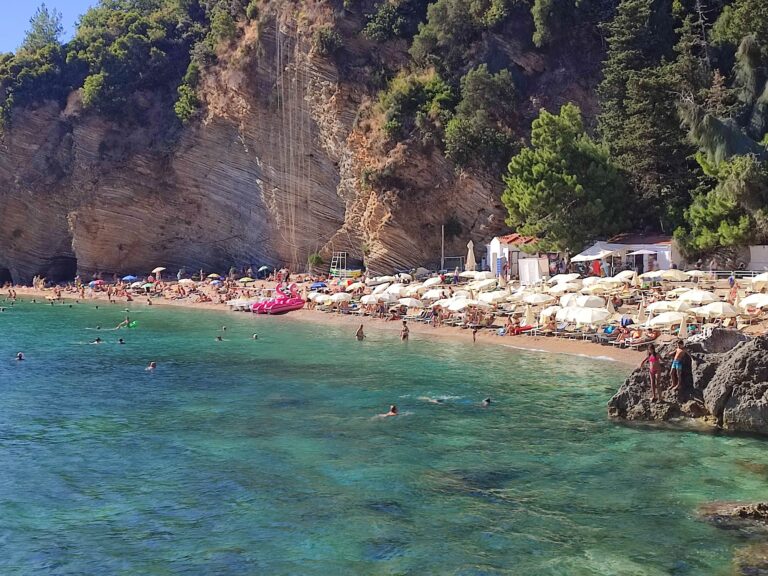
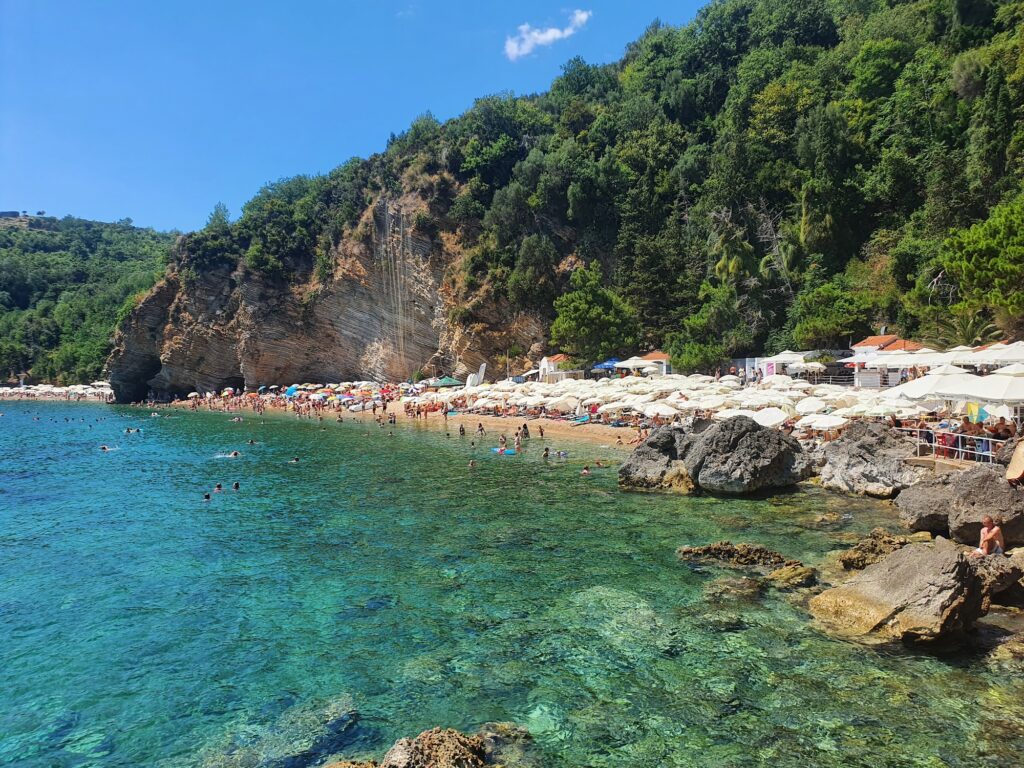
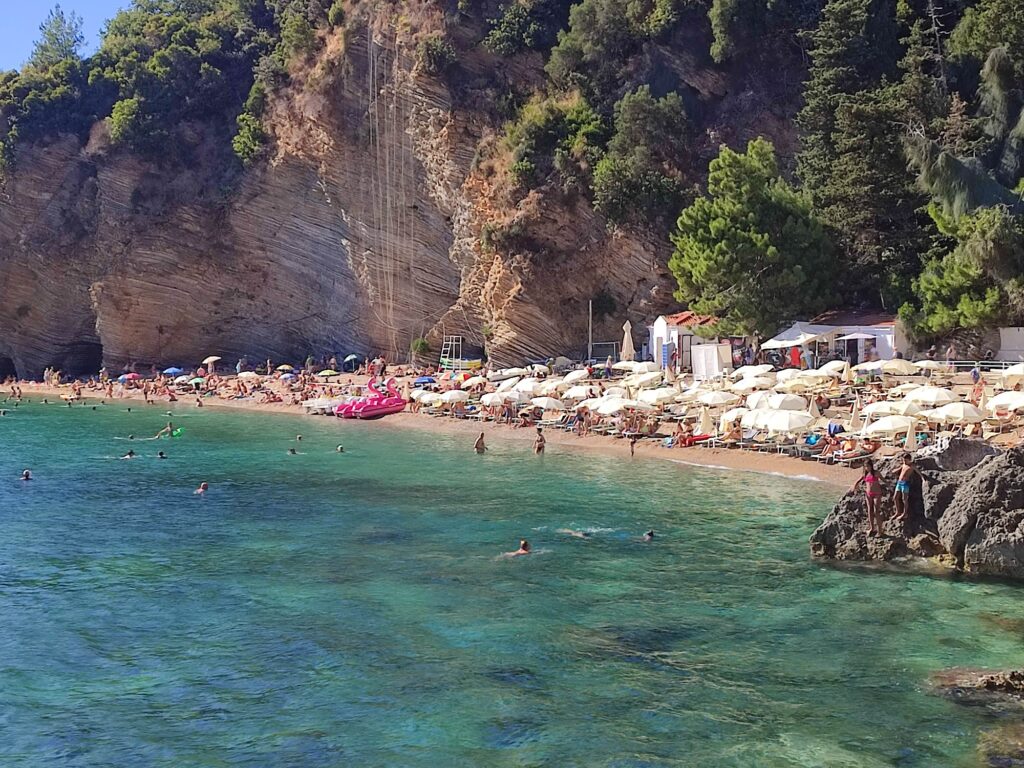
Only the ruins of the church remain. The beaches — both of them, connected by the tunnel through the limestone headland — carry the name, and the specific beach that became the quieter and more desirable of the two carries the ordinal: Mogren 2. Mogren consists of two sandy beaches of total length 350 metres, connected by a tunnel through the rocks. They are located 150 metres from Budva’s Old Town. Both beaches have received the Blue Flag certification for water quality and environmental management.
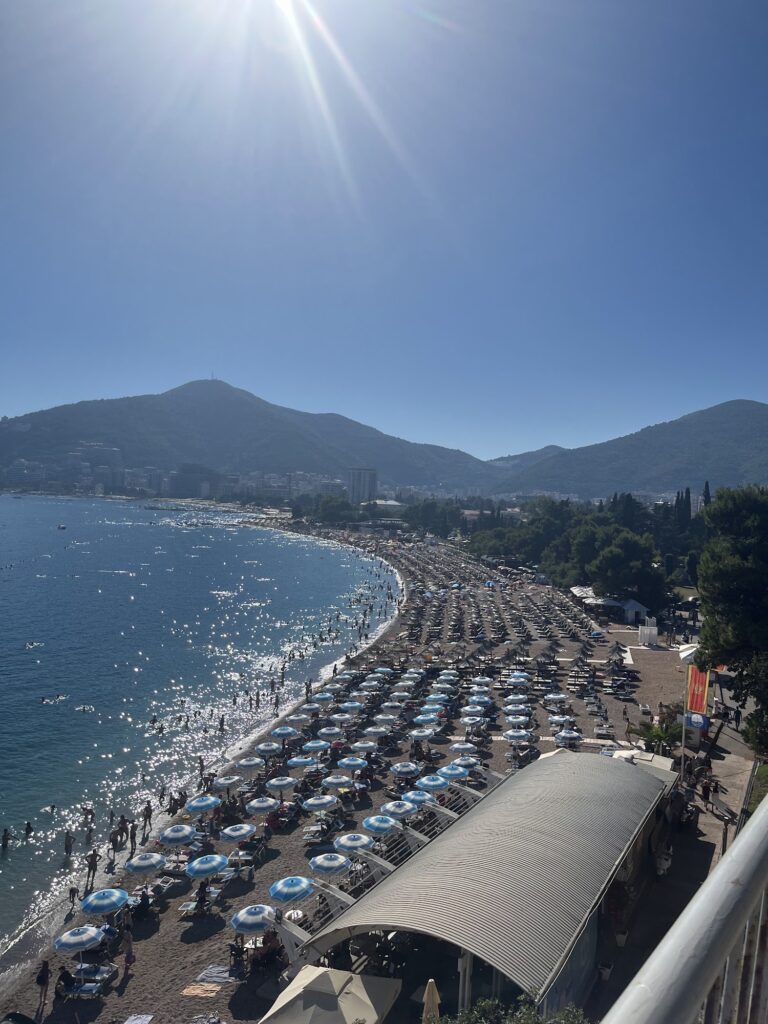
The beach is not a secret. In July, visitor accounts note that Mogren can be full by 7am — the combination of its close position to the Old Town, the visual quality of the cliff-backed cove setting, and the Blue Flag certification make it the most talked-about beach in Budva, and the volume of visitors in peak season is the primary practical reality to plan around.
Getting There: 10 Minutes on Foot from the Old Town, Past the Ballerina Statue, Through the Avala Path
From Budva’s Old Town (Stari Grad), the path to Mogren begins at the Ballerina Statue — the bronze figure of a ballerina on the cliff path just south of the old town walls, overlooking the sea. This is the landmark that every map and navigation instruction uses. From the statue, the paved cliff path continues to the Avala Hotel complex, through which the beach access road passes. A small entrance fee is charged at the hotel path entry, which limits access somewhat and is the mechanism that keeps the beach from becoming completely unmanageable in peak season.
The walk from the Old Town takes approximately 10 minutes on the well-maintained cliff path. The path is steep in sections and requires appropriate footwear — visitor accounts specifically flag this for those arriving in flip flops, which can be slippery on the worn stone.
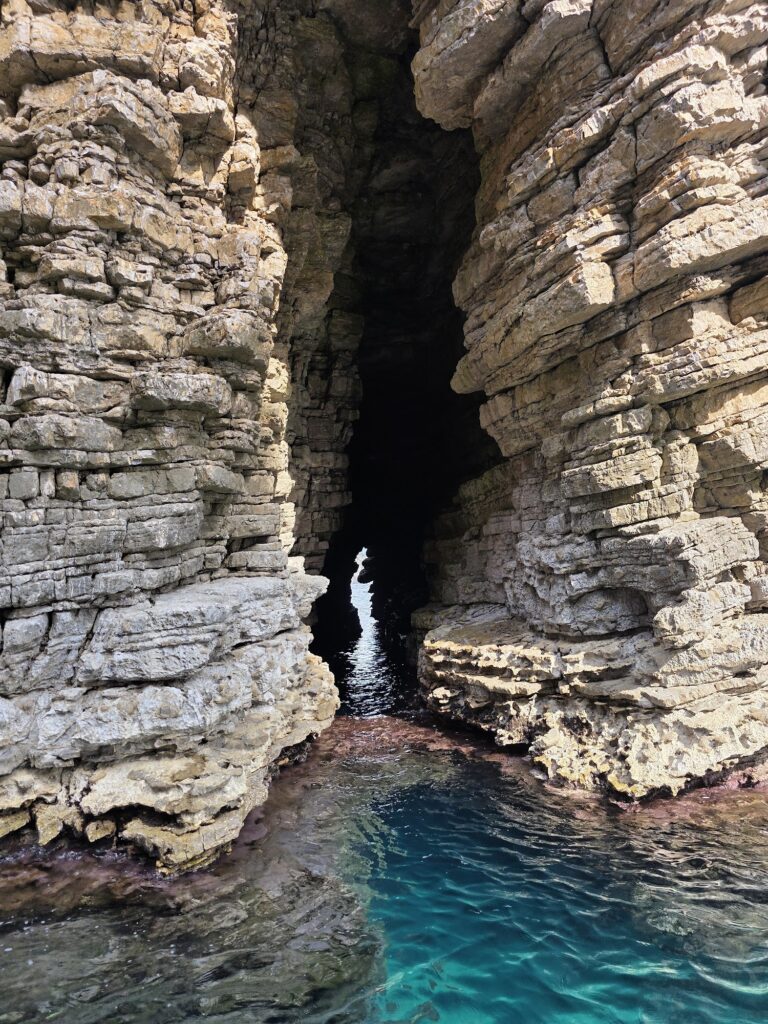
Once at Mogren 1, the walk to Mogren 2 continues to the far end of the first beach and through the short wooden bridge and rock tunnel — the passage that is the defining feature of the Mogren experience. The tunnel is short, wide enough for comfortable passage, and lit well enough to navigate without a phone torch. On the other side is Mogren 2.
There is no road access or car parking for the beach. It is a pedestrian-only destination.
The Two Beaches and the Tunnel
The 350-metre total of the Mogren complex is divided between the two coves by the limestone headland, with the tunnel as the connection. Mogren 1 is the first and larger cove encountered on the path from the town — busier, with more sunbed organisation and the beach bar infrastructure. For a slightly more secluded experience, venture through the short tunnel to Mogren 2. This second cove tends to be quieter, offering a more tranquil atmosphere for relaxation. You’ll still find rental facilities, though sometimes fewer than on Mogren 1.
The “more secluded” characterisation is relative to Mogren 1 and to Budva’s main beach rather than to a genuinely empty cove — in July and August, Mogren 2 fills completely by mid-morning. The practical advantage is that it remains noticeably quieter than its twin for a longer portion of the day, and the cliff shadow in the afternoon gives it the shade that the south-facing Mogren 1 lacks at the same hour.
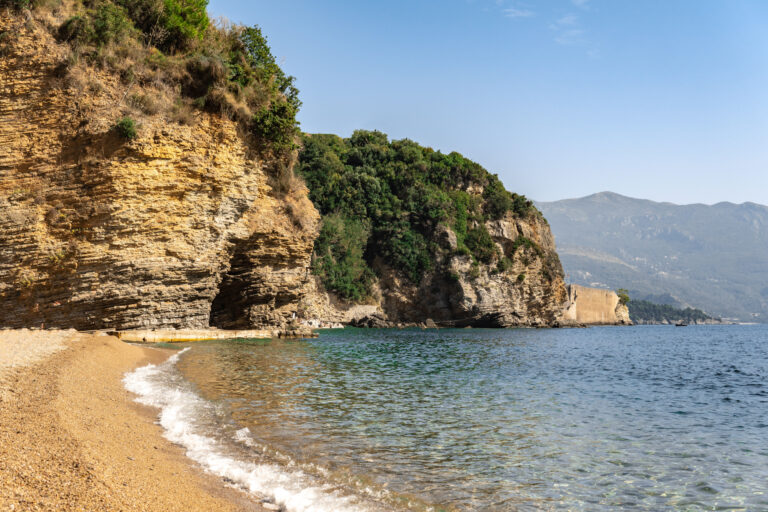
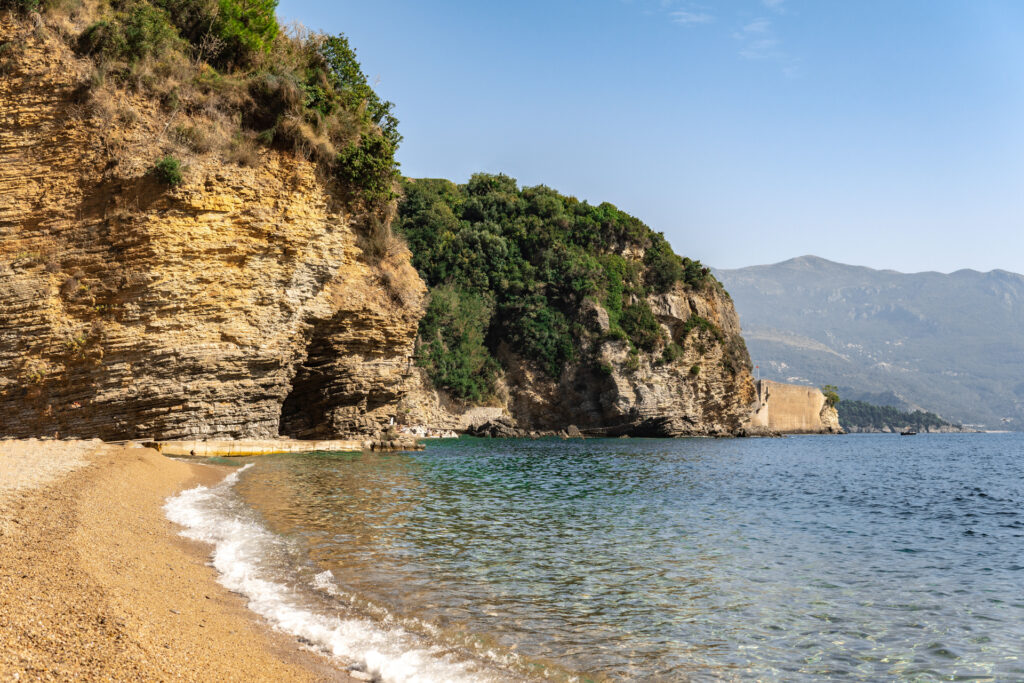
Both beaches are sandy with some pebble — finer and more mixed than the large pebble beaches of the northern Montenegrin coast. Water shoes are helpful but not essential for most of the beach surface. The seabed slopes relatively steeply, which is better for swimming than for toddler wading.
Shark’s Rock (Hridina Ajkula): The Cliff Jump Beyond Mogren 2
Just beyond the second of Mogren’s beaches is Shark’s Rock — a popular spot for jumping or diving into the sea below. Hridina Ajkula (the Croatian/Montenegrin name translating as Shark’s Rock) is the cliff formation immediately past Mogren 2 where confident swimmers and the adventurous teenage crowd have established the jump tradition. The rock face provides multiple heights for the approach, and the deep clear water below makes the landing zone clean. The jump is not regulated, there are no safety officials, and the assessment of conditions and clearance from boats below is the visitor’s own responsibility.
It is the specific activity that extends the Mogren 2 visit for visitors who want more than swimming and sunbathing, and the spectacle element — watching the jumpers from the beach — is part of the atmosphere of the cove even for those who do not jump.
Blue Flag, Sunbed Prices, and the Peak Season Reality
Mogren’s Blue Flag certification confirms the water quality and beach management standards — an accurate reflection of the clean, clear Adriatic water in the cove that visitor accounts consistently confirm. Sunbed prices at Mogren 2 range from €15 to €50 per set depending on position and operator — the upper end of what Budva charges for organised beach access, and a price point that multiple visitor accounts identify as the main practical limitation.
Free space — towel-on-sand options away from the sunbed section — is limited in peak season and disappears by mid-morning. The recommendation to arrive at dawn is consistent across every Mogren 2 visitor account from July and August: 7am or earlier for a free position, 8am for a realistic sunbed choice, 9am and later for whatever is left.
The Cliff Path View and the Old Town Backdrop
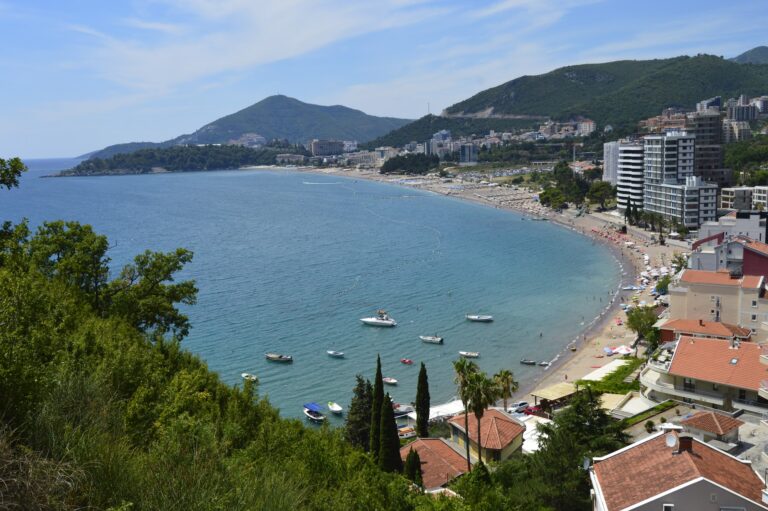
The walk to Mogren provides the view that the beach itself cannot — the approach along the cliff path from the Ballerina Statue looks back across the Budva bay toward the Old Town peninsula with its walls, citadel, and the island of Sveti Nikola offshore. The view is the standard Budva promotional photograph: the old town profile from the cliff path at the time of day when the light hits the white walls.
For visitors who want the cliff path view without the full Mogren commitment, the walk to the statue and the first section of the path provides the panoramic position without continuing to the beach.
Budva Old Town: The 2,500-Year Context of the Beach
Budva is one of the oldest urban settlements on the Adriatic — traditionally dated to the 5th century BC by Greek and later Roman sources, and the Old Town walls enclose a medieval and early modern urban fabric that survived the 1979 earthquake (which damaged it severely) and the subsequent reconstruction. The specific heritage of Budva Old Town — the Citadel, the churches, the narrow lanes — is the cultural context immediately adjacent to the beach, 150 metres from the tunnel entrance.
The combination of swimming at Mogren 2 and exploring the Old Town walls, the Citadel, and the church of Santa Maria in Punta (founded 840 AD) within the same half-day is the specific Budva programme that the beach’s position enables without any transport requirement.
Mogren 2 Beach in Budva is the quieter twin cove of the Montenegrin coast’s most famous two-beach complex — Blue Flag sandy cove behind a limestone headland, reached through the rock tunnel after the first beach, 150 metres from the Old Town via the cliff path past the Ballerina Statue, named after a shipwrecked Spanish sailor who built a church here in the 1600s, and Shark’s Rock cliff jump immediately beyond.
Arrive at 7am for a free spot. Pay the entrance fee at the Avala Hotel path.
The tunnel is on the left at the far end of Mogren 1.
Map
Sorry, no records were found. Please adjust your search criteria and try again.
Sorry, unable to load the Maps API.
Near by places: