Flogita Beach Halkidiki: Palms, Sand, Nightlife
Profile
Flogita Beach: The Village Built by Refugees Who Renamed a Coastline
Greece | Halkidiki | Nea Moudania | Thermaikos Gulf
Flogita takes its name from a village in Cappadocia, deep in what is now central Turkey, a place its founders never saw again after 1923. Refugees fleeing the aftermath of the Greco-Turkish War and the population exchange formalized at Lausanne arrived on this stretch of the Thermaikos Gulf with nothing but the name of the home they’d lost, and they built their new settlement directly on the grounds of a former Russian monastic dependency, the same site that later housed the area’s first hospital until it closed in 1934. I hadn’t expected a beach known today mainly for its palm trees and beach bars to carry this kind of weight, but nearly every “Nea,” every “New,” town scattered across this part of Halkidiki holds some version of the same story.
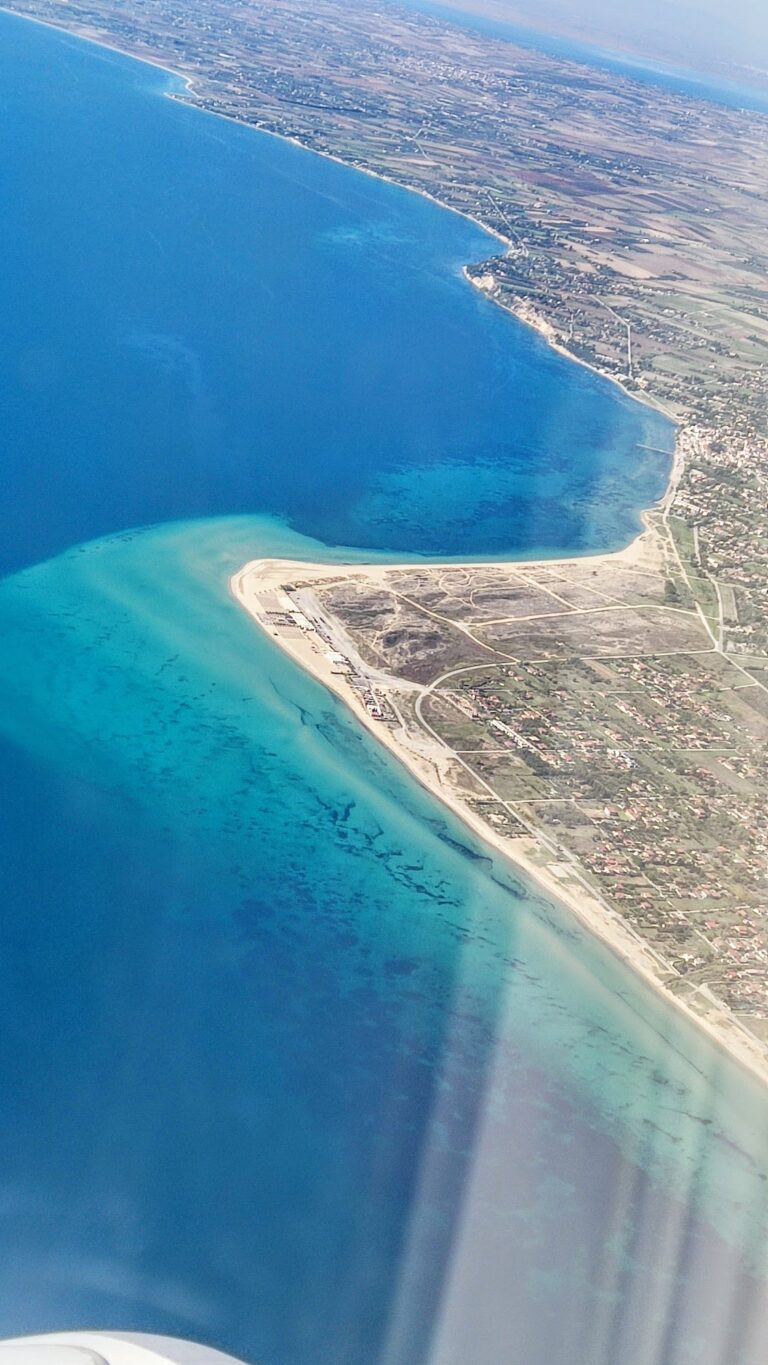
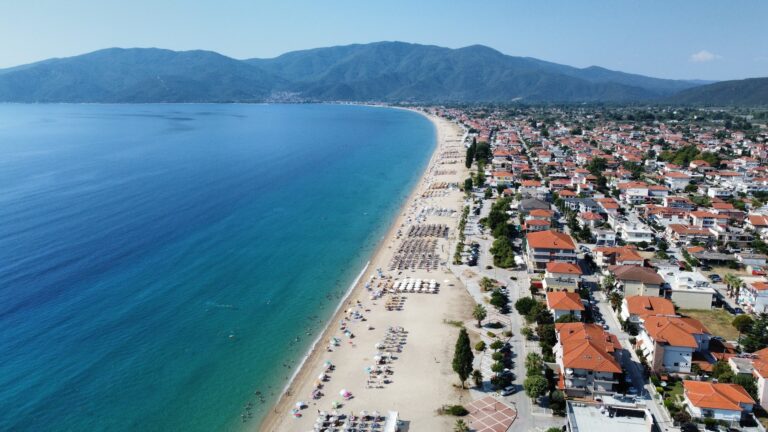
Flogita Beach, still commonly called Nea Flogita, sits below the village its refugee founders built into the hillside, amphitheater-style, overlooking the gulf, and on a clear day the view stretches all the way to Mount Olympus across the water.
A Gently Sloping Shore Beneath Six Hundred Palms
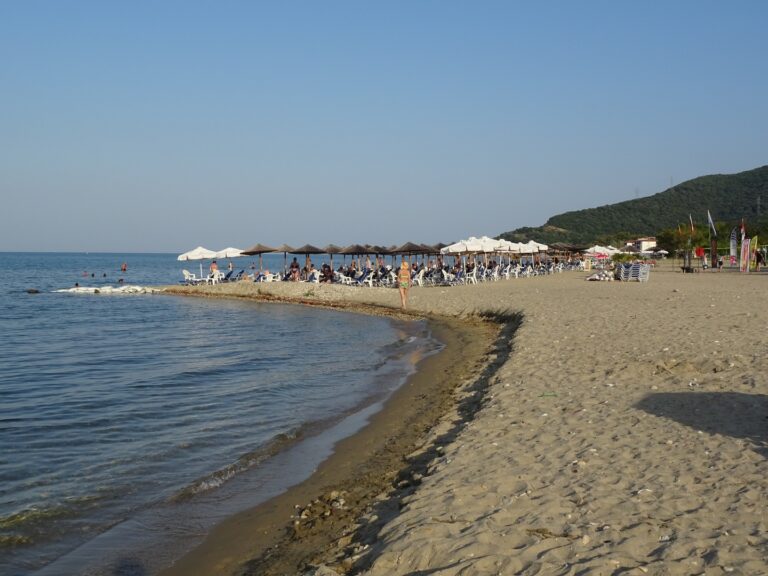
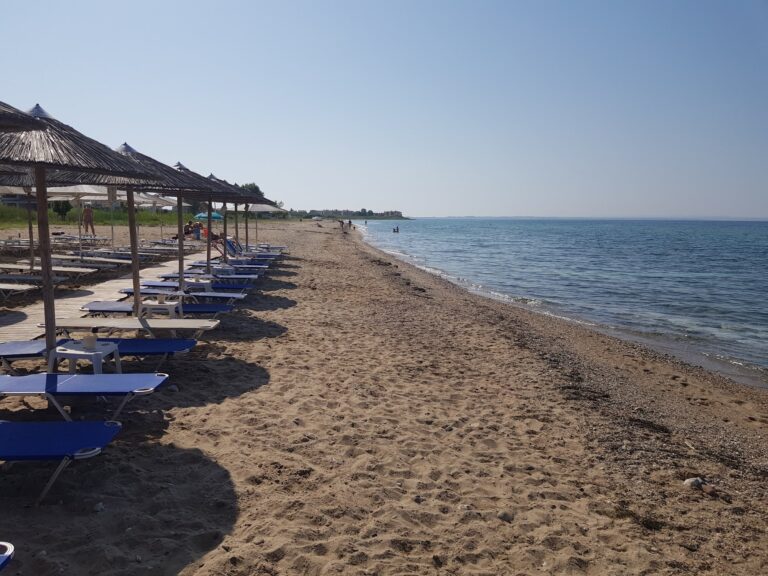
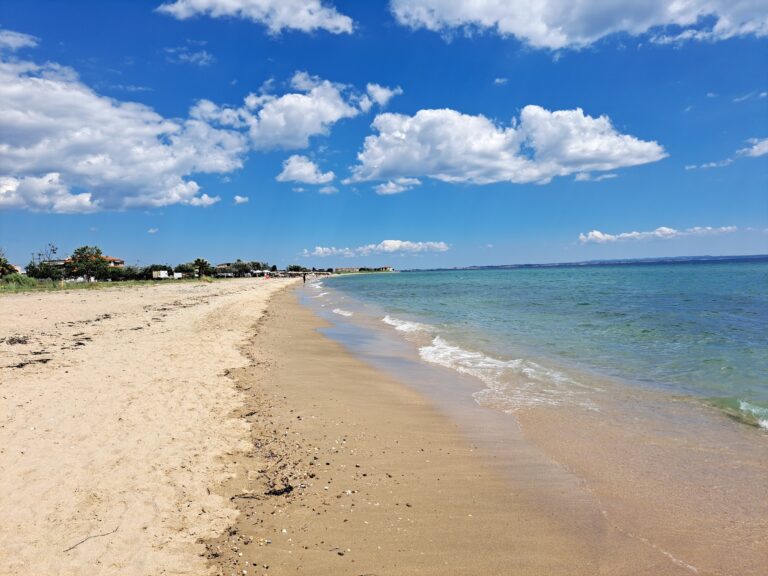
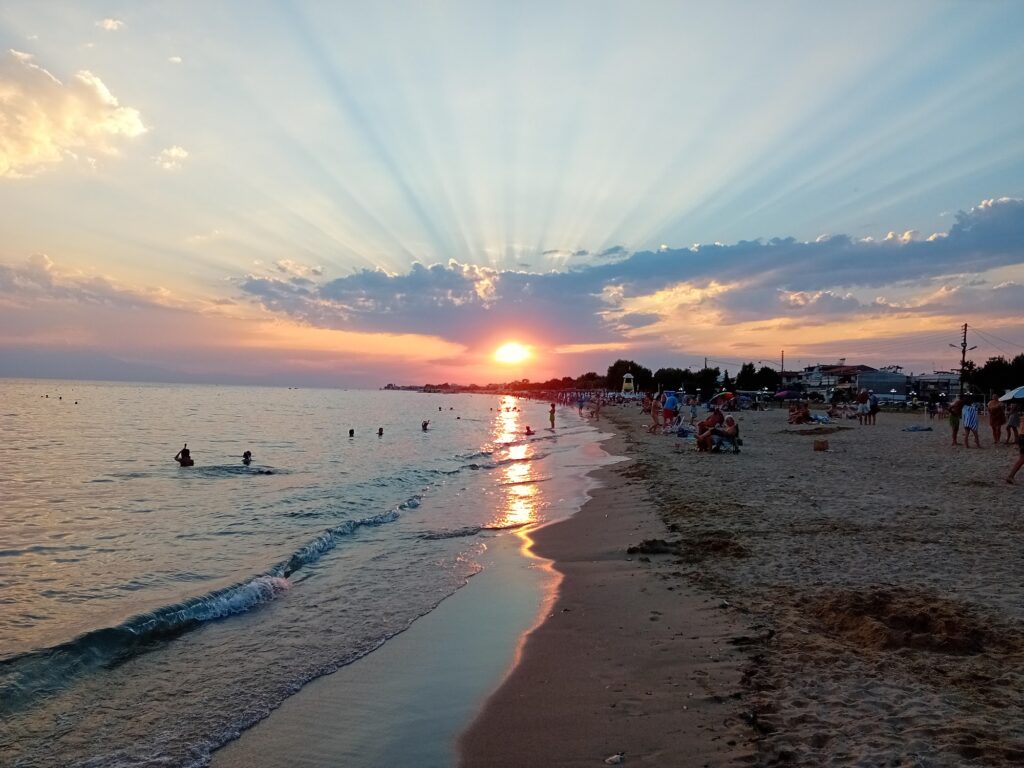
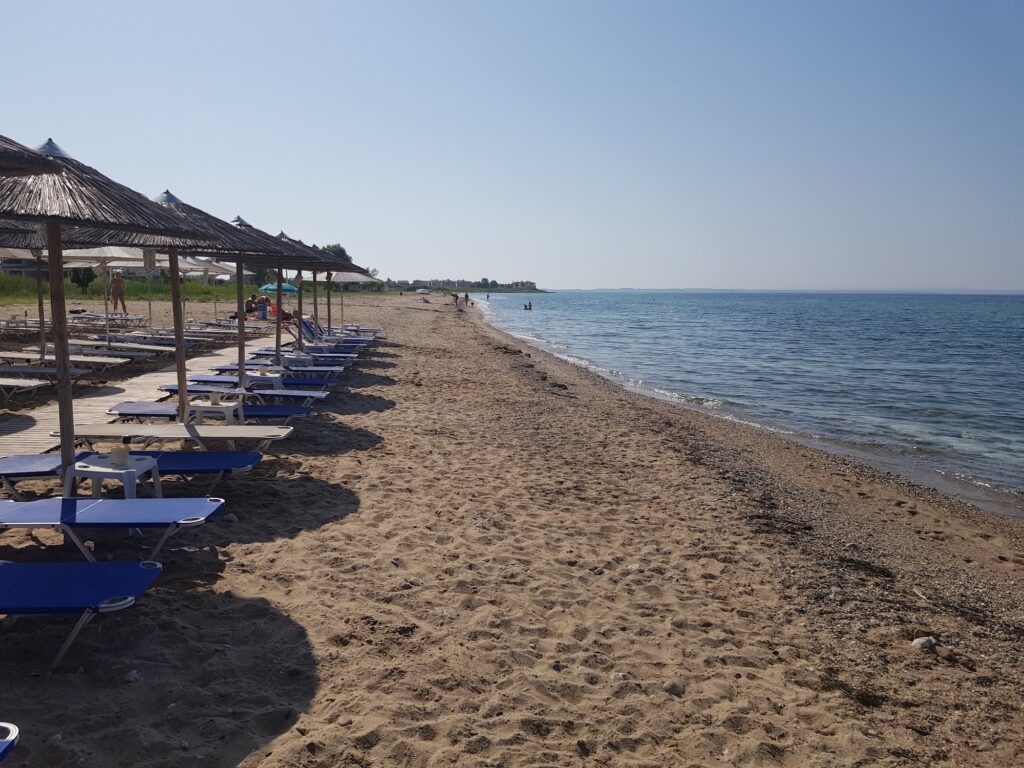
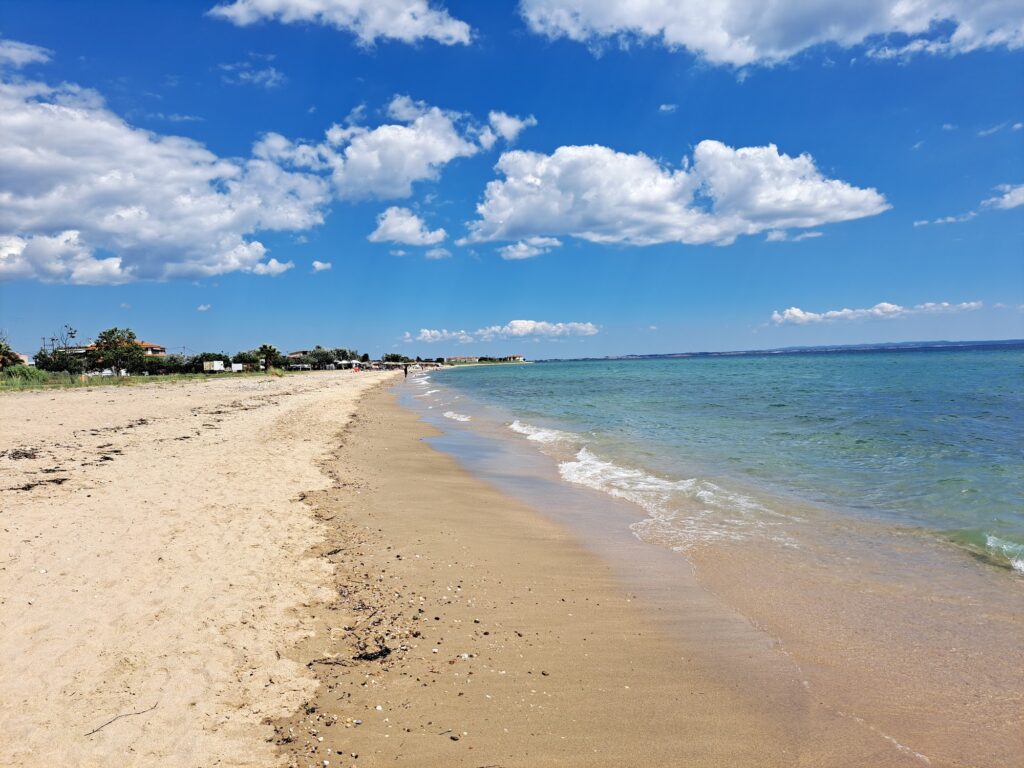
The beach itself runs wide and genuinely soft, fine golden sand kept to a high environmental standard, and I found the water clarity consistently excellent across multiple visits, the sea staying calm enough that I could see well past where visibility usually drops off elsewhere on this coast. The seabed slopes gradually, and I’d call this one of the more reassuring beaches in western Halkidiki for supervised swimming with young children, the shallow water extending a genuine distance from shore before any real depth sets in. Behind the sand, a paved promenade lined with roughly six hundred palm trees runs the length of the beach, and I made a habit of walking it most evenings, the palms and flower beds giving the whole stretch a considerably more polished feel than a typical village beach.
Beach Bars That Turn Into a Party Village by Night
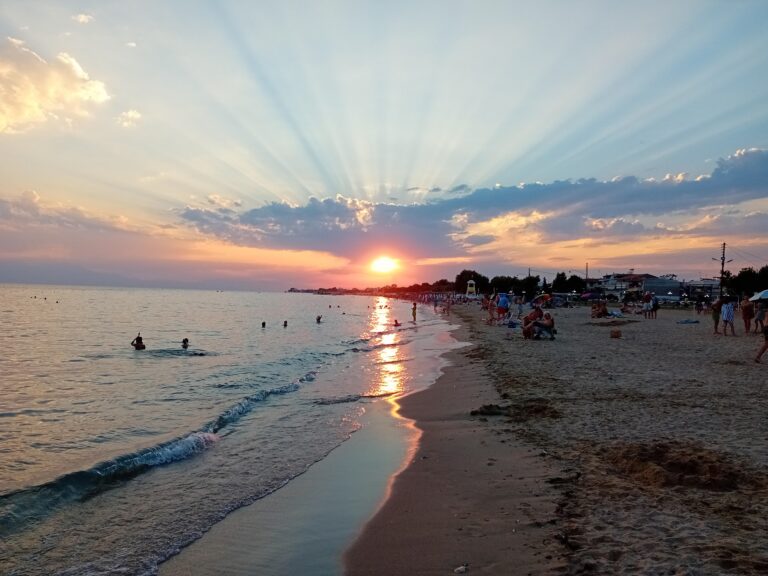
Flogita’s daytime character shifts noticeably once the sun drops. The stretch of coast between here and neighboring Nea Plagia fills with beach bars and clubs running live music and DJ sets well into the night, and locals genuinely describe the peak summer atmosphere as a party village, a fair description based on what I found on a Saturday evening in August. Given how organized and commercially managed most of this beachfront is, I’d expect dogs to require explicit permission at any managed beach bar section, consistent with how organized Greek beaches generally handle pets, though quieter stretches further from the main bar cluster likely follow the standard leash rule outside the water.
Fish Tavernas and Ouzerias Behind the Sand
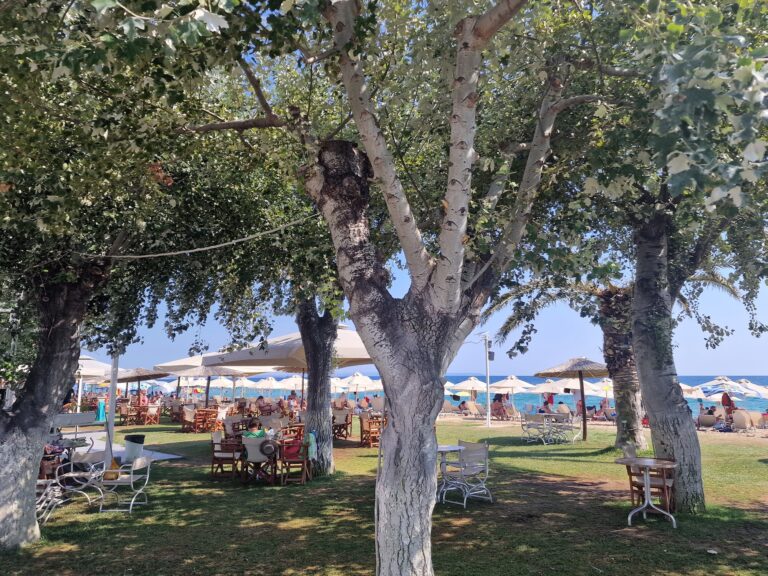
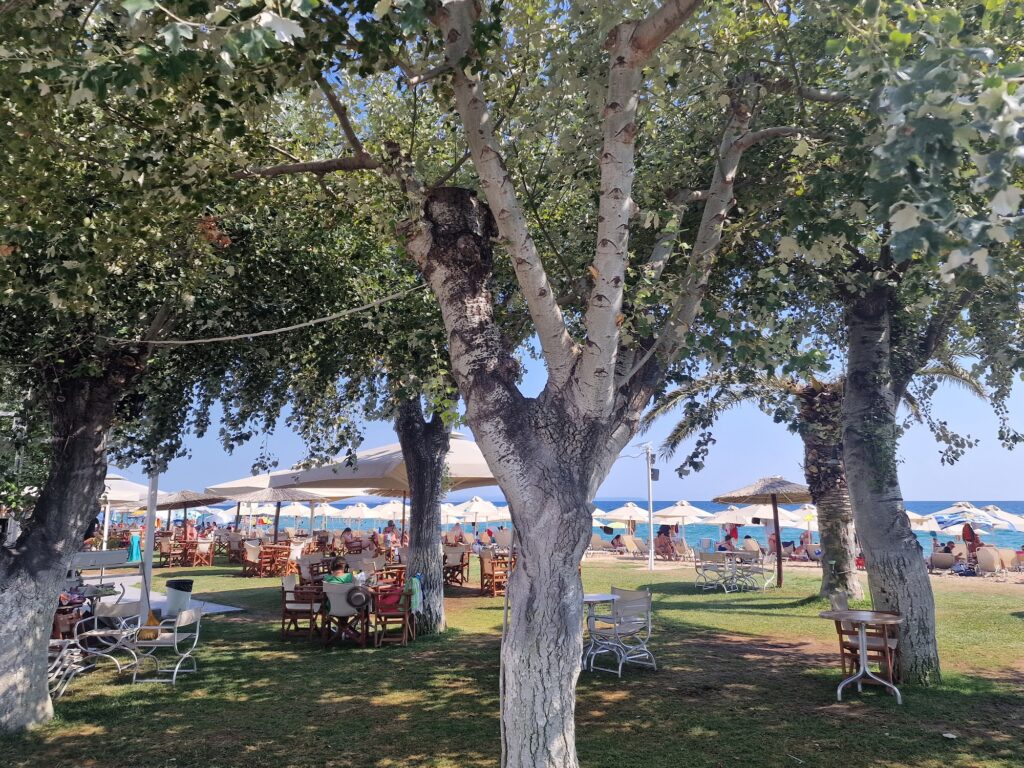
A row of traditional tavernas, pizzerias, and ouzerias lines the beachfront, and I ate well at more than one, fresh local seafood served on shaded terraces with a direct view back toward the water. The overall standard felt consistent with what I’d expect from a resort town that’s spent decades refining its tourist offering without losing the working fishing-village character underneath it.
Lifeguards, Water Sports, and Basic Facilities
Professional lifeguards patrol at regular intervals through the summer season, and changing cabins, outdoor showers, and restroom facilities cover the basics along the beach. Designated zones for water sports and beach volleyball sit toward one end of the sand, and I found the beach’s sheer scale meant these active areas never felt like they were crowding out anyone simply looking to sunbathe.
The Byzantine Monastery Site Behind the Village
A short walk up from the beach, the ruins and renovated buildings of the old Panteleimon monastery site, still known locally as the Russian Metohi, mark the exact spot where Flogita’s refugee founders first settled in 1923. I visited on a quiet morning and found the renovation work still ongoing, byzantine antiquities specialists clearly treating the site as more than a footnote to the village’s tourist identity.
Getting There: Thirty-Five Minutes From Thessaloniki
Flogita Beach sits roughly 52 kilometers from Thessaloniki, a drive of thirty-five to forty-five minutes along the A24 motorway toward Nea Moudania, taking the exit signed for Nea Flogita and Nea Plagia. I found the route straightforward, a well-maintained highway the entire way.
The KTEL Bus From Thessaloniki
Frequent KTEL Chalkidikis buses run from Thessaloniki’s terminal directly to Flogita, stopping centrally within a five-minute walk of the beachfront. I used this option once and found it a genuinely easy, low-effort way to reach the beach without needing a rental car for a day trip.
Parking Before the Weekend Crowd
Large public parking lots and street parking run parallel to the beach, and I found arriving before eleven made a real difference in claiming a spot close to the water, especially on peak summer weekends when the party crowd from Thessaloniki fills the town by early afternoon.
Comparing Flogita to Its Neighboring Refugee Villages
Flogita sits within a cluster of beaches founded under nearly identical circumstances. For a quieter, more family-paced alternative nearby, Sahara Beach Nea Kallikratia Greece offers a comparable gradual entry without Flogita’s after-dark intensity.
Watching Olympus Hold the Last Light Across the Gulf
By the time I packed up on my last evening, the palms along the promenade had gone dark against a sky still catching color, and across the water, Mount Olympus held the last of the light a little longer than the beach itself, the same view, more or less, that a group of refugees building a new life from nothing would have seen from this exact hillside just over a century ago.
Map
Sorry, no records were found. Please adjust your search criteria and try again.
Sorry, unable to load the Maps API.
Near by places: