Nea Fokea Beach Kassandra: The Tower Stood in 1407
Profile
Nea Fokea Beach Kassandra Chalkidiki Greece: A Tower That Has Watched This Shore Since 1407
Greece | Nea Fokea | Kassandra, Chalkidiki, Central Macedonia
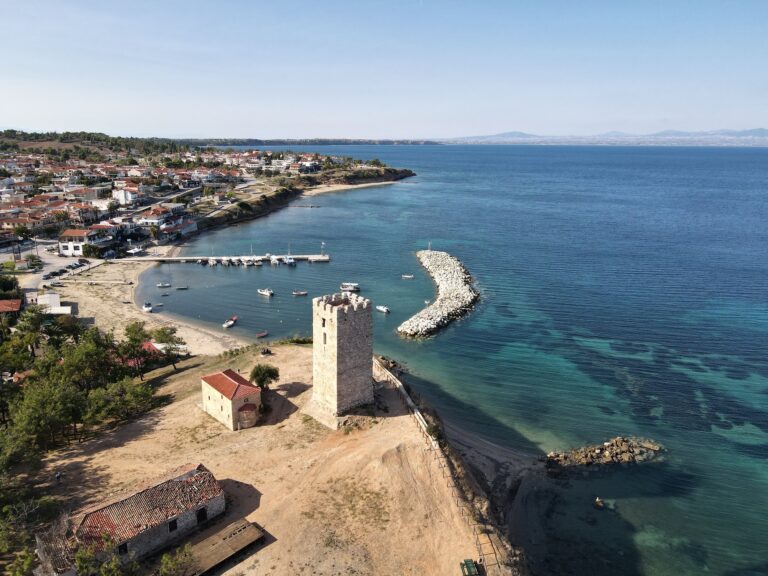
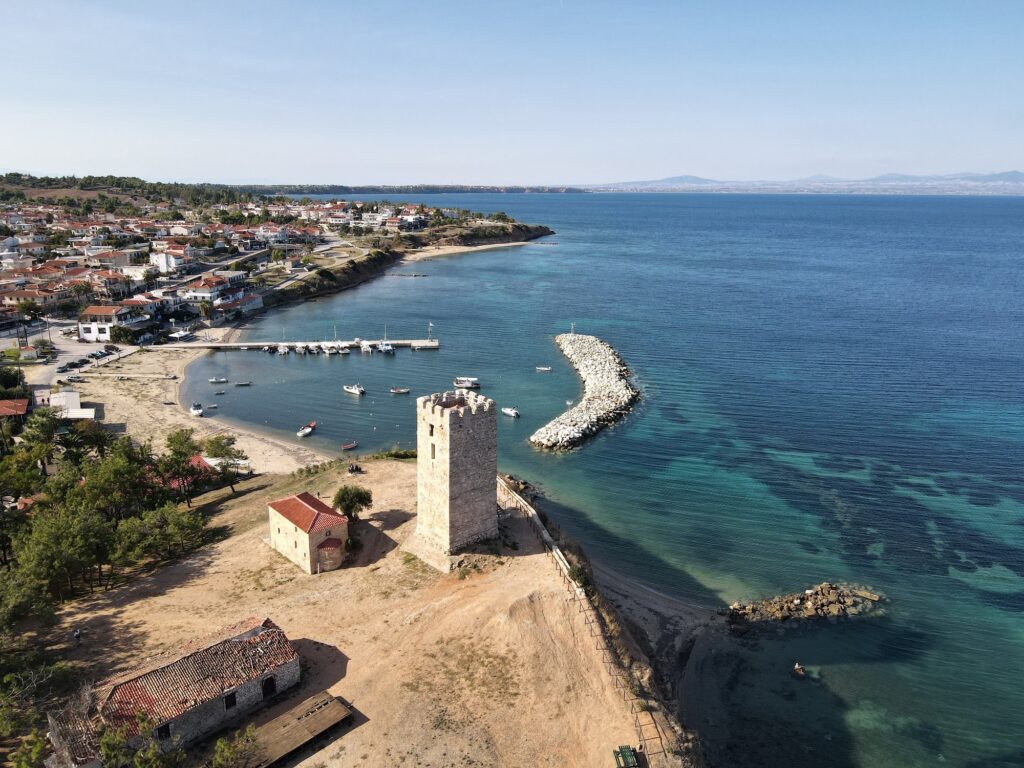
The hill above Nea Fokea has been occupied since approximately 5,000 BC. By the time the Byzantine tower was raised on it — sometime after 1407, when Emperor Ioannis Palaiologos donated the surrounding territory to St. Paul’s Monastery on Mount Athos — the site had already cycled through a Neolithic settlement, a Bronze Age phase, and an unknown period of abandonment ending around 1,000 BC. The tower itself was built from the materials of those earlier structures, the ancient stone repurposed into a fortress to protect the monastery’s agricultural holdings. It stands 17 metres tall on a 7×7 metre base, and it is the only tower in all of Chalkidiki that has survived intact to its battlements — the crenellations still complete, the stone still reading as a working fortification rather than a picturesque ruin.
In 1821, Emmanouil Papas, the leader of the Greek War of Independence in Chalkidiki, established his headquarters inside the tower. That same year it was set on fire. The roof was rebuilt in 1976, and the tower now stands restored, hosting summer events as part of the Kassandra Festival on its upper platform. A cave at the base of the hill is associated by local tradition with Apostle Paul’s passage through this coast on his first journey to Macedonia, and a small church and holy spring occupy the site. Below the church, 20 metres of carved corridor descend to the underground sanctuary. The hill, the tower, the cave, and the spring are effectively a single layered site, and they sit directly above the beach at Nea Fokea.
Getting to Nea Fokea Beach Kassandra Chalkidiki Greece: 78 Kilometres From Thessaloniki on the Eastern Kassandra Coast
The drive from Thessaloniki covers 78 kilometres, the route heading southeast through the Thessaloniki plain before crossing into the Kassandra peninsula and following its eastern coast south. Nea Fokea sits roughly in the middle of that eastern coastline, between Kallithea to the north and Afytos to the south, and the approach by road gives an early view of the tower on the hill before the village itself comes into sight. The KTEL Halkidikis bus runs from Thessaloniki’s dedicated Chalkidiki station to Nea Fokea through the summer season, making the journey accessible without a rental car.
Parking is available in the village and along the seafront road, though the summer population swells from around 2,000 permanent residents to more than 10,000, and arriving before mid-morning is the practical advice for anyone visiting in July or August.
Nea Fokea Beach Kassandra Chalkidiki Greece: Hot Springs on the Shore, Clear Water, a Fishing Harbour
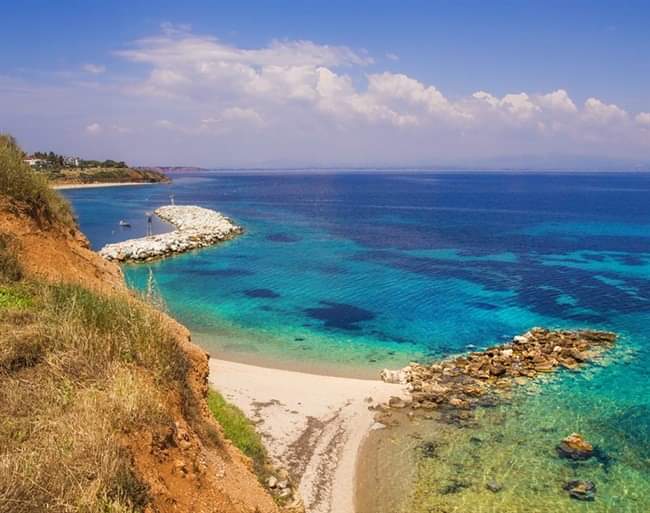
The specific quality that separates the Nea Fokea waterfront from the longer, sandier bays elsewhere on Kassandra is the hot springs. Natural thermal water reaches approximately 35°C and flows directly onto the beach, creating pools in the shallow zone that are warm enough in cooler months to be actively sought after rather than merely tolerated. The springs were known and used in Roman times for their therapeutic properties, particularly for rheumatic and dermatological conditions. The combination of the hot spring water mixing with the cooler Aegean at the shoreline is physically unusual and produces a layering of temperature that takes a moment to locate when you first wade in.
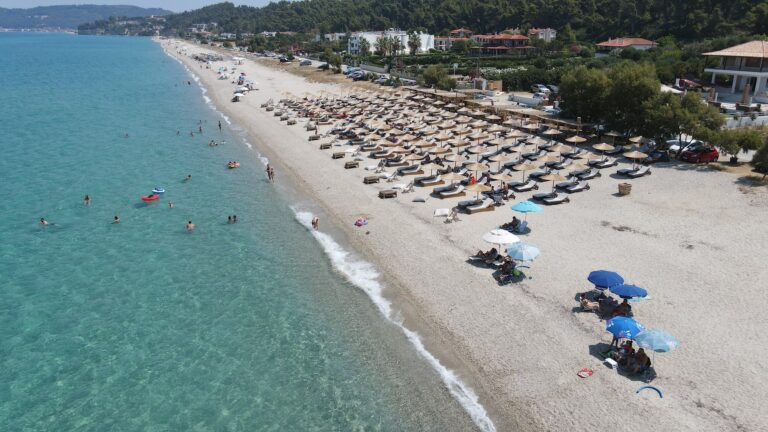
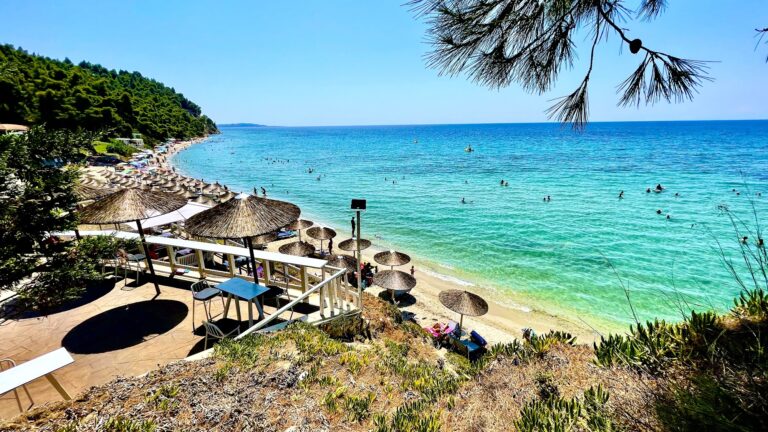
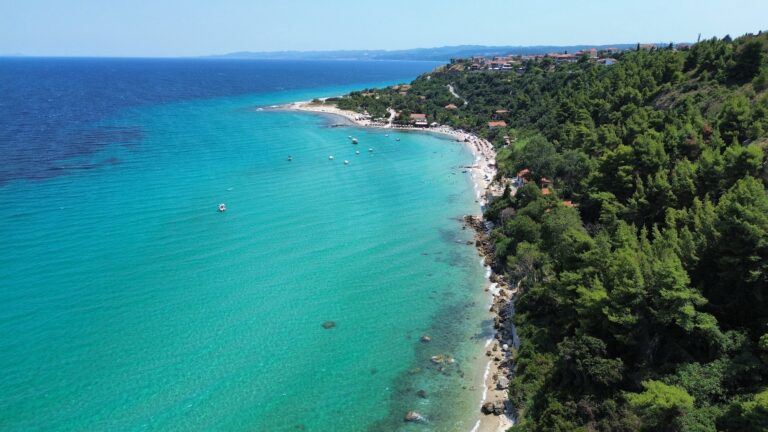
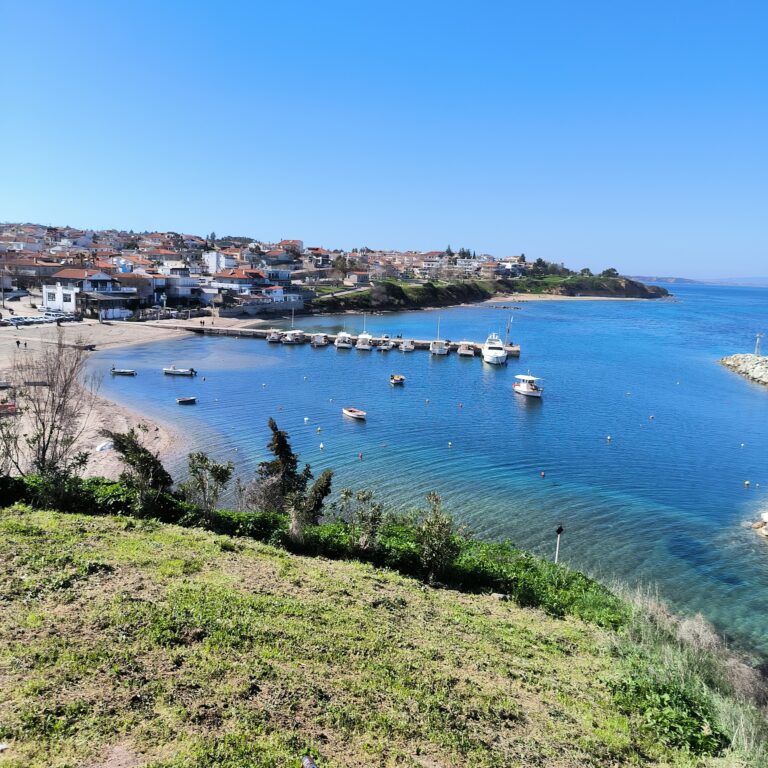
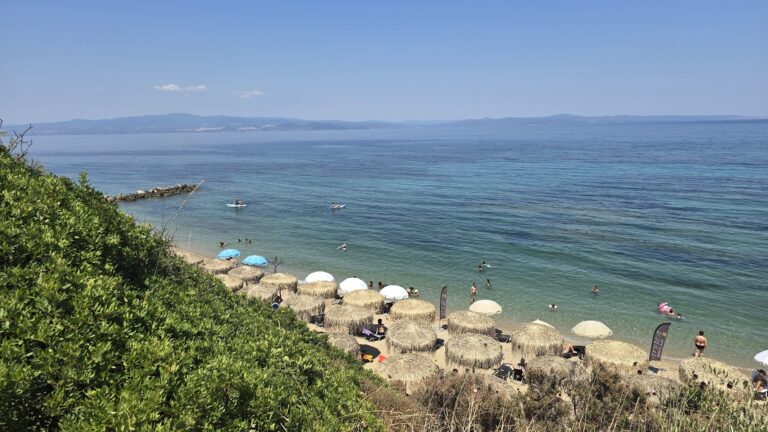
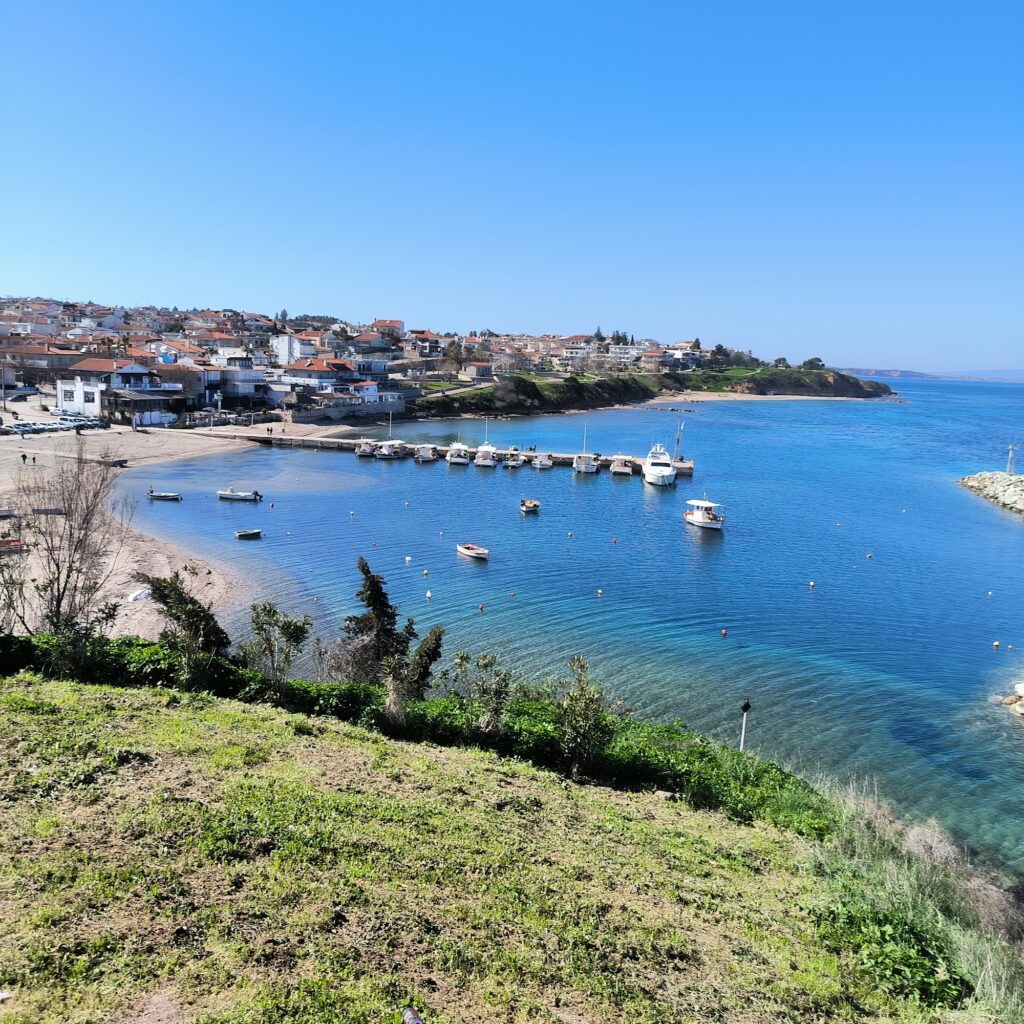
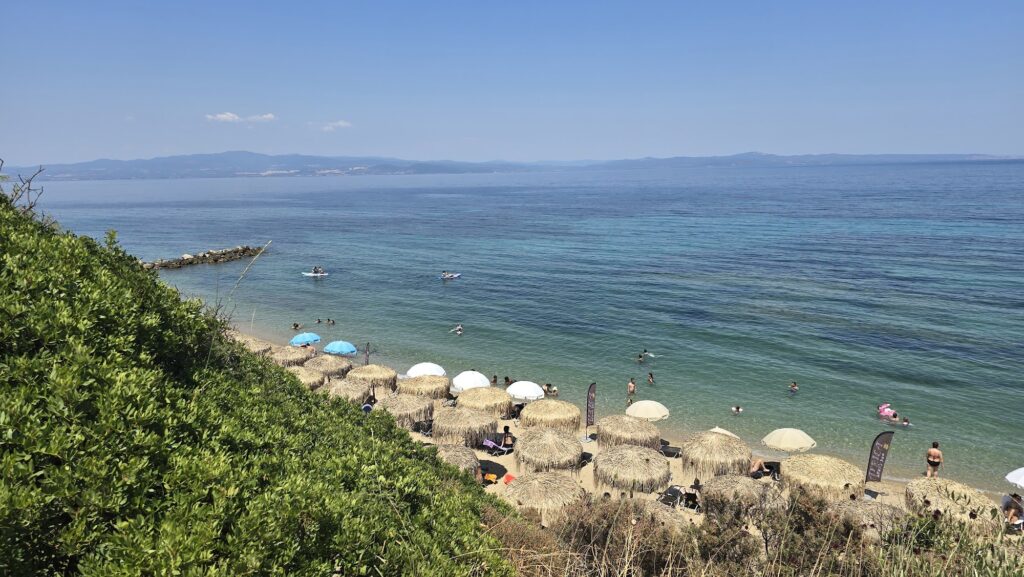
The beach itself is not the longest or the most obviously spectacular on the peninsula — the same accounts that describe the tower and the springs are candid that visitors looking purely for a sprawling sandy beach have better options nearby. What Nea Fokea offers instead is a compact, historically freighted waterfront with a working fishing harbour, traditional tavernas close to the water, and a beach character shaped by the fact that this is still partly a functioning village rather than a purpose-built resort.
The water around Nea Fokea is part of the NATURA 2000 wetland network, the surrounding coastal wetlands providing habitat for migratory birds and giving the area an ecological designation that the more developed resort stretches nearby cannot claim.
The Village: Refugees, a Central Square, and a Church That Named Itself Twice
Nea Fokea is one of the younger settlements on Kassandra by a considerable margin. It was founded in 1924 by refugees from Phocaea — ancient Foça, on the Aegean coast of what is now Turkey — as part of the population exchange that followed the Greek-Turkish War. On 2 October 1924, the settlers formally petitioned to name their new village Nea Fokea in honour of what they described as their “abandoned most historic” homeland. The community was officially constituted in 1928, with Nikolaos Paschalis as its first president.
The refugees from Phocaea had a dispute with themselves about what to name the church. The people from the old Phocaea, who identified as a seafaring community, wanted to dedicate it to Agios Nikolaos, patron saint of sailors. The compromise that eventually held was to name it jointly: Holy Church of Agios Nikolaos and the Assumption of the Virgin. The central square holds a monument to the Asia Minor refugees, a fountain dedicated to the settlement of 1925, and the church of Agios Ioannis, which occupies the site of the old monastery dependency. A pond with goldfish sits in the pine forest south of the village.
The Tower Up Close: Dimensions, Construction, and the Summer Programme
Walking up to the tower from the harbour takes less than ten minutes on a path that is steep but well-maintained. The stone is clearly old — not in a polished, restored way but in the way of something that has genuinely been standing for over six centuries, its surface uneven and darkened. The base dimensions of 7×7 metres make it appear narrower from below than the 17-metre height suggests, and the completeness of the upper crenellations, which no other tower in Chalkidiki has retained, gives it a functional rather than merely decorative profile.
The materials of ancient buildings are visible in the stone — pieces of earlier construction incorporated into the tower walls, the way most medieval builders in the Aegean region worked, stone being valuable enough to reuse rather than quarry fresh. Around the tower stand ruins of the east and south wing of the monastic dependency, and the small church of the Holy Apostles, built in 1868, occupies the same enclosure. Summer performances are held at the top of the tower as part of the Kassandra Festival programme.
What Sits Around Nea Fokea Beach
Kalithea Beach Kassandra Chalkidiki Greece, north along the same eastern coast, is the most directly comparable nearby beach — also historically significant, sitting above the sanctuary of Ammon Zeus where a hotel construction crew broke ground in 1968 and found a 4th-century BC temple. The two sites, Kalithea and Nea Fokea, represent different periods of the peninsula’s history within a short drive of each other.
Practical Notes for Visiting Nea Fokea Beach Kassandra Chalkidiki Greece
The Thokos café bar on the hill near the tower offers the best elevated view of the village and the water; the Massalia Restaurant on the central square has a more ambitious menu than the fish tavernas on the waterfront, with smoked eel, lavraki tartare, and mussels among the dishes that repeat in accounts of the place. The waterfront tavernas draw their fish from local boats that supply the restaurants daily, which is worth knowing when choosing between the two options.
The hot springs are most noticeably warm when the air is cool, which makes the beach worthwhile outside of the peak August heat in a way that many summer-only beach destinations are not. Nea Fokea in September, with the Kassandra Festival still running at the tower and the beach considerably less crowded than in July, is the specific combination that makes the most of what the village actually has to offer.
Map
Sorry, no records were found. Please adjust your search criteria and try again.
Sorry, unable to load the Maps API.
Near by places: