Karathonas Beach Nafplio: 3km Sandy, Coastal Path, Caves
Profile
Karathonas Beach, Nafplio: The 3km Sandy Blue Flag Beach Behind Palamidi, Reached by the 2.6km Coastal Path Under the Fortress That Passes Rare Endemic Peloponnese Plants and Three Hidden Coves
Greece | Karathonas | Nafplio, Argolida, Peloponnese
The Venetians built Palamidi fortress in three years — 1711 to 1714 — on the hill that rises 216 metres above Nafplio. The construction was a military engineering project of exceptional ambition: eight self-contained bastions connected by curtain walls, each capable of independent defence if the others fell. The staircase that descends from the fortress to the town below is popularly claimed to have 999 steps; the actual count is 857, but 999 has entered the local consciousness as the number and is repeated in every guide. The fortress fell to the Ottomans in 1715, one year after its completion — the engineering that had taken three years to build held for one year against an Ottoman force of 70,000. Nafplio subsequently became the Ottoman capital of the Peloponnese. The Venetians recaptured it in the 18th century, lost it again, and Nafplio became the first capital of independent Greece in 1821.
Karathonas beach is on the far side of the Palamidi hill from the town — the beach you cannot see from Nafplio’s historic centre because the fortress and the hill are between them. Reaching it by car takes 5 minutes, following the road around the base of the hill. Reaching it on foot takes 45 minutes, on the coastal path from Arvanitia beach that runs for 2.6 kilometres under the fortress walls along the cliffs.
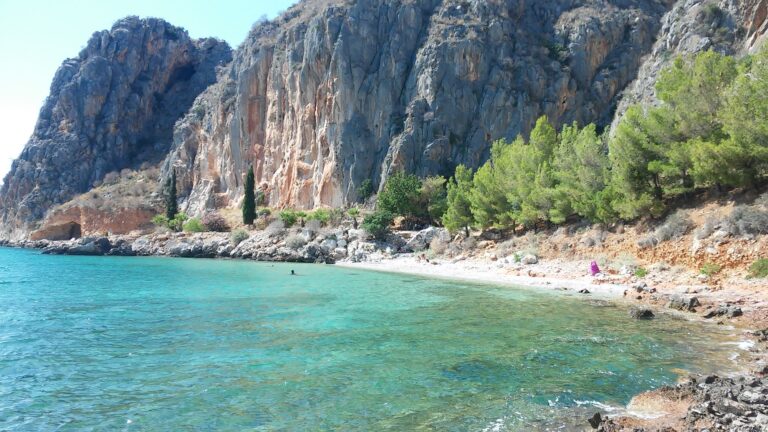
The coastal path is not only a route to the beach. It passes through a specific botanical environment — endemic plants of the Peloponnese identified in formal ecological surveys of the cliff vegetation: Campanula Andrewsii, Daphne, Erysimum Corinthium, Stachys Chrysantha, Stachys Swainsonii Argolica, Mediterranean scrub and macchia that stabilise the limestone cliff face. These are not cosmopolitan coastal plants; they are specific to this landscape.
Getting There: 5-Minute Drive Around Palamidi on 25 Martiou Street, or 45-Minute Coastal Walk From Arvanitia Beach, Free Parking at the Beach
By car from Nafplio centre, take 25 Martiou Street east and follow it around the base of the Palamidi hill. The road descends to the beach after 3 kilometres — the drive takes 5 minutes. A large free parking area runs parallel to the beach.
The coastal walk from Arvanitia beach (the town’s nearest beach, a 10-minute walk from the old town) follows the cliffside path southeast for 2.6 kilometres. The path is flat, well-marked, passes three small intermediate coves where swimming is possible from the rocks, and takes approximately 45 minutes at a moderate pace. The return route can follow the same path or ascend from Karathonas up to Palamidi and descend into Nafplio from the fortress — a longer circuit with the views from the ramparts included.
Local buses run from Nafplio bus station to Karathonas in summer.
The Beach: 3km Sandy Blue Flag, Eucalyptus and Palms, Very Shallow Gradual Entry, Windsurfing, Four Small Chapels
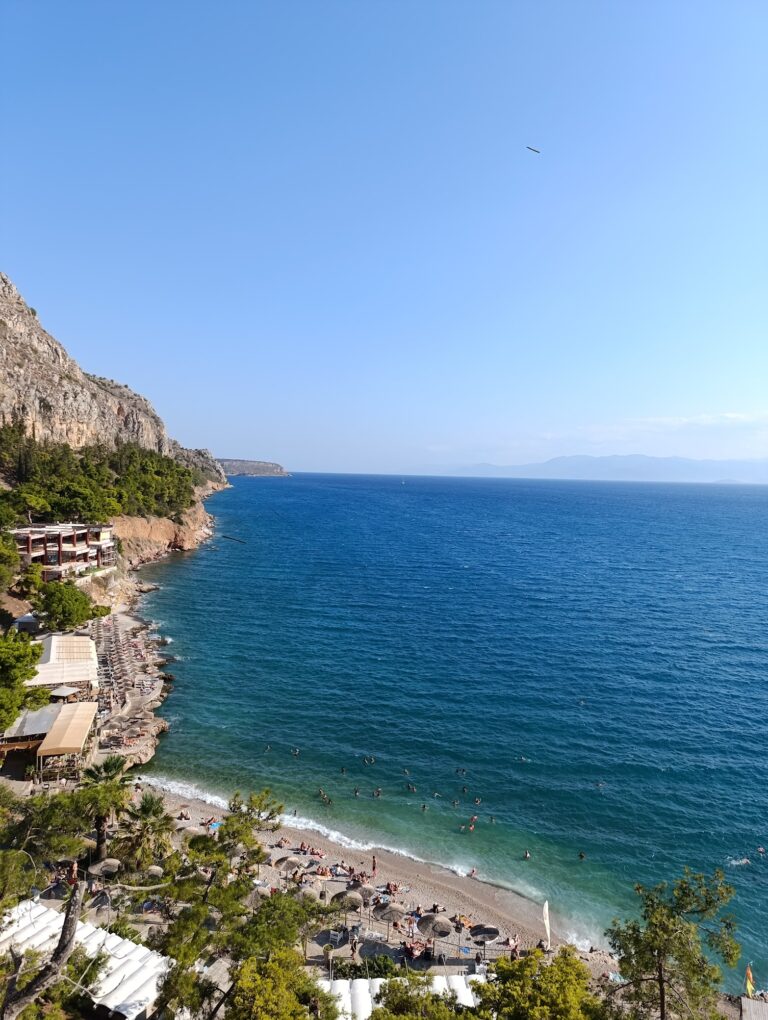
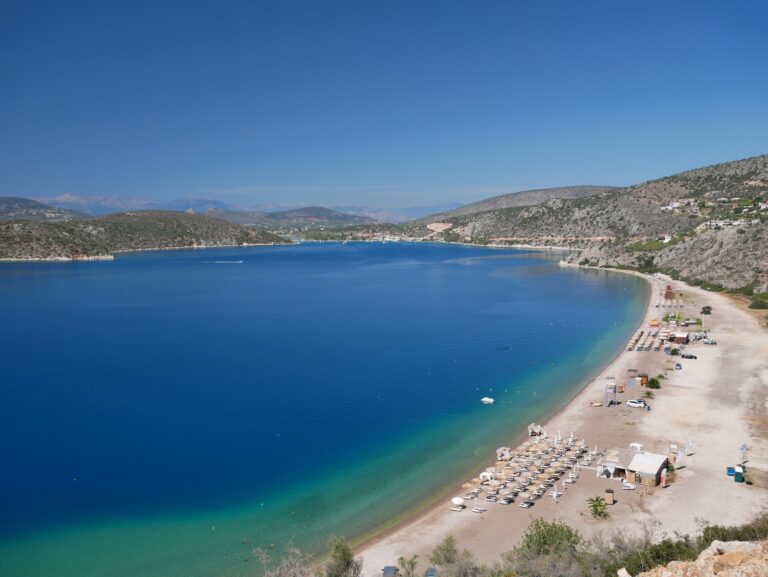
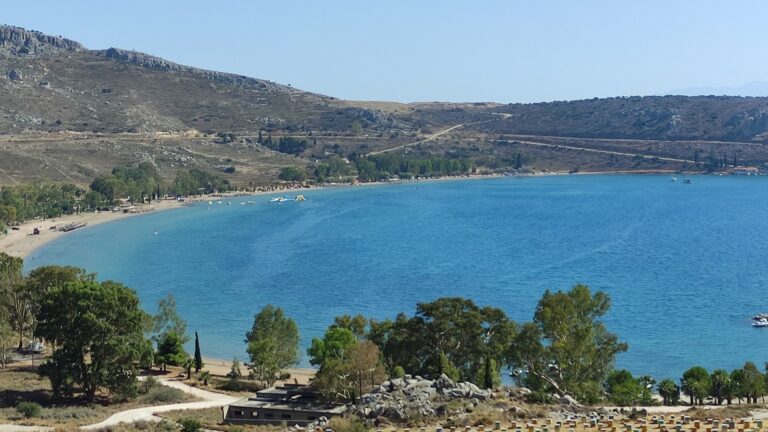
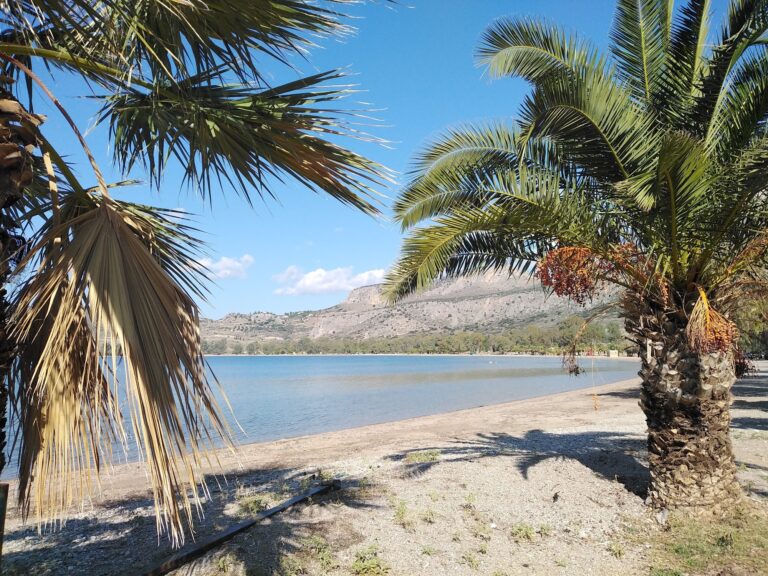
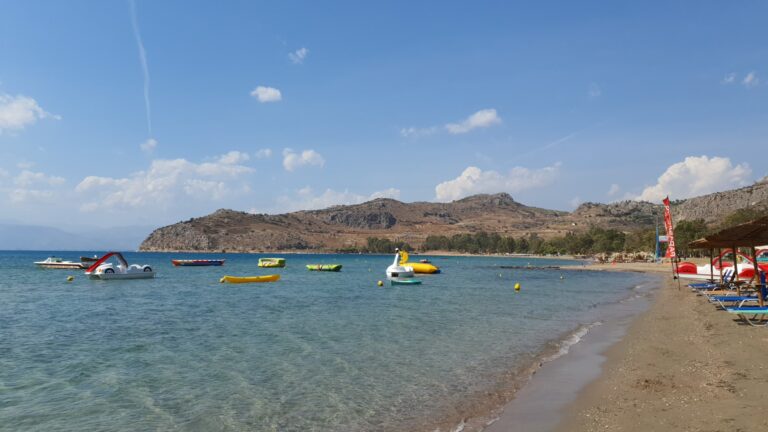
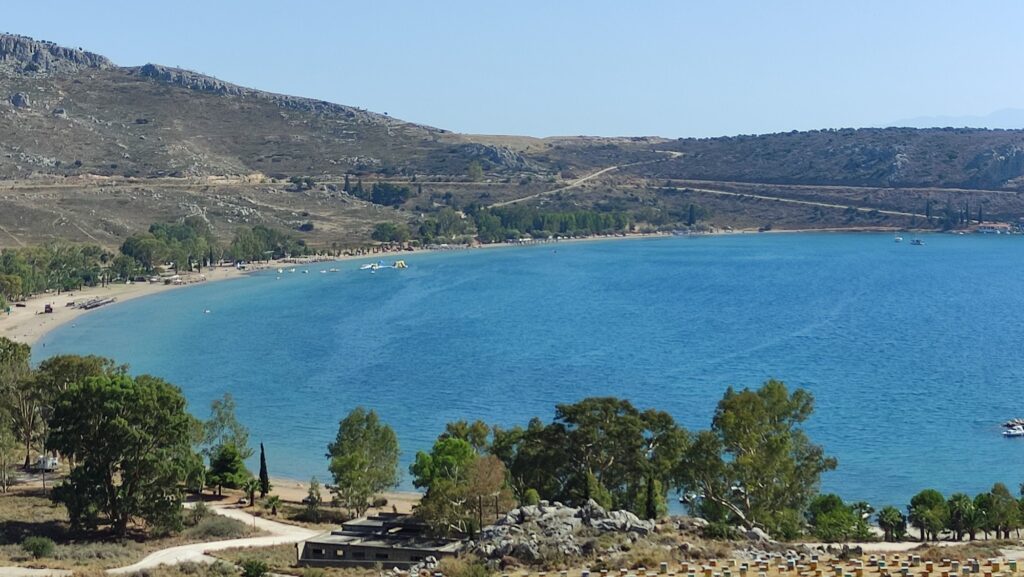
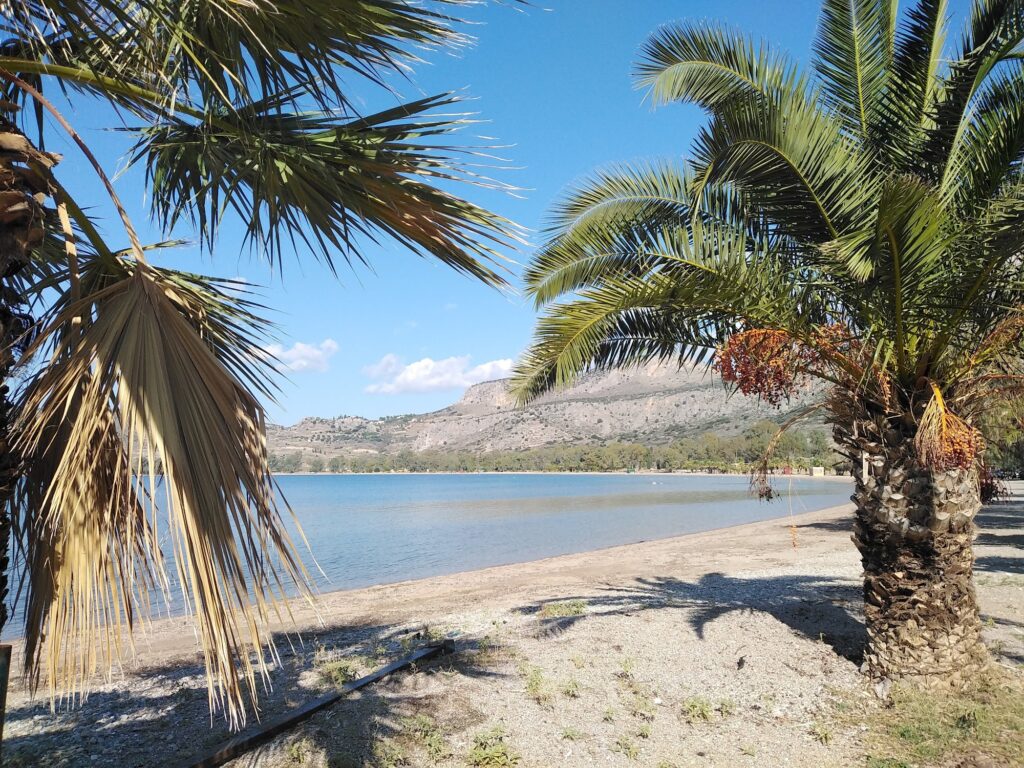
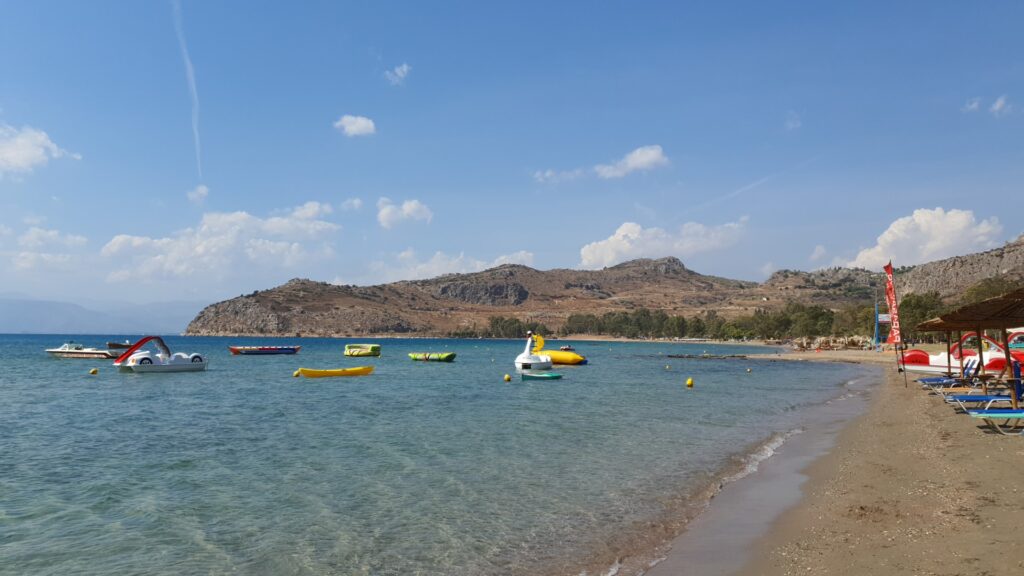
The beach is 3 kilometres long, the longest in the Nafplio area, with fine golden sand, very shallow and gradual entry, and the full Blue Flag standard of water quality and facilities. The eucalyptus and palm trees that line the beach in sections are the specific shade source — their fragrance is the sensory note that several visitor accounts mention alongside the sand and the castle view. The water is warm and clear, the bay well-protected by the surrounding hills from the winds that affect the outer Argolic Gulf.
Beach bars and tavernas line the beach road, with sunbeds and umbrellas from the various operators. Windsurfing and kayak equipment hire is available. Space between the organised sections is free — a consistent Greek beach quality that even organised beaches with several club operations maintain.
Four small chapels are located around the Karathonas bay — the specific detail from the visitnafplio.com guide. The chapel of Saint Konstantinos is at the small harbour on the left end of the beach. The chapel of Saint Nicholas, built on rocks above the sea at the southern end, is reached from the harbour by a 500-metre path.
Panagia Katakrymeni: The Cave Chapel Beyond the Beach
Beyond the southern end of Karathonas bay, a gravel path continues along the cliff to the Panagia Katakrymeni — the “Hidden Virgin Mary” — a chapel built inside a natural cave in the limestone cliff face. The cave chapel is only fully visible when you are standing at the path directly outside it; from the beach and the sea it is concealed in the cliff. The path from the beach takes approximately 10 minutes. The name refers to the concealment — the chapel hidden in the rock.
The Three-Beach Nafplio Circuit: Arvanitia, Karathonas, and the Coastal Path Between Them
Arvanitia is the town beach — small, pebbled, rocky edges, within 10 minutes’ walk of Syntagma Square, cafes and sun loungers, lifeguard. The beach is small and popular; it fills on weekends. Its value is the proximity to the town and the view of Akronafplia castle directly above.
The path from Arvanitia to Karathonas is the specific reason to walk rather than drive. The three small intermediate coves — reachable from the path by stepping down to the water — are unnamed and uncrowded. They provide the swimming experience between the two main beaches that neither has, as the path itself is not the swimming location but the access to them.
Tolo Beach Nafplio Greece — the 2km fine sandy beach 10km south of Nafplio, with the three offshore islands (Koronisi, Romvi, Daskalio — the secret school island), the Cretan refugee foundation of 1824, and the Trawler Festival in late September — is the comparative in this series: the other major Nafplio area beach, of different character and history.
Nafplio: The First Capital, the Bourtzi Castle, the Palamidi Fortress
Nafplio was the first capital of independent Greece from 1821 to 1834 — the city where Ioannis Kapodistrias, the first Governor, was assassinated in 1831 and where the Bavarian King Otto ruled until the capital moved to Athens. The Bourtzi island castle — visible from the beach across the Argolic Gulf — was used as a residence for the fortress’s executioner in the Ottoman period and as a luxury hotel in the 20th century before returning to public ownership. The Syntagma Square archaeological museum holds finds from Tiryns and Mycenae.
Karathonas Beach at Nafplio is the 3km Blue Flag sandy beach behind Palamidi fortress — 5-minute drive around the hill or 45-minute coastal walk from Arvanitia beach (2.6km path past endemic Peloponnese flora and three hidden coves), eucalyptus and palm shade, very shallow gradual entry, windsurfing and kayak hire, four small chapels on the bay, Saint Nicholas chapel on the rocks at the south end, Panagia Katakrymeni cave chapel 10 minutes further on the cliff path, free parking, summer buses, and Tolo beach 10km south.
Drive 5 minutes around the hill. Or walk 45 minutes under it. Both arrive at the same sand.
Map
Sorry, no records were found. Please adjust your search criteria and try again.
Sorry, unable to load the Maps API.
Near by places: