Plaža Dječji Raj Sukošan: Best Family Beach Zadar Region
Profile
Plaža Dječji Raj, Sukošan: The Beach That Actually Delivers on Its Name
Croatia | North Dalmatia | Zadar Region Beaches
Beach names on the Croatian coast tend toward the aspirational. Golden this, Paradise that — the language of tourism promotion applied liberally to places that are, in the main, perfectly good pebble beaches with clear water and acceptable facilities. Plaža Dječji Raj — Children’s Paradise Beach — in the small coastal town of Sukošan, approximately fifteen minutes south of Zadar, is one of the rare cases where the name turns out to be a description rather than a claim.
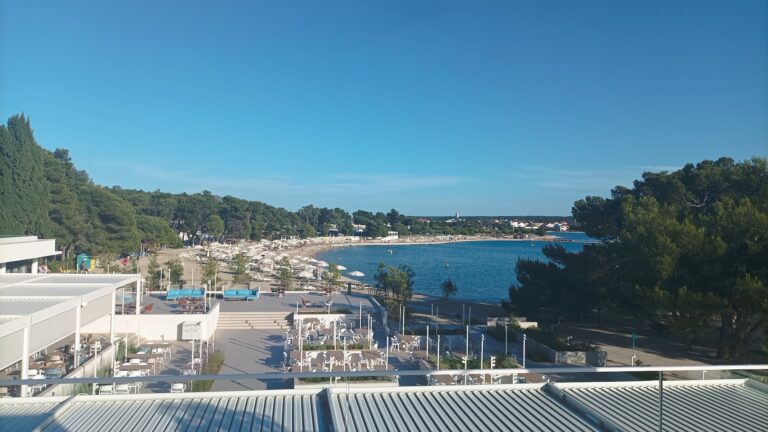
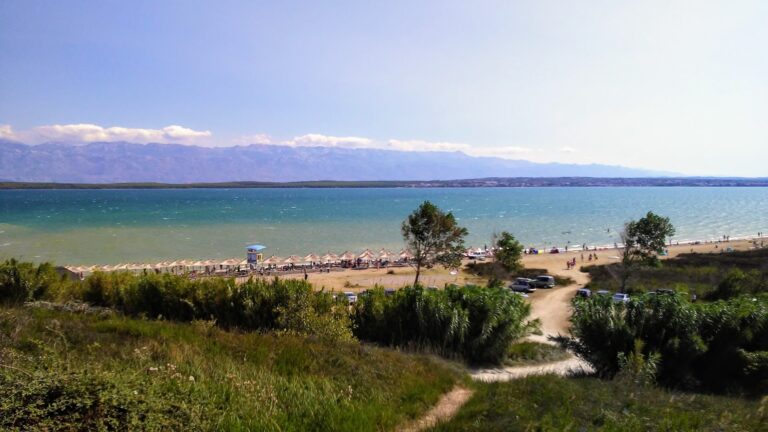
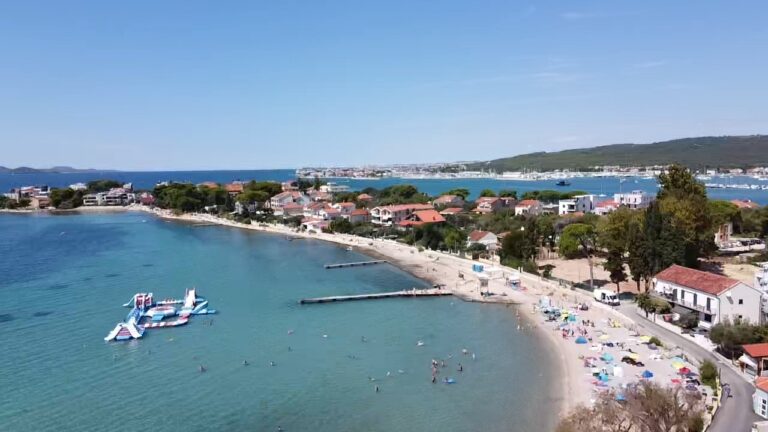
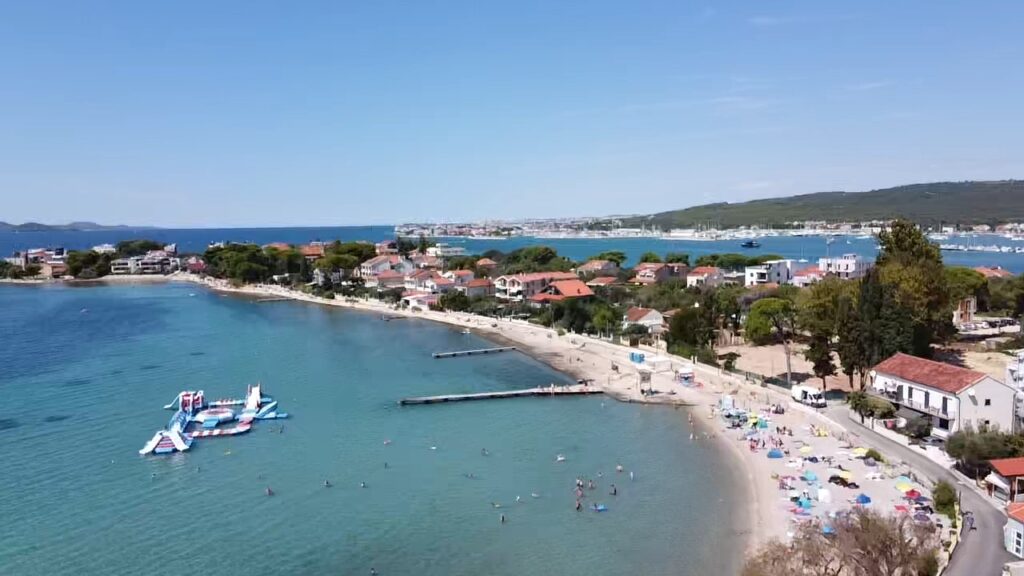
I arrived on a Tuesday morning in late July, having driven south from Zadar along the coastal road with modest expectations and a generalised scepticism about beach names in the superlative register. What I found in the sheltered arc of Zlatna Luka — Golden Harbour — was a beach so specifically and thoroughly configured for young children and their parents that the name, far from overstating the case, almost understates it. The shallows here extend so far from the shore, in water so warm and so clear, that the beach functions less like a coastal destination and more like a very large, very clean, open-air swimming pool with a Dalmatian view.
Getting There: Straightforward from Zadar
Getting to Plaža Dječji Raj from Zadar is one of the simpler logistics in this part of the coast.
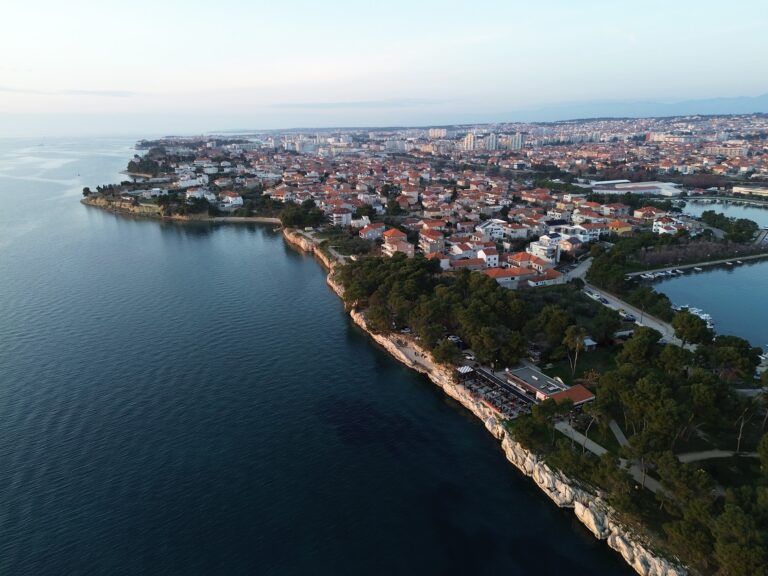
By car, the coastal road south from Zadar reaches Sukošan in ten to fifteen minutes depending on summer traffic. Public parking is available near the beach entrance and in the town generally — filling progressively through the morning on peak summer days, so arriving before ten is the standard practical advice. The drive itself follows a pleasant stretch of the northern Dalmatian coast with the sea visible to the left and the low hills of the hinterland to the right.
Regional bus lines connect Zadar main station with Sukošan regularly throughout the day, stopping close enough to the beach for the walk to be short and level. For visitors based in Zadar without a car, this is an entirely practical option for a full beach day. For those already staying in Sukošan, the beach is the natural centre of the town’s waterfront and reachable on foot from any accommodation in the immediate area.
The Harbour Setting: Why the Geometry Matters
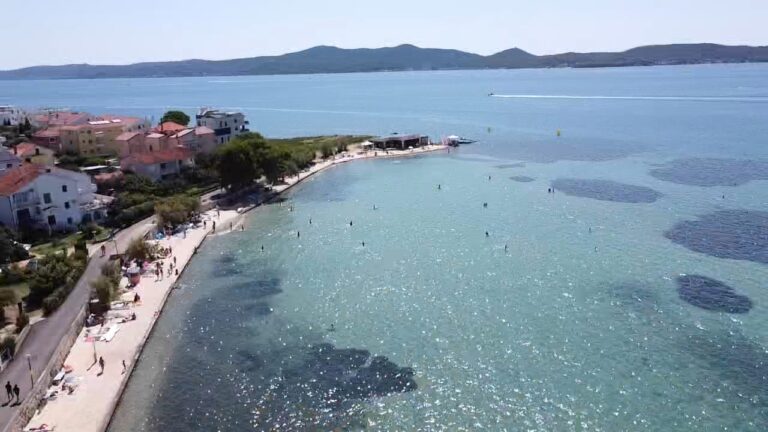
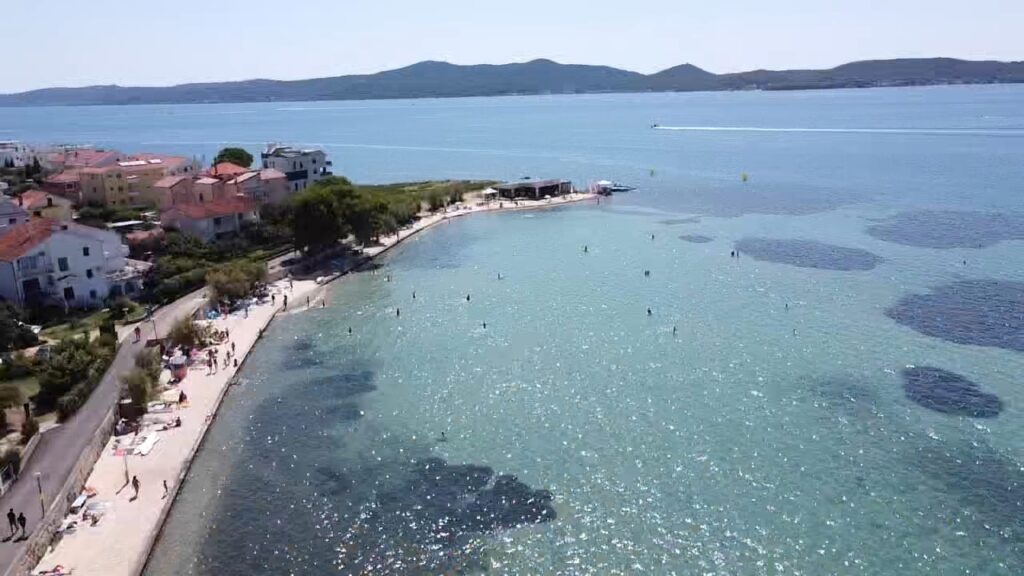
The specific quality that makes Plaža Dječji Raj exceptional for families with young children is not primarily a feature of the beach itself but of the bay that contains it. Zlatna Luka — Golden Harbour — is a deeply sheltered coastal inlet whose enclosed geometry produces two practical consequences that shape everything about the swimming experience here.
The first is the absence of meaningful wave action. The harbour’s protected position keeps the water inside it in a state of near-permanent calm — the kind of still, glassy surface in the mornings and gently rippled surface through the afternoon that only genuinely enclosed water bodies produce. For parents of toddlers and very young children, this means a swimming environment without the unpredictable energy of open-sea beaches, where a wave arriving at the wrong moment can turn a pleasurable paddling session into a frightening one.
The second consequence is water temperature. Shallow, enclosed, south-facing water in a protected harbour heats through the summer to temperatures that open-sea beaches simply do not achieve. By mid-July, the shallows at Children’s Paradise Beach Sukošan are genuinely warm — the kind of temperature that eliminates the cautious entry ritual that colder Adriatic water requires and that allows very young children to move freely in the water without the cold being a practical obstacle.
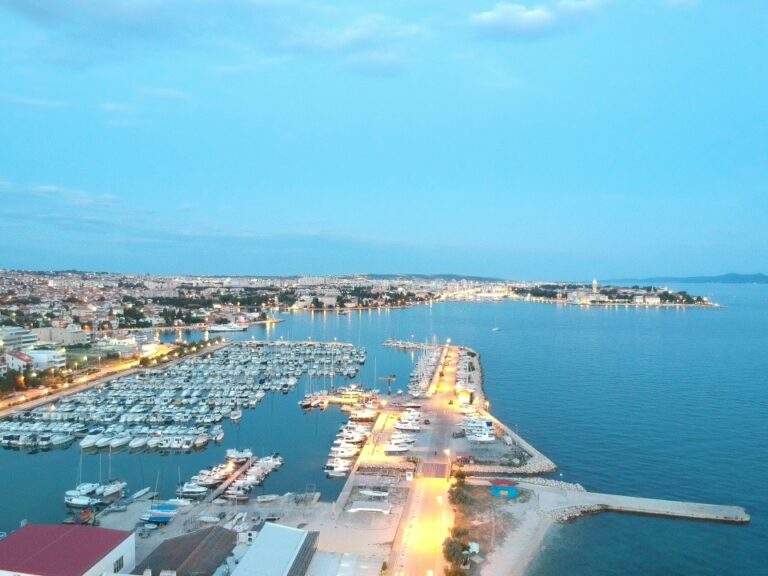
The Marina Dalmacija — one of the larger marina facilities on the northern Dalmatian coast — sits adjacent to the harbour, and the masts of the moored sailing yachts are visible from the beach throughout the day. It is a detail that adds a particular visual character to the setting and gives the horizon of the bay a distinctive quality — the white hulls and rigging of the marina against the open water of the channel beyond.
The Shore and Water Quality
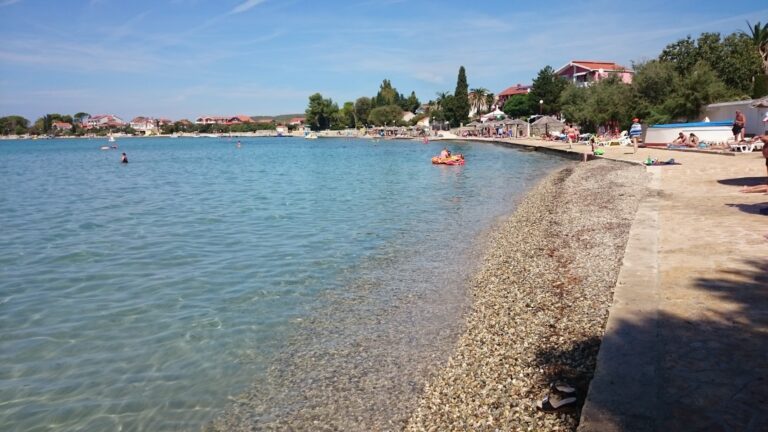
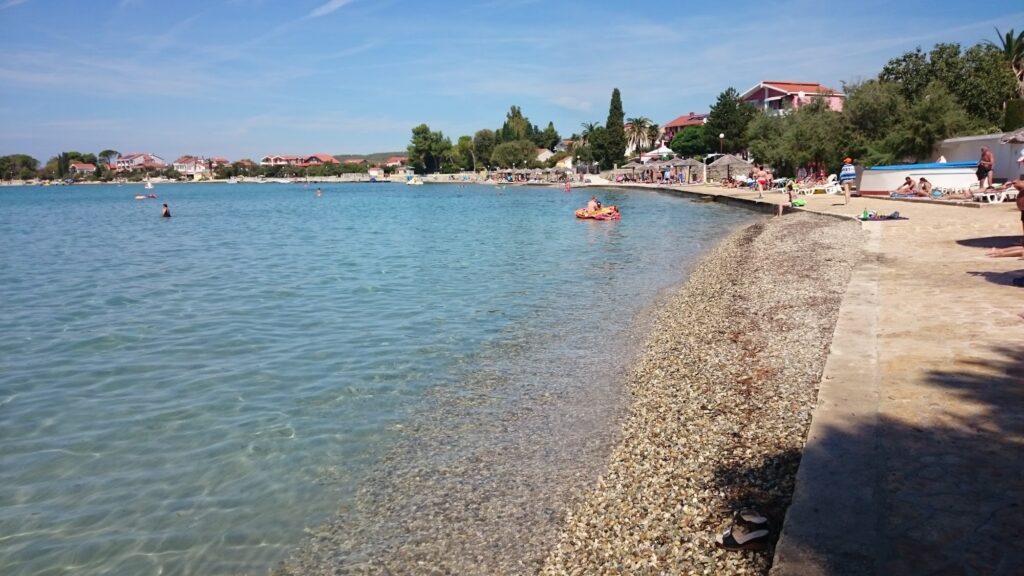
The shoreline at Plaža Dječji Raj is fine, smooth pebbles transitioning to a sandy seabed as the water depth increases — a combination that provides a clean, comfortable surface on the shore and a soft, foot-friendly underwater surface from the point of entry. The sandy seabed extends for a considerable distance from the shore, maintaining gentle depth through a wide zone that keeps the water at knee height for a surprisingly long distance from the waterline.
That extended shallow zone is the defining practical feature of the beach. Children can walk into the sea, and keep walking, without the depth changing meaningfully for far longer than they can at most Dalmatian beaches. For parents of children between the ages of one and five, this is the single most valuable quality a beach can possess, and Dječji Raj delivers it more completely than anywhere else I have visited in the Zadar region.
The water quality at Children’s Paradise Beach is consistently maintained and clearly prioritised — clean, transparent, and warm in a combination that the harbour’s enclosed character sustains naturally. The clarity is excellent throughout the bay, the sandy bottom visible from the surface in the characteristic way of clean, shallow Adriatic water, and the overall impression on entering is of a sea that is entirely comfortable and entirely safe.
Facilities: Built Around Family Needs
Plaža Dječji Raj facilities are organised with the specific orientation of a beach that has committed fully to its family identity and has aligned its infrastructure accordingly.
Freshwater showers and changing cabins are positioned accessibly along the waterfront. Sunbeds and umbrellas are available for hire at various points along the shore. Certified lifeguards monitor the swimming zones from elevated stations during peak summer months — a provision that the beach’s popularity with families makes not merely advisable but essential, and that the local municipality maintains with apparent consistency. Well-maintained public restrooms are available near the beach and easy to locate.
The aqua park at Dječji Raj — a substantial inflatable structure anchored in the bay — is the facility that most clearly signals the beach’s orientation and that generates the most sustained active engagement from the older children and teenagers who use it. On both mornings of my time at the beach, the aqua park was occupied from its opening through the full midday hours by a rotating group of children whose enthusiasm showed no sign of diminishing. Pedalo rentals and sea kayaks are available for families wanting to explore the calm harbour water at a gentler pace.
Playgrounds positioned near the beach provide the supplementary land-based activity that rounds out a full day for young children who have temporarily exhausted their interest in the water — which, at Dječji Raj, with its warm shallows and aqua park, tends to take longer than at most beaches but eventually arrives regardless.
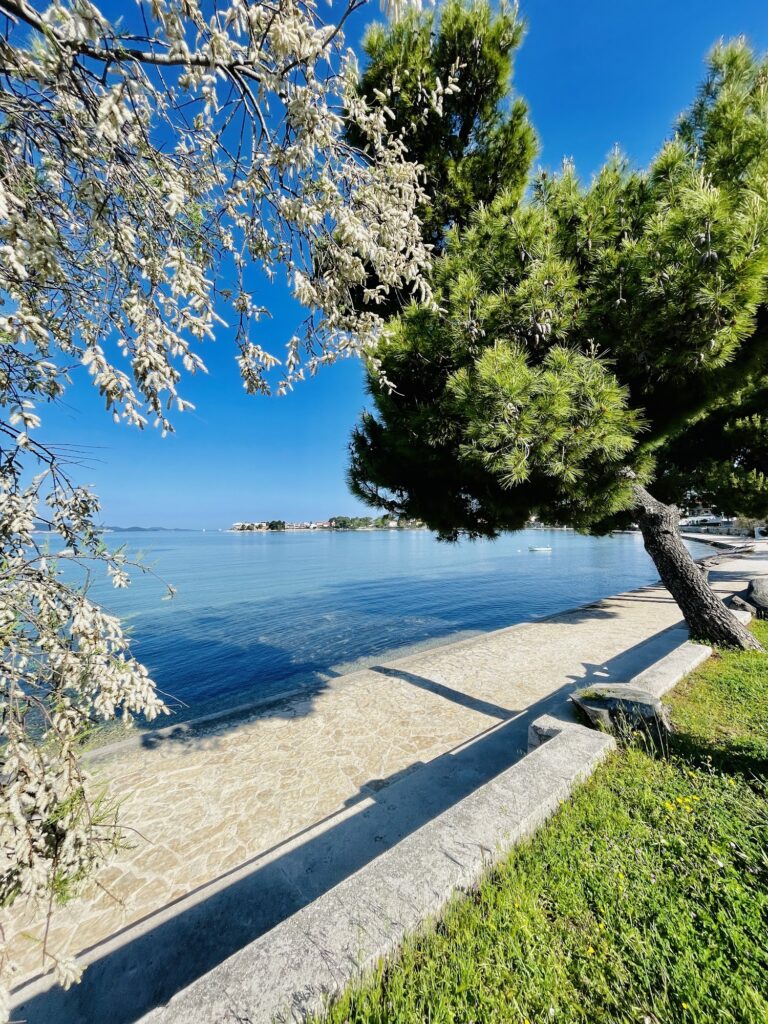
The beach’s practical limitation is shade — the shoreline itself has limited natural tree cover, which makes midday sun management a more active consideration than it is at pine-backed beaches elsewhere in the region. Hired umbrellas are the straightforward solution, and the proximity of the town’s cafés and shaded terraces means that a retreat from direct sun never requires leaving the immediate beach environment.
For Families: The Case in Full
Plaža Dječji Raj with children is the strongest family beach in the Zadar region and, for families with very young children specifically, one of the most comprehensively suitable beaches in the whole of northern Dalmatia. The case does not rest on any single quality but on a combination that is genuinely difficult to find assembled in a single location.
The extraordinarily shallow entry — walkable for tens of metres at knee height — is the foundational advantage. The warm, enclosed harbour water removes the cold-entry problem. The absence of wave action eliminates the most common source of distress for very young swimmers. The sandy seabed removes the sharp pebble difficulty that most Dalmatian beaches present for small bare feet. The aqua park keeps older children engaged through the full day. The lifeguard presence provides formal supervision. The playgrounds provide land-based alternatives. The town proximity keeps practical supplies within minutes.
Each of these would be a meaningful advantage individually. Together, they produce a beach that functions as the answer to almost every question a parent with young children asks about what to look for in a Croatian beach day.
Food and Drink
The beach bars and restaurants along the Sukošan waterfront serve the day with competence and genuine local identity. Morning coffee at a table looking toward the marina and the open channel beyond it is a pleasant and unhurried beginning to a beach day — the yachts visible in the adjacent berths, the water of the harbour still in the early light, the first swimmers already in the shallows.
For a full meal, the konobas and bistros along the waterfront and in the town centre offer the standard Dalmatian coastal cooking that this part of the coast does with reliability if not with the distinctive regional identity of more remote locations — fresh calamari, grilled fish, local salads dressed with good olive oil, the food of a small Dalmatian town that sources its ingredients locally and prepares them without unnecessary complication.
The social rhythm of the waterfront through the day follows the arc of the beach itself — quiet and unhurried in the morning, animated and family-busy through the midday hours, gradually settling into the more relaxed pace of the early evening as the beach empties and the families with young children make their way back to wherever they are staying. The bars handle that evening transition well, and a cold drink on the terrace as the harbour light softens in the late afternoon is a satisfying conclusion to the kind of thoroughly active day that Dječji Raj tends to produce.
Sukošan and the Surrounding Area
Sukošan is a small town with a quality of life that its proximity to Zadar and its position on the northern Dalmatian coast combine to support well — good water, accessible services, the marina providing a year-round community of sailing visitors that gives the place a slightly more cosmopolitan character than a purely agricultural or fishing village would have.
For visitors using the beach as part of a broader stay in the Zadar region, the town’s position on the coastal road makes it a natural inclusion in a day that might also involve the old town of Zadar — the Roman forum, the Church of St. Donatus, the famous sea organ — or the beaches and landscape of the Kornati Islands accessible by excursion boat from the Zadar waterfront. The combination of a morning at Dječji Raj with an afternoon in Zadar old town is a particularly well-matched pairing that uses the short driving distance between them efficiently.
Plaža Dječji Raj in Sukošan earns its name in a way that most optimistically-titled Croatian beaches do not. The extraordinary shallows, the enclosed warm water, the sandy seabed, the aqua park, the lifeguard coverage, the playground provision — all of it is specifically and consistently oriented toward the experience of a family with young children rather than toward the broader beach-going public that other beaches serve more generically.
For parents travelling the northern Dalmatian coast with children under ten, particularly with toddlers and early swimmers for whom the depth and temperature of the water is the primary practical consideration, Sukošan and Dječji Raj represent the most complete answer the region offers. The drive from Zadar takes fifteen minutes. The name tells you exactly what you are going to find.
For once, it is entirely accurate.
Map
Sorry, no records were found. Please adjust your search criteria and try again.
Sorry, unable to load the Maps API.
Near by places: