Zlatni Rt Golden Cape Rovinj: Forest Park and Coast
Profile
Zlatni Rt (Golden Cape) Forest Park, Rovinj: The Six-Pointed Cedar Star and the Coast of the Sun
Croatia | Rovinj | Istrian Peninsula
In 1908, Georg Hütterott published a brochure. Its title was Klimatischer Kurort Cap Aureo bei Rovigno – Istrien. Ein Projekt — A Climatic Health Resort at Cape Aureo near Rovinj, Istria. A Project. The cape he had been transforming since 1890 was what is now called Zlatni Rt, or Golden Cape, and the “coast of the sun” that Hütterott described in his project was the forested peninsula immediately south of Rovinj that he had been systematically planting with pine, cypress, laurel, Himalayan cedar, Lebanese cedar, Douglas fir, Ginkgo biloba, and eucalyptus over the preceding two decades. He died in 1910, two years after publishing the brochure. The health resort was never built. The park was declared a special nature site in 1948 and officially protected as a forest park in 1961.
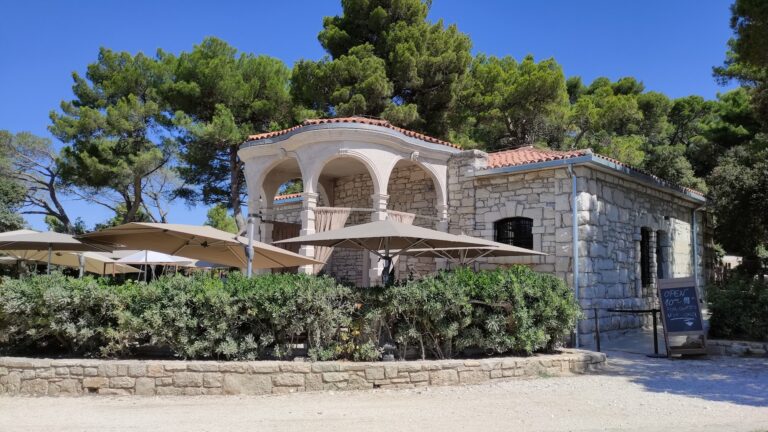
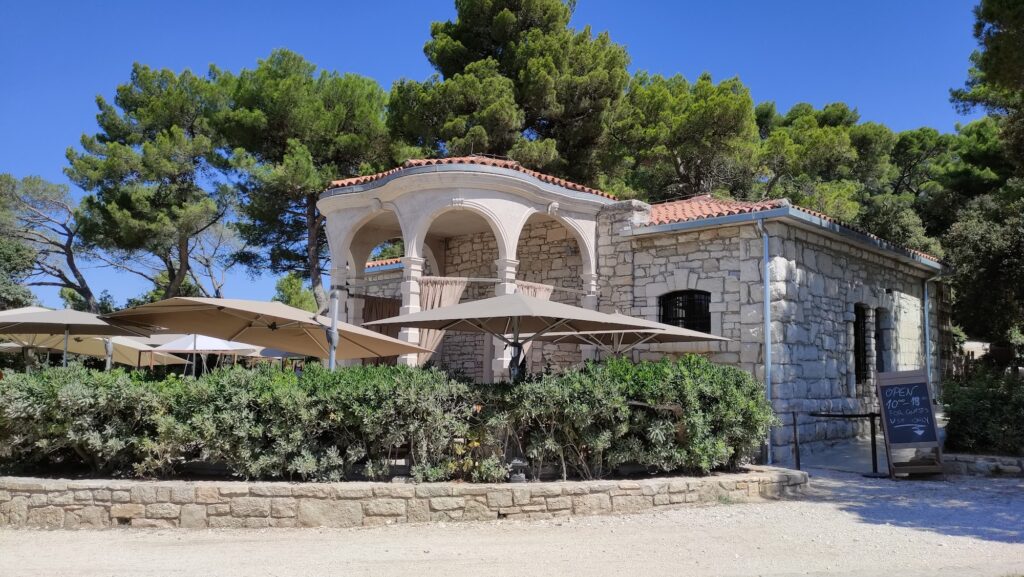
What Hütterott left behind was the botanical collection that makes Zlatni Rt unusual rather than merely beautiful — not a natural Istrian coastal forest but a designed landscape planted by a Trieste entrepreneur who had the sensibility of the English landscape park tradition in mind when he positioned the trees. In front of the Punta Corrente meadow, tall and beautiful Himalayan cedars are arranged in a six-pointed star — a planted geometric figure that only becomes legible from above or from a specific angle on the path. The quarry he used to supply stone — the old quarry in the park whose walls are now the free-climbing site — supplied stone for Venice’s buildings. His wife’s pavilion and the forest ranger’s house remain in the park. The old docks, the drystone walls, the perimeter wall that marked the boundary of his property: all still present within the forest.
Getting There: 15 Minutes on Foot from the Old Town, by Bicycle, or by Car to the Monvi Parking
From Rovinj old town, Zlatni Rt is a 15 to 20-minute walk south along the coastal promenade — the same path that passes Mulini Beach in Lone Bay before continuing into the forest park. The entrance to the park proper begins where the hotel zone south of the town ends and the pine canopy starts. The walk from the old town through Lone Bay and into Zlatni Rt follows the sea continuously, with the forest beginning gradually rather than at a formal entrance gate.
By bicycle, the park is accessible in five minutes from the central area and is specifically recommended for cycling — the unpaved paths through the park are suitable for mountain bikes and e-bikes, and the coastal trail south of Rovinj through Zlatni Rt is one of the most scenic cycling routes on the Istrian west coast. Bicycle rentals are available throughout Rovinj, and the combination of cycling and swimming at the park’s coves is the standard full-day programme for visitors with moderate fitness.
By car, the nearest parking is the Monvi car park at the edge of the park, from which the paths into the forest interior are accessible on foot. Driving directly into the park is not possible; the forest trail network is pedestrian and bicycle only.
The Forest: 54 Hectares, Over 120 Species, and the English Landscape Tradition
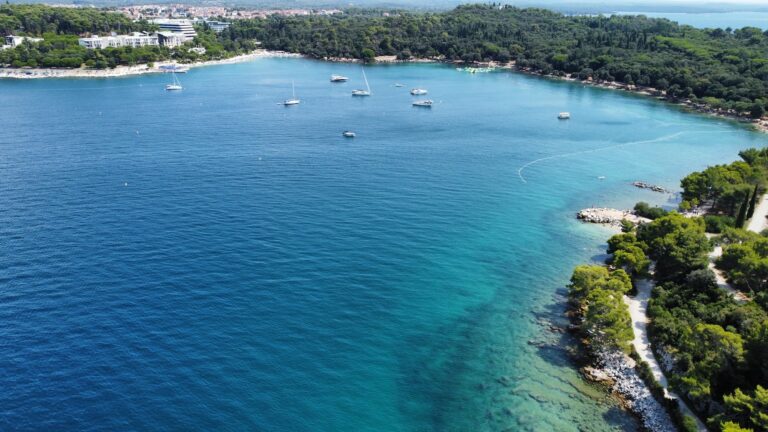
Zlatni Rt covers approximately 54 hectares of peninsula south of Rovinj. The most common tree types are pine, cypress, and laurel, with exotic species including Lebanese cedar, Douglas fir, Ginkgo biloba, and eucalyptus that Hütterott received as gifts or brought from his travels. The park contains over 120 plant species in total — a botanical diversity that exceeds any natural coastal forest on the Istrian coast at comparable scale, produced by 20 years of deliberate planting by someone with the resources and the horticultural ambition to make a designed landscape rather than simply clear land.
The six-pointed star of Himalayan cedars on the Punta Corrente meadow is the single most architecturally deliberate feature of the park — the moment where Hütterott’s design intention is most visible and most strange. A geometric figure planted in living trees on a coastal meadow, intended to be read as a composition rather than a random stand. The cedars are now mature and the star configuration requires knowing it is there to identify it in the landscape; it does not announce itself from the path.
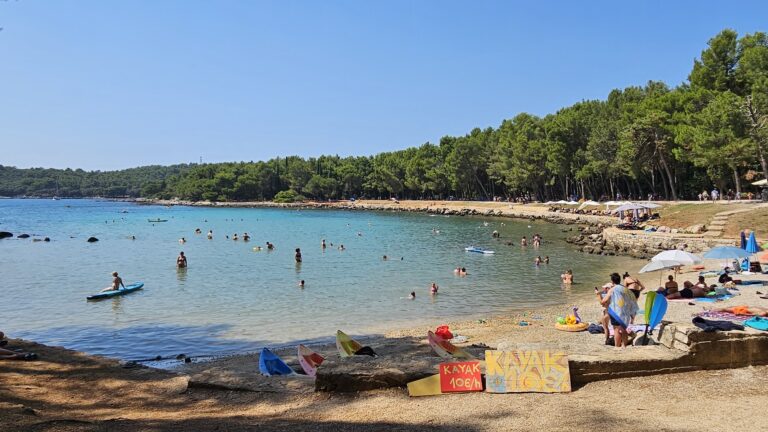
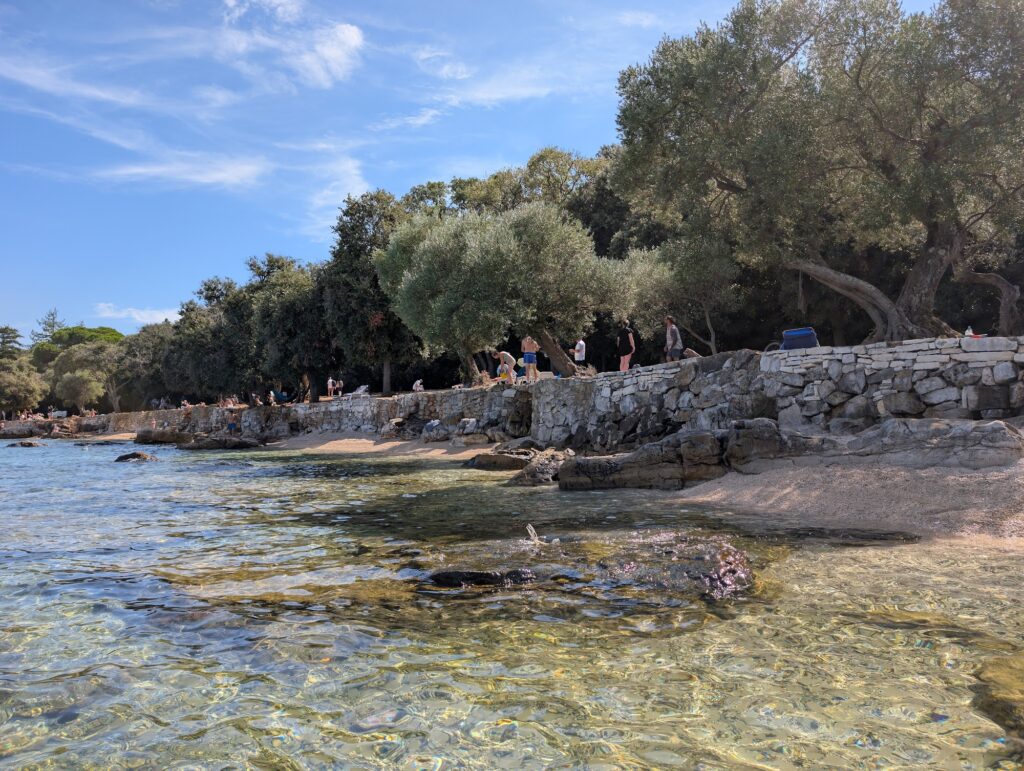
The shade quality under the mature canopy of mixed conifers and exotic species on a hot Istrian summer day is the specific physical benefit of Hütterott’s planting project — the microclimate that his 1908 brochure described as clinically beneficial is present and real. The forest runs to the edge of the coast at most points, meaning that the beaches and swimming coves of Zlatni Rt are shaded beaches, which is the quality that makes them categorically different from the exposed rock platforms of Plaža Balota in the old town above.
The Beaches: Rocky Platforms, Pebble Coves, and the Lone Bay Transition
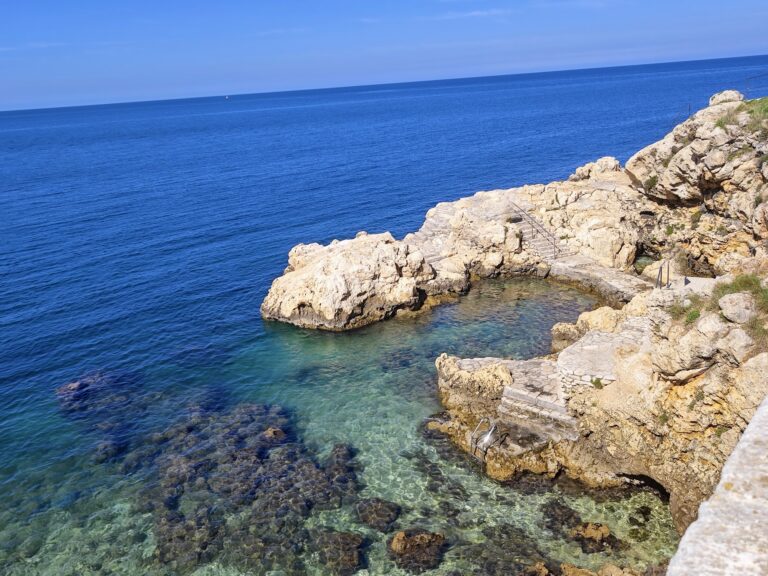
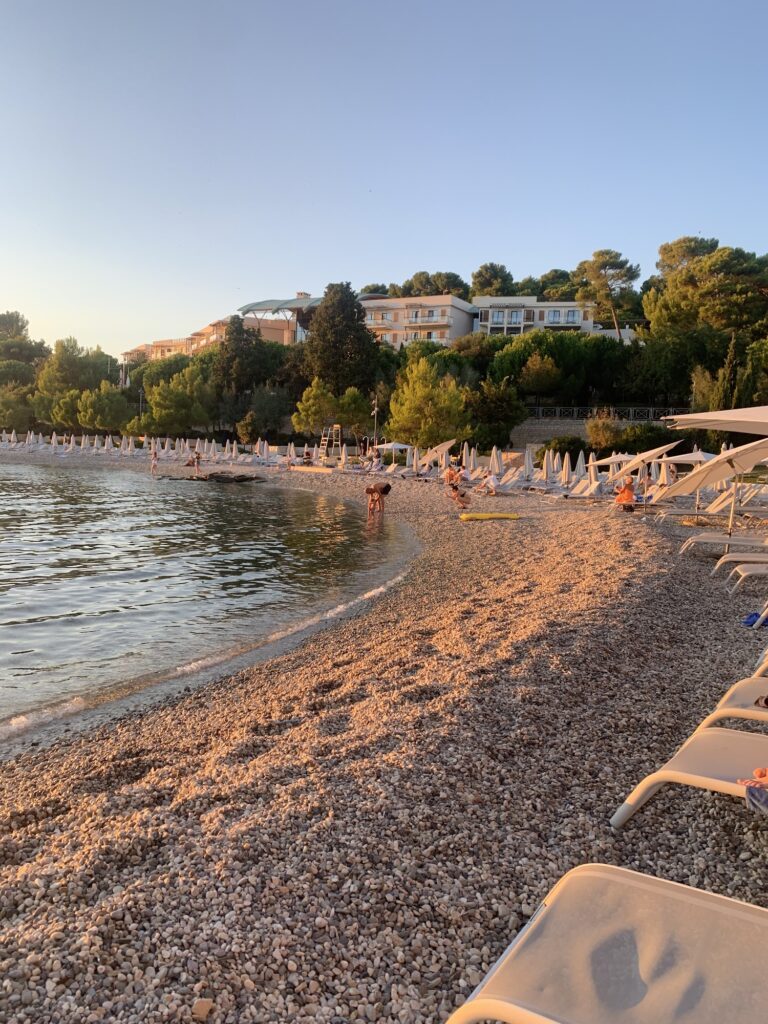
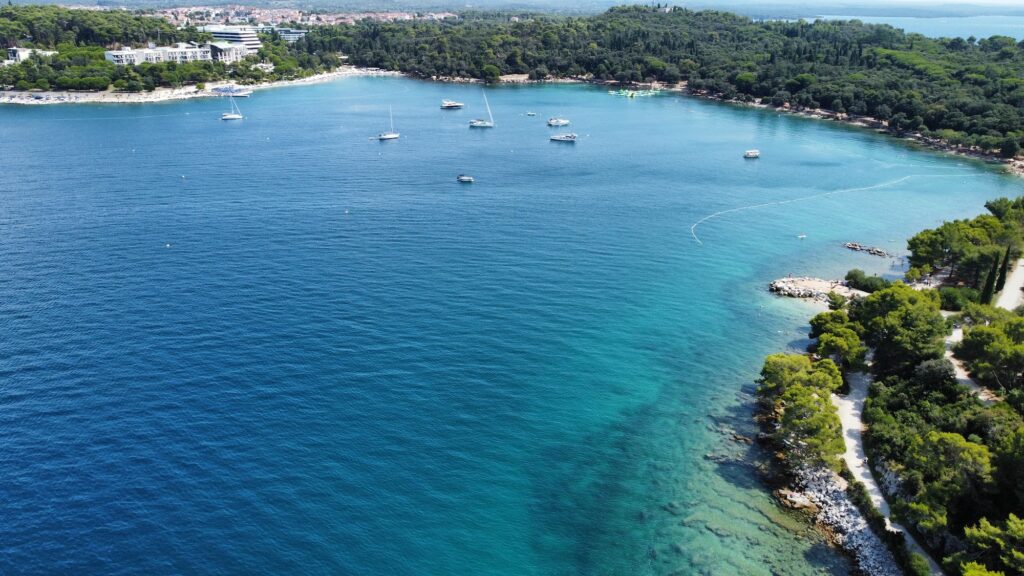
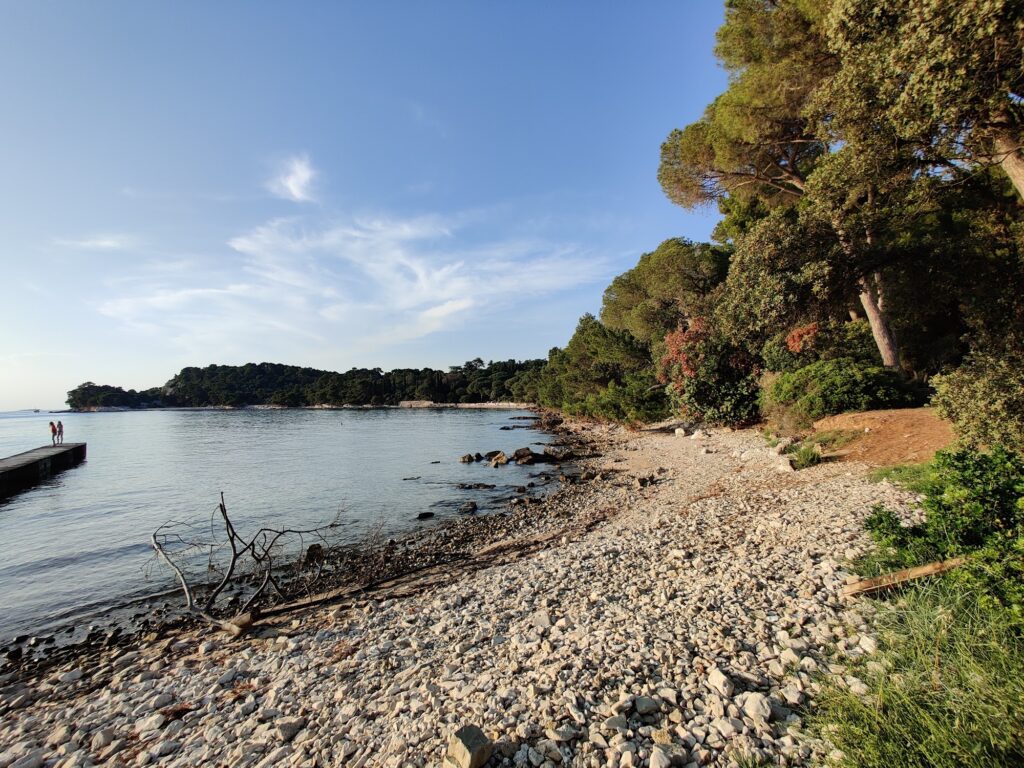
The coastline of Zlatni Rt consists of rocky platforms and pebble coves alternating around the two capes — Montauro and Punta Corrente — that define the park’s southern extent. The character ranges from the organised beach infrastructure of Lone Bay at the northern entrance (sunbeds, the Paradiso Beach Club, the family-oriented pebble entry) to the increasingly wild and undeveloped coves as the path progresses south toward Punta Corrente.
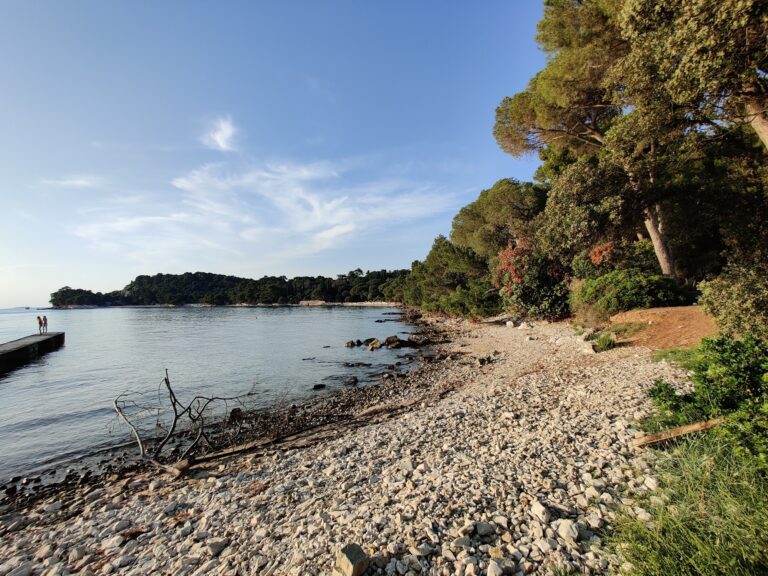
The pebble coves in the middle sections of the park — away from the hotel zone of Lone Bay and before the fully exposed southern tip — are the most sought-after swimming spots for visitors who want the combination of shade, clear water, and relative quiet. These coves are accessible only on foot or by bicycle from the park trails, and their distance from the road gives them a natural filtering effect that the closer beaches lack.
For visitors coming directly from the old town and walking south along the coastal path, Mulini Beach Rovinj in Lone Bay is the first organised beach encountered before the park begins — the transitional point between the hotel beach zone and the forest coves. The Zlatni Rt coves proper start south of the Maistra hotel complex.
The Quarry Climbing Wall
The quarry within the park — the source of stone that was used for Venetian buildings in the period before Hütterott’s acquisition — is now the free-climbing site that makes Zlatni Rt one of the better sport climbing locations on the Istrian coast. The quarried limestone walls provide natural climbing routes of varying difficulty, and the site is used by both local climbing clubs and visiting sport climbers as a technical climbing venue. The combination of swimming in the coves below and climbing the old quarry walls above within the same park visit is the specific activity combination that Zlatni Rt offers that no other location on this stretch of coast provides.
Hütterott’s Vision and What Remained
Georg Hütterott also bought four islands of the Rovinj archipelago — St. Andrija, Maškin, Sturag, and St. Ivan — as part of his broader vision for the health resort zone. The Island Hotel Istra on St. Andrija is now housed in the same building that was once Baron Hütterott’s summer residence, with the La Serra Restaurant operating in the former villa space. The history of the Rovinj archipelago’s development as a tourist zone is substantially the history of Hütterott’s late 19th-century land acquisitions and the institutional succession — national park designation, hotel development, the Maistra resort group — that his project eventually produced.
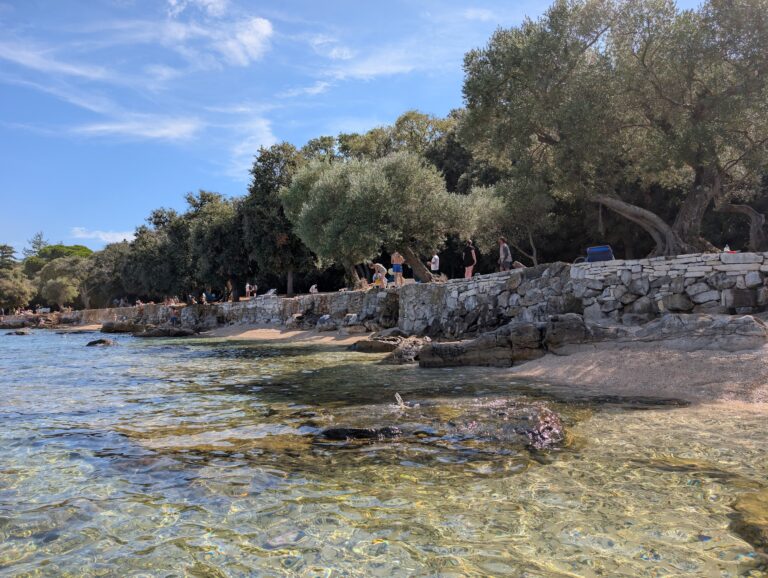
The park’s status as a protected natural site has preserved the botanical diversity he created. The drystone walls, the perimeter wall, the old dock positions, and the pavilion remains are the physical evidence within the forest that this was a private estate before it was a public park — the specific archaeological layer that makes walking through Zlatni Rt with attention to the non-botanical features as interesting as the trees themselves.
Cycling, Jogging, and the Coastal Path South
The coastal trail south from Rovinj through Zlatni Rt is the most used active recreation route from the town — cyclists and joggers using the pine-shaded paths as the specific complement to the urban promenade that begins in the old town. The trail system within the park connects multiple access points and cove approaches, and the route can be extended to loop the full Punta Corrente tip and return via the inland path, covering most of the park’s 54 hectares in a two to three-hour cycling circuit.
The combination of the Rovinj old town, the Mulini Beach zone, and the full Zlatni Rt loop by bicycle is the standard active day programme for visitors based in Rovinj — achievable in six to eight hours including swimming stops, and covering the full geographic range of the Rovinj coastal offer from the old town rock platforms at Plaža Balota Rovinj to the wild southern coves of the cape.
Zlatni Rt (Golden Cape) south of Rovinj is the forest park that a Trieste entrepreneur planted in a six-pointed star of Himalayan cedars, described as the “coast of the sun,” and never finished before he died in 1910. It has been protected since 1961, and the trees he planted are mature enough now that the shade is genuinely different from anything else on this coast.
Walk south from the old town. The forest begins where the hotel zone ends.
The cedar star is in the Punta Corrente meadow. You have to know it is there to see it.
Map
Sorry, no records were found. Please adjust your search criteria and try again.
Sorry, unable to load the Maps API.
Near by places: