
Ahtopol Beach Bulgaria: Southernmost Resort, Lardigo Bay
Profile
Ahtopol Beach, Bulgaria: The Lardigo Bay at Bulgaria’s Southernmost Town, Named “City of Happiness,” Rebuilt After a Fire That Destroyed Everything in 1918
Bulgaria | Ahtopol | Tsarevo Municipality, Burgas Province
The name means “City of Happiness.” Ahtopol comes from the ancient Greek agathos polis — good or prosperous city — which is what the Byzantine commander Agathon called it when he rebuilt it after the barbarian invasions of late antiquity. The name survived 2,500 years and at least three complete destructions. The most recent was in 1918, when a fire burned almost everything to the ground. The town was rebuilt from scratch; only the Church of the Ascension survived. The church, built in 1796, is now part of the Saint Yana Monastery Complex and is the oldest standing structure in a town that has otherwise been continuously rebuilt across two and a half millennia.
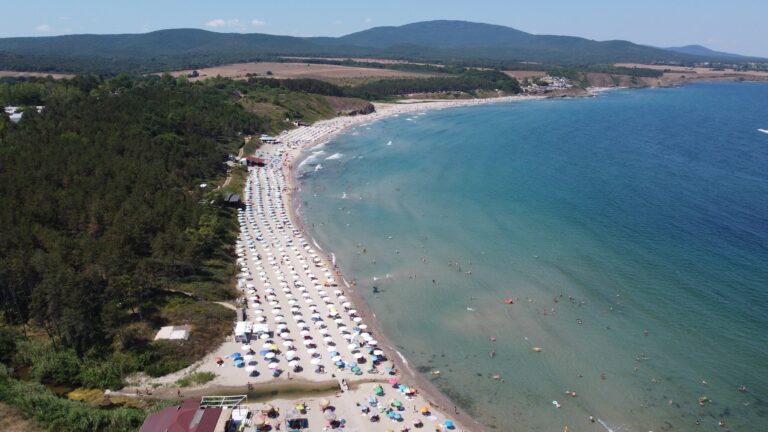
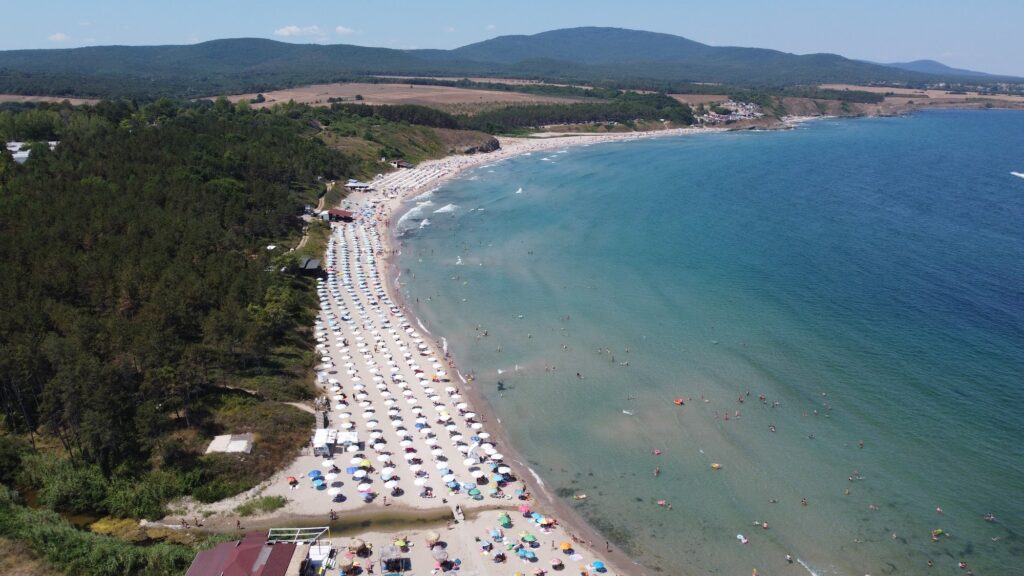
Ahtopol is the southernmost Bulgarian Black Sea resort. The beach is in the bay of Lardigo — a name left by the Greek community who lived here until 1913, from the Greek larus, meaning seagull. The beach itself is 1.8 kilometres long, up to 100 metres wide in its widest section, and reaches the Dolphin Campsite to the north. The Nakovo Dere stream at the edge of the dunes has been declared a natural landmark and turtle shelter — a small river that European pond turtles use as a sunbathing ground.
Getting There: 77km From Burgas, Regular Buses Year-Round, 10-Minute Walk From the Town Peninsul, Free Parking Behind the Dunes
Ahtopol is located 77 to 87 kilometres south of Burgas — the distances given by different sources reflect different measurement approaches, but the drive takes approximately 1 hour 20 minutes on the E87 and then road 9901 south through Tsarevo and Varvara. Regular buses connect Burgas and Ahtopol year-round, which is unusual — most southern coast villages lose their bus service after October.
The town itself sits on a rocky peninsula 500 metres long and 300 metres wide, set 15 metres above the sea. From the peninsula, a paved coastal path leads north to the beach in under ten minutes. Free parking is available at the main beach entrance behind the dunes — a provision that distinguishes Ahtopol from the bigger resorts where peak-season parking is a paid and competitive exercise.
The Beach: 1.8km of Lardigo Bay, Rocks and Reef at the Southern End, Turtle Stream at the North, Shallow Throughout
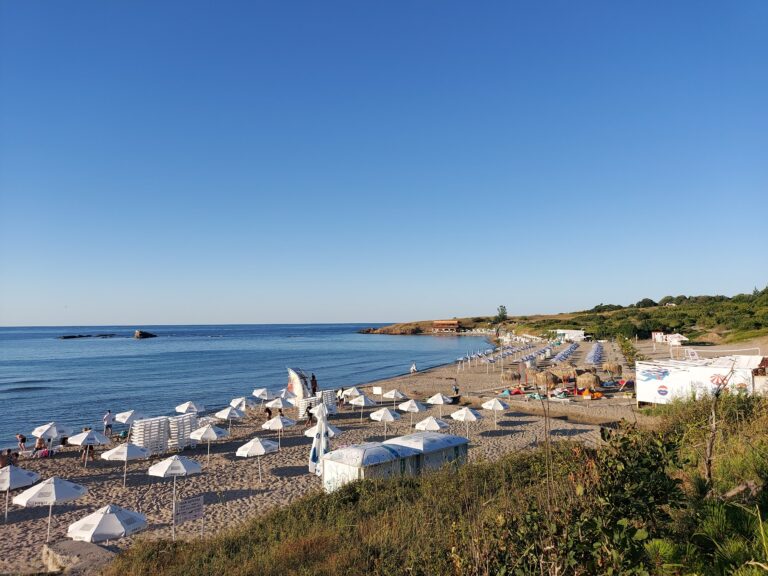
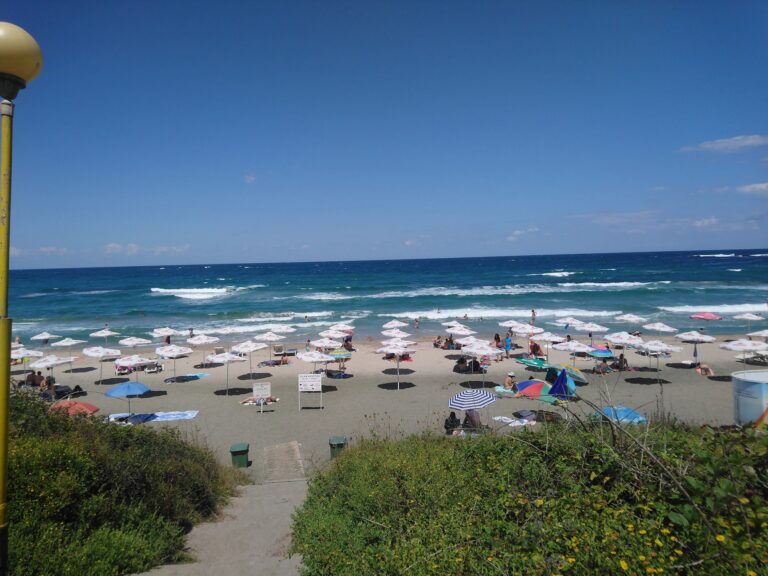
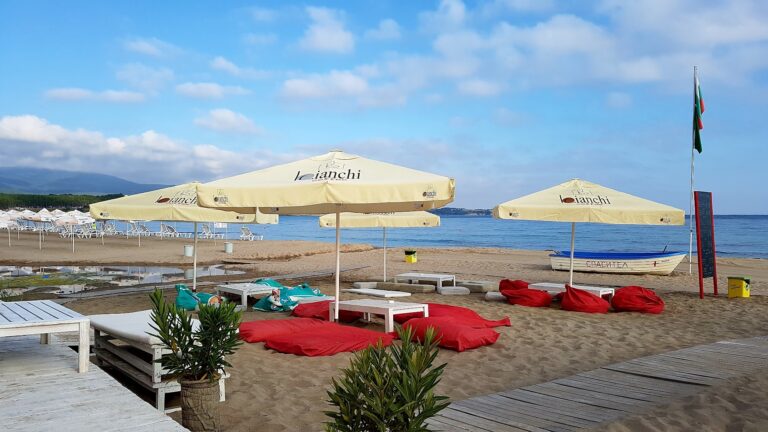
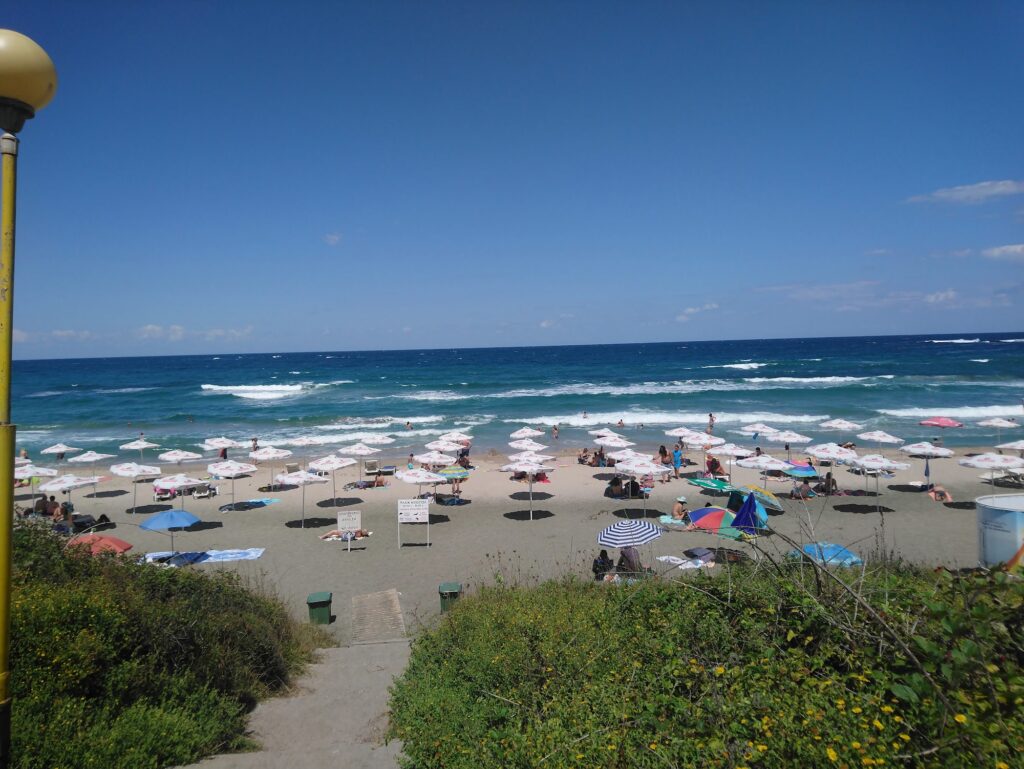
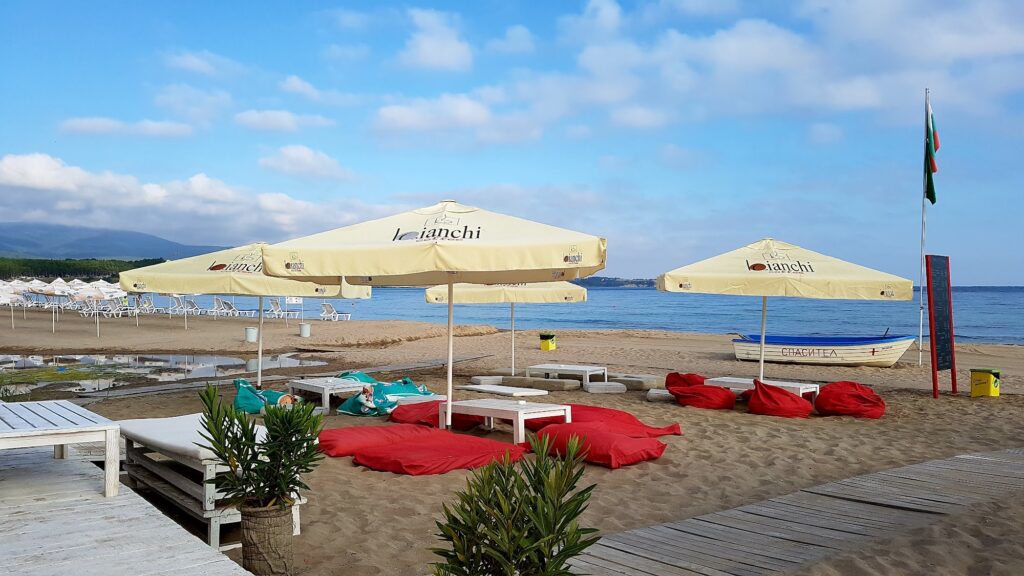
The beach is well sanded with shallow, clean and warm water almost throughout the whole year — that last part is the specific Ahtopol quality. The average July temperature here is 22 to 23°C, slightly cooler than further north, and the Strandzha mountain breezes moderate the summer heat. The water temperature sits around 25°C in peak season. Visitors describe the water as more placid and warmer than expected for an exposed open-sea beach.
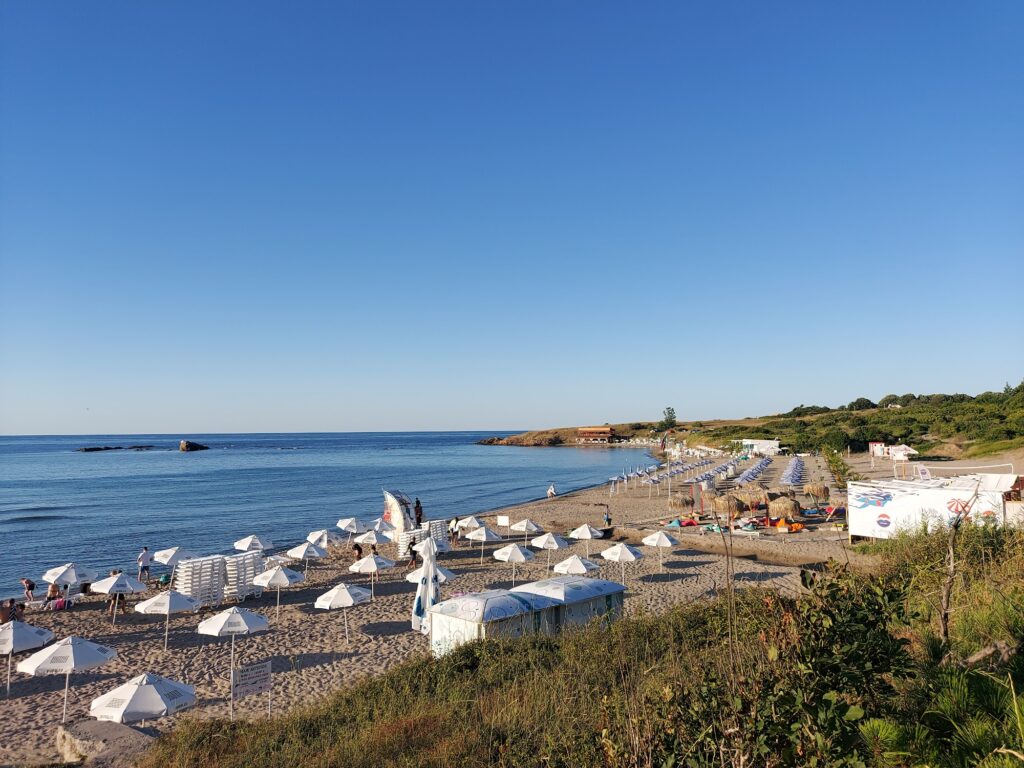
The southern end of the beach is where the experience shifts. The rocks there resemble reefs, and combined with the clear waters, make it a favourite for snorkellers. This is the part of the beach that rewards exploring beyond the main sunbed section — the underwater rock formations that would be fenced off or organised into a dive zone in a bigger resort are just there, at the end of the sand, for anyone who swims out to them.
The Nakovo Dere stream at the northern end is the specific wildlife encounter that the source article correctly identifies. The natural landmark designation protects it as a turtle shelter — a slow-moving freshwater channel where European pond turtles bask on warm days, an unusual and quiet sight at the edge of a beach.
The Town: Rebuilt in 1918, Roman Fortress Walls Still Standing, History of Anchors Museum, Soviet Rocket Launches
The ancient history of Ahtopol is unusually well-layered for a town of its size. Thracian settlement from the Late Stone Age. Greek colonisation around 430 BC. Roman fortress called Peronticus. Byzantine reconstruction under Agathon. Ottoman conquest in 1362, when it functioned as a port and shipyard exporting timber, coal, and fish to Constantinople. The Arab geographer al-Idrisi mentioned it in his 12th-century memoirs.
Parts of the ancient fortress wall, reaching 8 metres high and 3 metres wide in places, are still visible in the town centre. The History of Anchors Museum — its name is an understatement, covering far more than anchors — tells the maritime and archaeological story. The area was also the site of Soviet M-100 rocket launches during the Cold War, which adds a specifically 20th-century layer to a town that has been strategically important in every era that preceded it.
The Veleka River: 4km South, One of the Most Beautiful River Mouths on the Bulgarian Coast
The Veleka River mouth is 4 kilometres south of Ahtopol — and Veleka Beach Sinemorets Bulgaria at the mouth is covered separately. The Veleka comes from deep in the Strandzha mountains and enters the Black Sea in a lagoon setting of extraordinary beauty. The drive south from Ahtopol takes ten minutes. For anyone staying in Ahtopol, the Veleka lagoon is the afternoon excursion that makes the base worthwhile beyond the beach itself.
Further south again, Sinemorets and Rezovo continue the southern coast sequence to the Turkish border — the southernmost accessible point on Bulgaria’s Black Sea coast.
Ahtopol Beach is the Lardigo seagull bay at Bulgaria’s southernmost resort — 1.8 kilometres long, shallow and clean throughout, rocks and reef at the southern end for snorkellers, the Nakovo Dere turtle stream at the northern edge, the town itself rebuilt after a 1918 fire with only the 1796 church surviving, 2,500-year-old fortress walls still standing in the centre, 77 kilometres from Burgas by bus, and the Veleka River lagoon 4 kilometres south at Nestinarka Beach Bulgaria… no, at Sinemorets — the entirely different and extraordinary thing waiting when you’ve had enough of the sand.
Walk south from the peninsula. The rocks at the end are the snorkelling.
Check the turtle stream when you leave.
Map
Sorry, no records were found. Please adjust your search criteria and try again.
Sorry, unable to load the Maps API.