Loutraki Beach Corinthia: 5km Promenade, Spa, Casino
Profile
Loutraki Beach (Paralia Loutrakiou), Corinthia: The 5km Blue Flag Promenade Beach of the Town Xenophon Called Therme, Destroyed by Earthquake in 1928, Rebuilt Using Rubble Claimed From the Sea, and Swimmable in Winter
Greece | Loutraki | Loutraki-Perachora-Agioi Theodoroi, Corinthia, Peloponnese
In 1928, the city of Loutraki was completely destroyed by an earthquake. The event that levelled the buildings also provided the solution to one of the town’s urban planning problems: the rubble of the fallen houses was used to reclaim land from the sea, creating a new section of the coastline. The park that now sits between the beach promenade and the thermal spring facilities — the Beach Park of Loutraki with its oleanders and its greenery — stands on the reclaimed land. The 1928 earthquake is built into the town’s physical geography.
The town had been known since antiquity as Therme — the hot springs. The first written reference in a surviving classical text is in Xenophon’s Hellenica, where he records that the Spartan army of General Agesilaus camped at Therme during the Corinthian Wars (395–387 BC). Hippocrates noted the therapeutic properties of the water. The Roman general Sulla bathed in the springs in 86 BC. The Geraneia Mountains behind the town push the thermal water — heated by geothermal activity deep in the limestone — out at the coastal springs that gave the town its purpose for two and a half millennia.
The name Loutraki means “little bath” — loutra is the Greek for baths, -aki the diminutive suffix. The name is the function. Modern Loutraki was officially recognised as a spa town in 1925, formalized the designation of what Xenophon had simply called the place where the water was warm.
The 1981 Alkyonides earthquake — the same event that damaged the Aigosthena fortress at Porto Germeno — also struck Loutraki again, though with less destructive effect than 1928.
Getting There: 80km From Athens (1 Hour on A8 Motorway), Train to Corinth Station Then Bus or Taxi 10 Minutes, Plentiful Parking Behind the Promenade
From Athens, take the A8 (Olympia Odos) motorway toward Corinth and Patras. After Corinth, take the exit for Loutraki (the Isthmus junction is the turnoff). Follow signs into the town. Total distance: approximately 80 to 84 kilometres, 1 hour by car.
By train, the Hellenic Train service from Athens runs to Corinth station — from there, buses and taxis cover the 8 kilometres to Loutraki in 10 minutes.
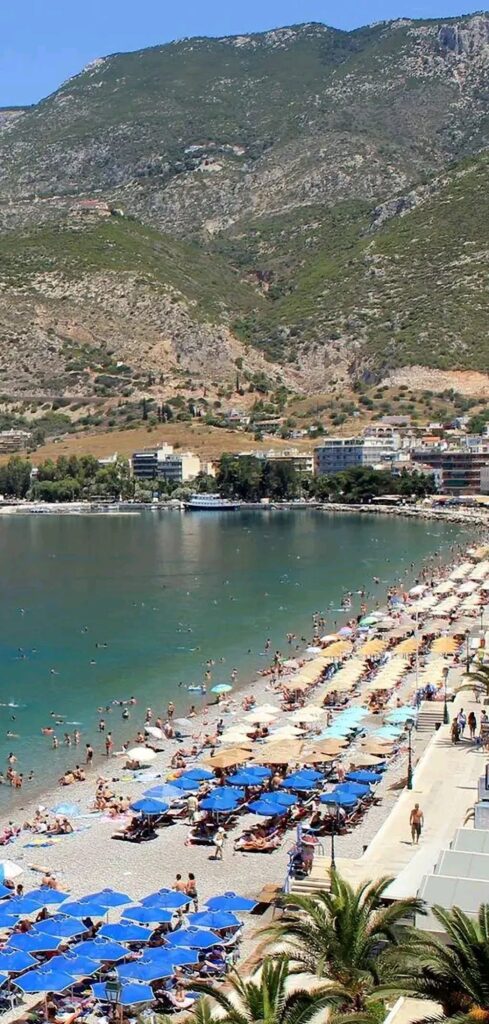
The Beach: 5km Pebble, Blue Flag, Promenade With Palm Trees and Artificial Waterfalls, Swimmable in Winter, Relatively Deep Water
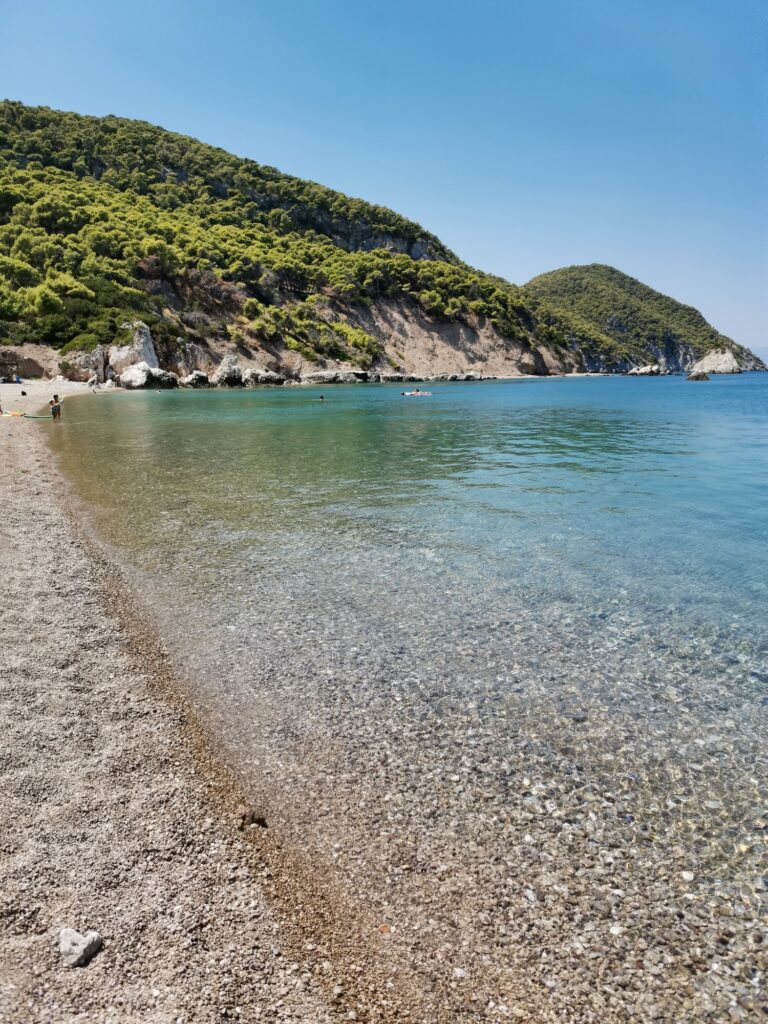
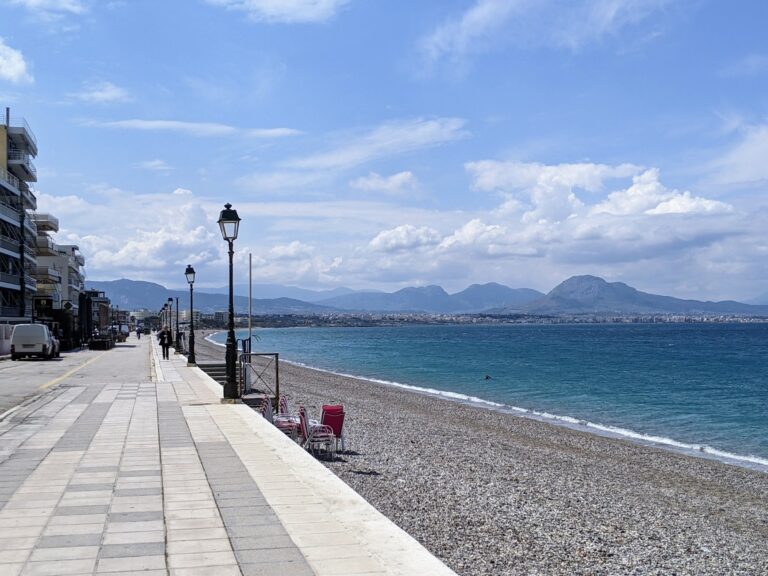
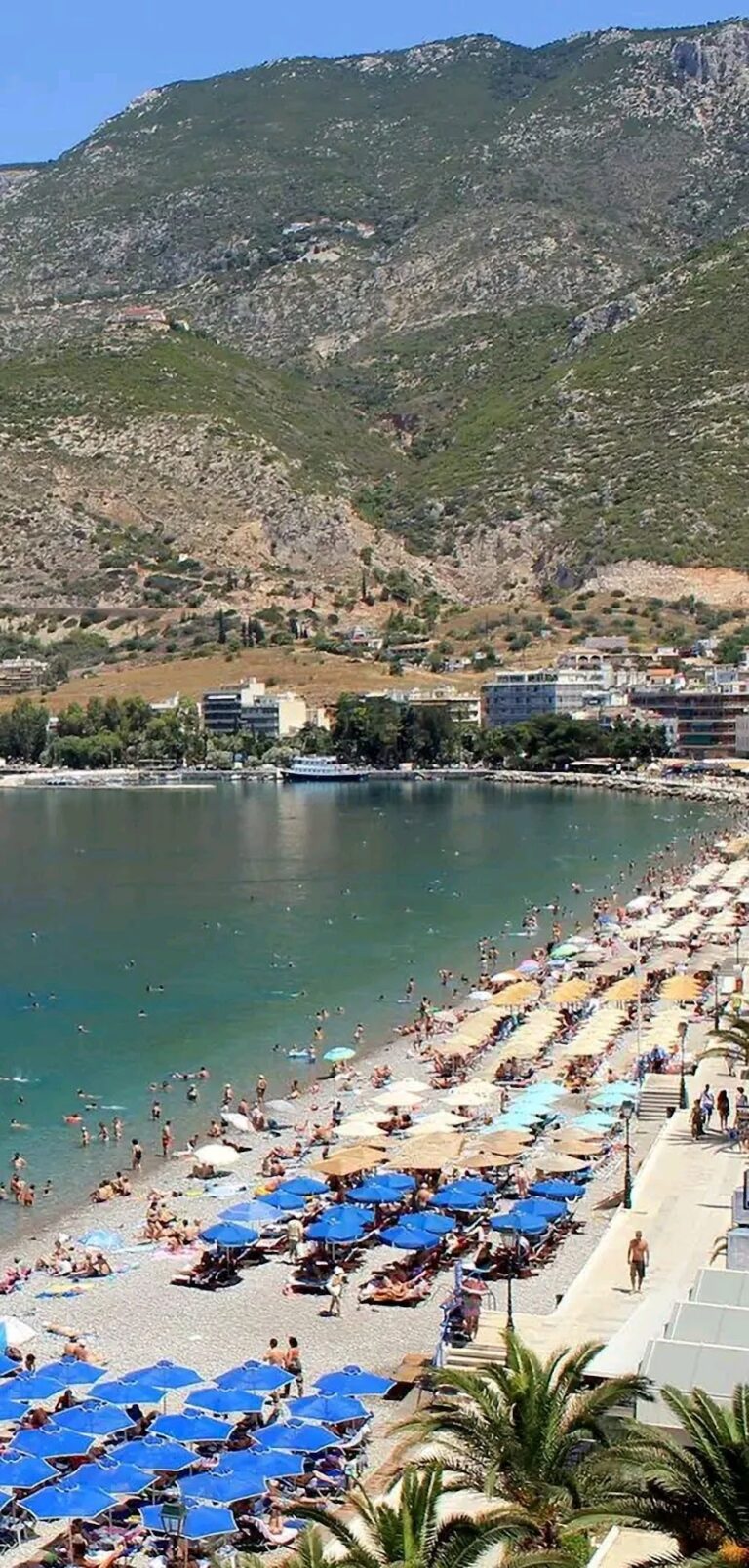
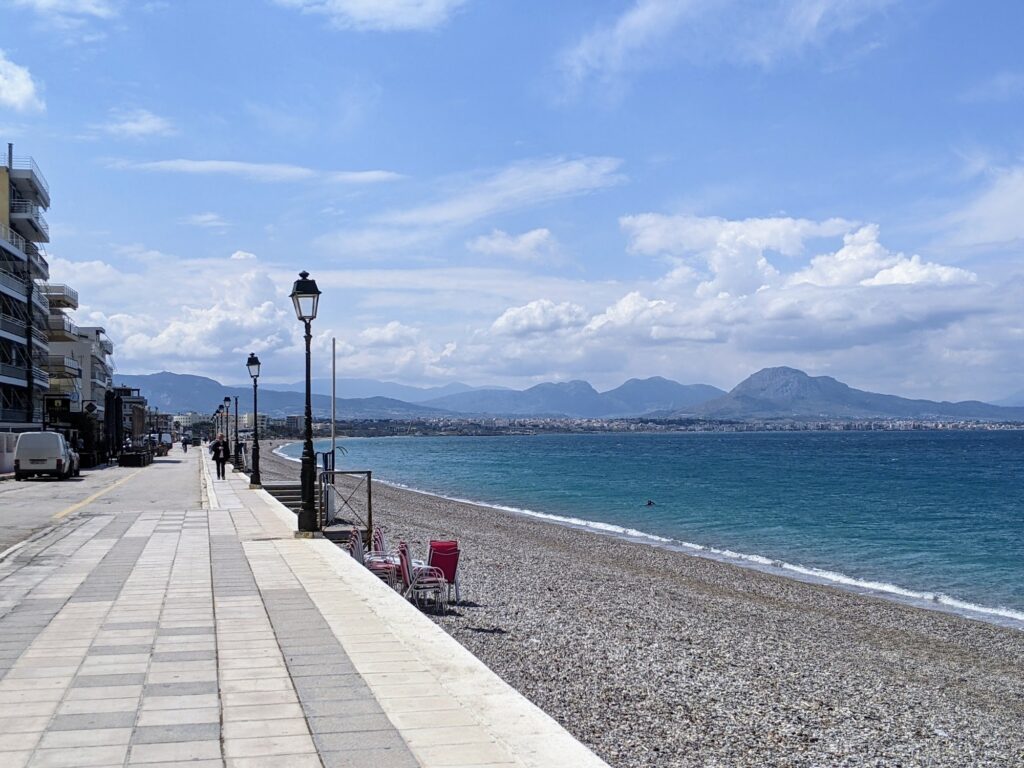
The beach runs for 5 kilometres along the Corinthian Gulf waterfront — from the town’s eastern edge toward the Corinth Canal direction, the full length of the coastal promenade. Pebble throughout. Blue Flag consistently. The water is relatively deep from entry — this is the honest calibration repeated across Loutraki visitor guides — and the clarity is exceptional.
The specific quality of the Loutraki beach not available at any comparable Greek city beach: it is swimmable throughout the year. The thermal influence and the protected gulf position keep the water temperature above average in winter; the town’s year-round population and infrastructure make the off-season visit viable. Swimming in February in Loutraki with the Geraneia Mountains snow-capped behind is the specific image the town’s winter guides promote — and it is accurate.
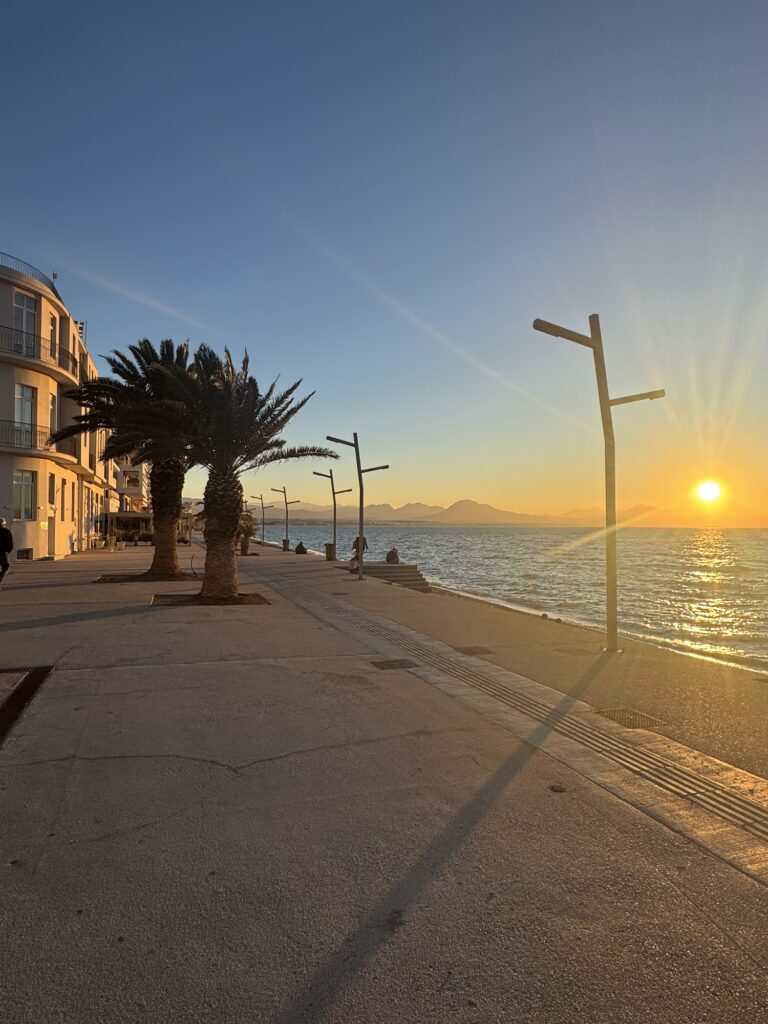
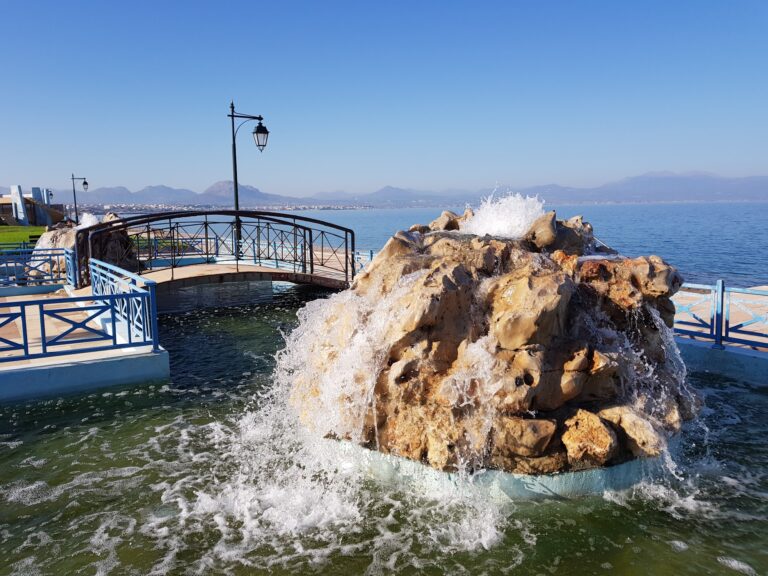
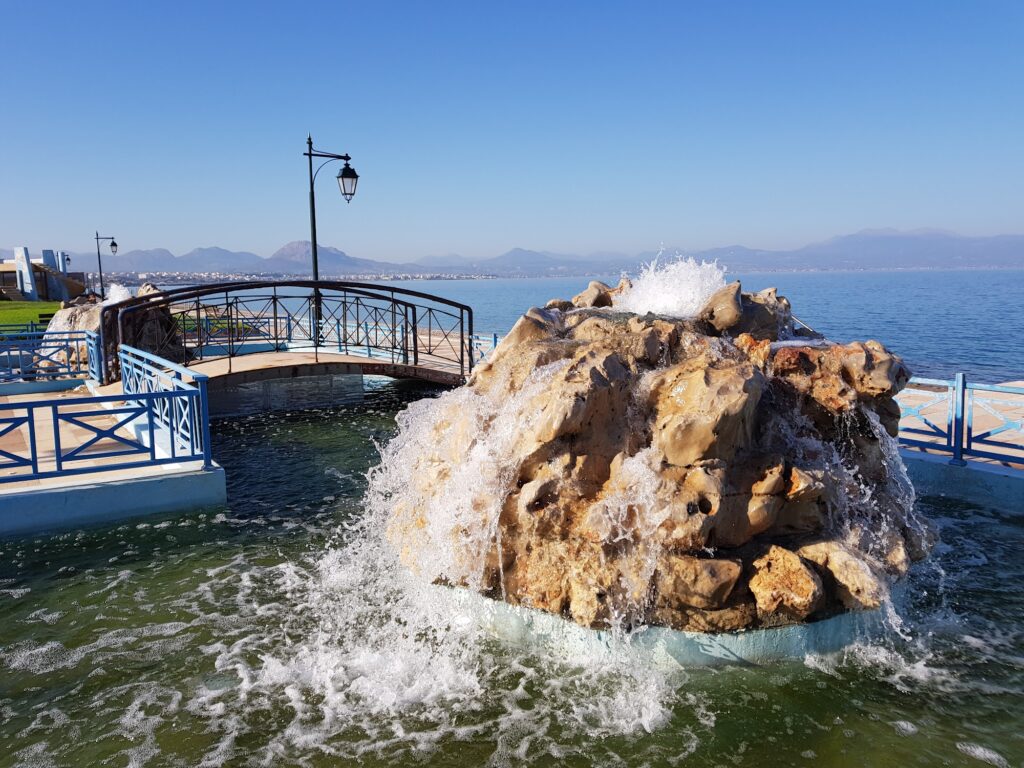
The promenade alongside the beach has the specific features that the EnjoyCorinthia.gr description provides: palm trees, artificial waterfalls, benches with sea views, cafes, the Beach Park with oleanders at the northern end. The entire 5km is pedestrian-friendly. Evening walks in summer bring the full social population of the town onto the waterfront in the way that the Italian passeggiata tradition functions in coastal resort towns.
The Pikionis Thermal Spring Building: Designed by the 20th Century’s Most Important Greek Architect, Mosaics by Xenopoulos
The Georgiou Lekka Thermal Spring building — the historic thermal spring facility on the promenade — was designed by Dimitris Pikionis (1887–1968) at the beginning of the 20th century. Pikionis is considered one of the most significant Greek architects of the modern period; his later work includes the paved pathways around the Acropolis in Athens, where the stone paving system he designed in the 1950s remains one of the most admired pieces of urban landscape design in Europe. The interior of the Loutraki thermal building is adorned with mosaics by Stefanos Xenopoulos depicting scenes from Greek mythology. The circular building is a specific piece of early 20th-century Greek architectural heritage on the town’s waterfront.
The Casino: First in Greece 1928, Reopened 1995, One of the Largest in Europe
The first casino in Greece opened in Loutraki in 1928 — the same year as the earthquake that destroyed the town, making 1928 the year Loutraki simultaneously lost its built fabric and established its defining entertainment institution. The current Casino Loutraki has been operating since 1995 and is one of the largest casinos in Europe — thousands of visitors daily in season. The casino is the economic anchor of the modern resort town, alongside the thermal spa.
Lake Vouliagmeni: The Lagoon 15km Northwest, 2km Long, Diving, Sandy Beach
Lake Vouliagmeni — not to be confused with the more famous Vouliagmeni near Athens — is 15 kilometres northwest of Loutraki, near Perachora. It is a lagoon connected to the Corinthian Gulf by a 6-to-8-metre channel. Its depth reaches 40 metres — the deepest lagoon in Greece — and its clear saltwater makes it exceptional for diving. The sandy beach at the lagoon edge is one of the few sandy beaches in the Corinthia region.
The Heraion of Perachora: 12km West, the 8th-Century BC Sanctuary of Hera at Cape Melagavi
The Heraion of Perachora — the ancient sanctuary of Hera at Cape Melagavi — is 12 kilometres west of Loutraki at the tip of the Perachora peninsula. The sanctuary dates to the 8th century BC, predating many of the major Greek sanctuaries. The two temples (of Hera Akraia and Hera Limenia), the Hellenistic fountain, and the working Melagavi Lighthouse at the cape are the site’s features. We covered the Heraion in the Mylokopi Beach Loutraki Greece — the twin earthquake bay 15km further west on the same peninsula.
Loutraki Beach (Paralia Loutrakiou) in Corinthia is the 5km Blue Flag pebble promenade beach of the town Xenophon called Therme (the Spartan army rested here in 394 BC) — completely destroyed by earthquake in 1928, rebuilt with the rubble used to claim the Beach Park land from the sea, recognised spa town since 1925, the Pikionis-designed thermal spring building with Xenopoulos mosaics, first casino in Greece 1928 (current since 1995, one of the largest in Europe), swimmable in winter, palm trees and artificial waterfalls on the 5km promenade, Lake Vouliagmeni 15km northwest (deepest lagoon in Greece, 40m, diving), Heraion of Perachora 12km west, 80km from Athens on the A8, 8km from Corinth.
Drive from Athens. Walk the full 5km promenade. Swim in February.
Map
Sorry, no records were found. Please adjust your search criteria and try again.
Sorry, unable to load the Maps API.
Near by places: