Bol Port Beach Brač Island: Swim in a Historic Harbour
Profile
Bol Port Beach, Brač Island: Swimming in the Harbour of a Fifteenth-Century Town
Croatia | Dalmatia | Brač Island
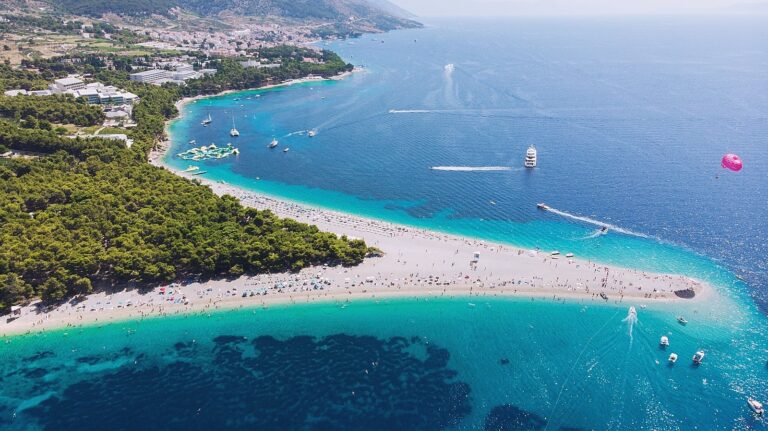
Most people who come to Bol on Brač Island come for Zlatni Rat. That is entirely understandable — the shifting white pebble cape extending half a kilometre into the Hvar Channel is one of the most genuinely singular beaches in the Mediterranean, and it justifies the journey from almost anywhere. But there is a particular kind of traveler, and a particular kind of day, for which the cape two kilometres along the promenade is not the right answer. A morning with an hour to spare before the catamaran. An afternoon too hot for the walk. An evening when the appeal of the water is inseparable from the appeal of the town immediately behind it.
For all of those occasions, Bol Port Beach is where I go — and on each visit it has delivered something that Zlatni Rat, for all its extraordinary qualities, does not.
What it delivers is the specific pleasure of swimming in a harbour. Not a beach attached to a town, but a beach that is genuinely and inseparably part of one — the stone walls of fifteenth-century buildings rising directly above the pebbles, bougainvillea trailing over the harbour walls into the salt air, the masts of moored yachts visible from the water. It is a beach that makes you feel like a resident rather than a visitor, which is a quality that no amount of natural scenery can manufacture and that Bol Port Beach produces without apparent effort.
The Beach in Context: Bol Town and the Eastern Harbour
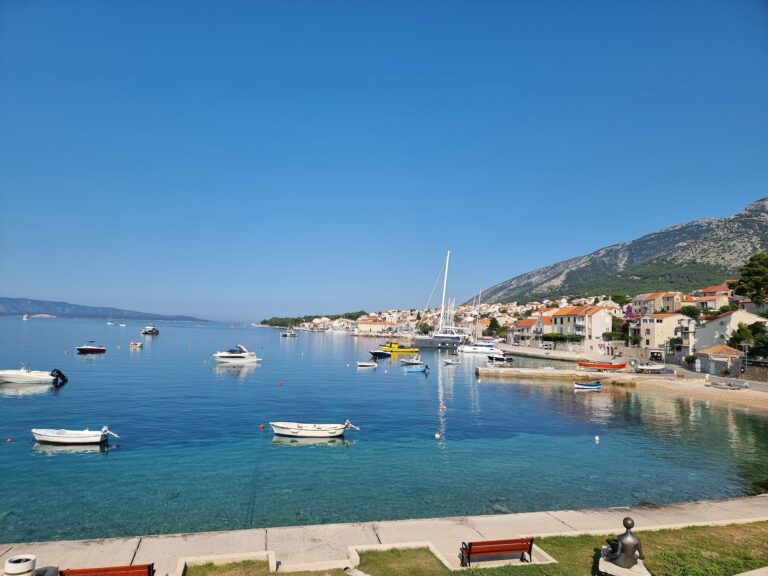
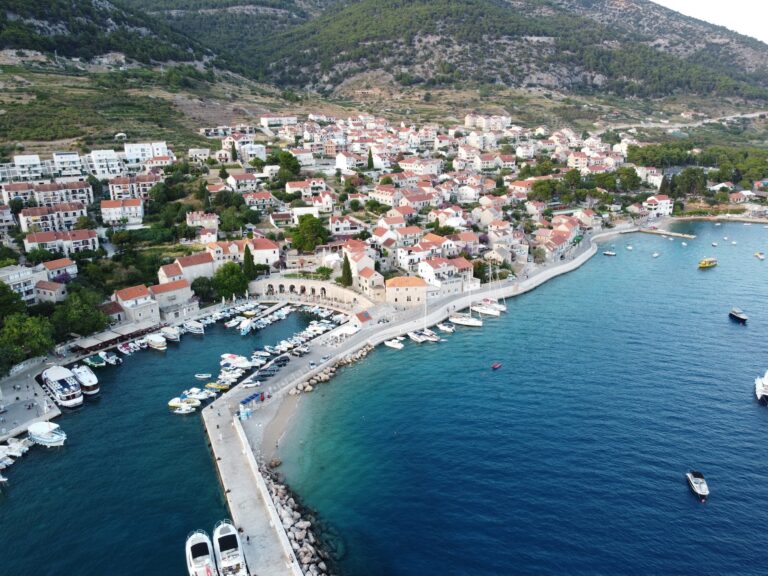
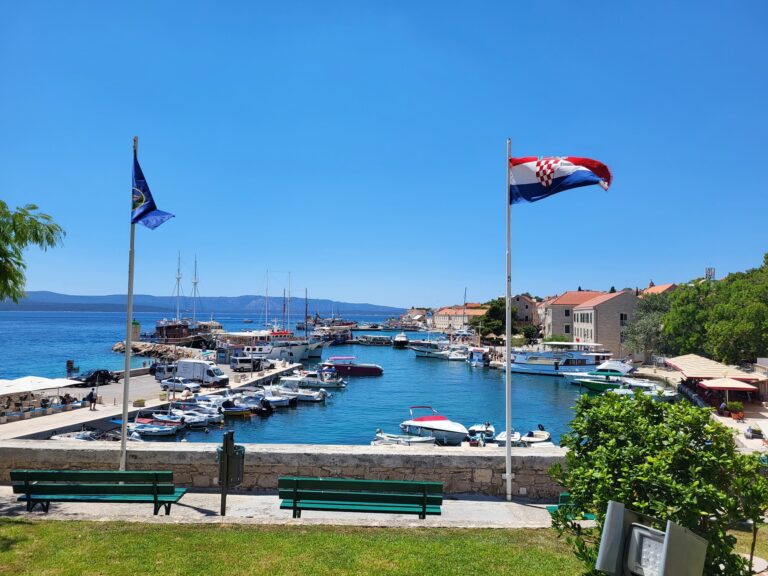
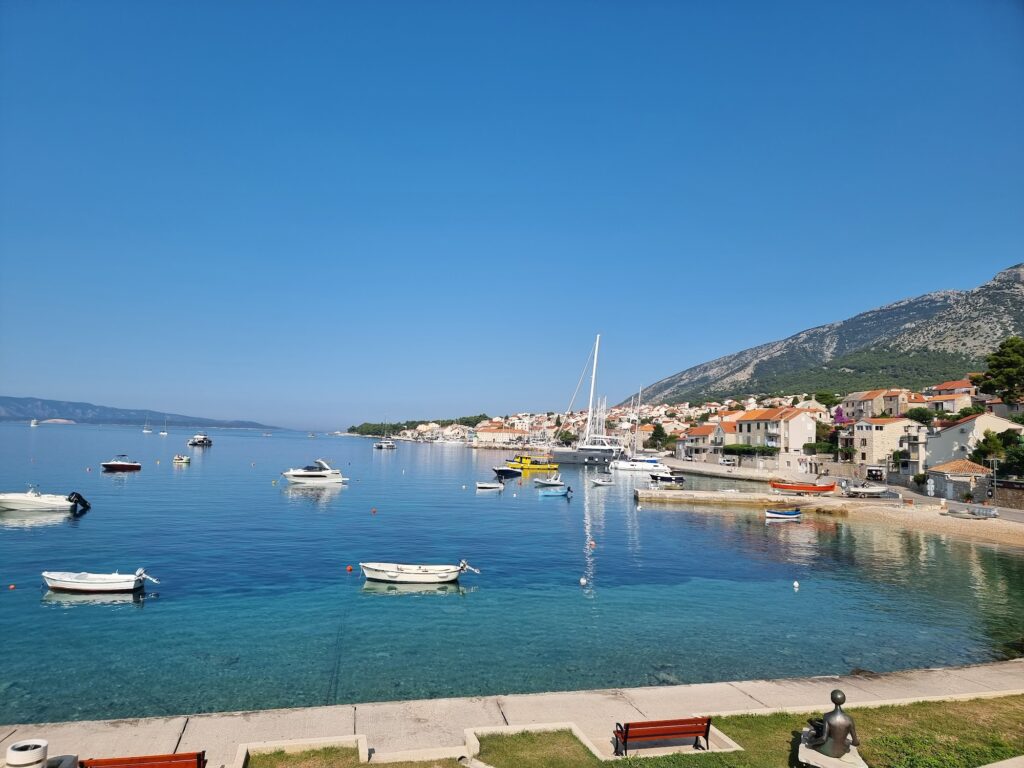
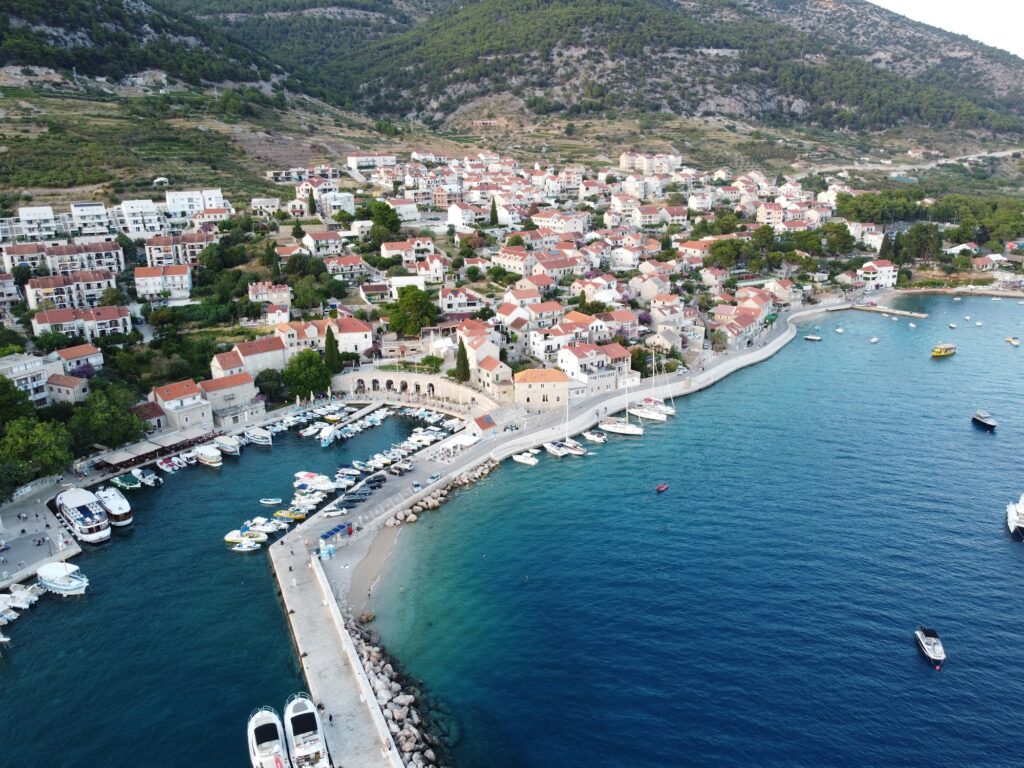
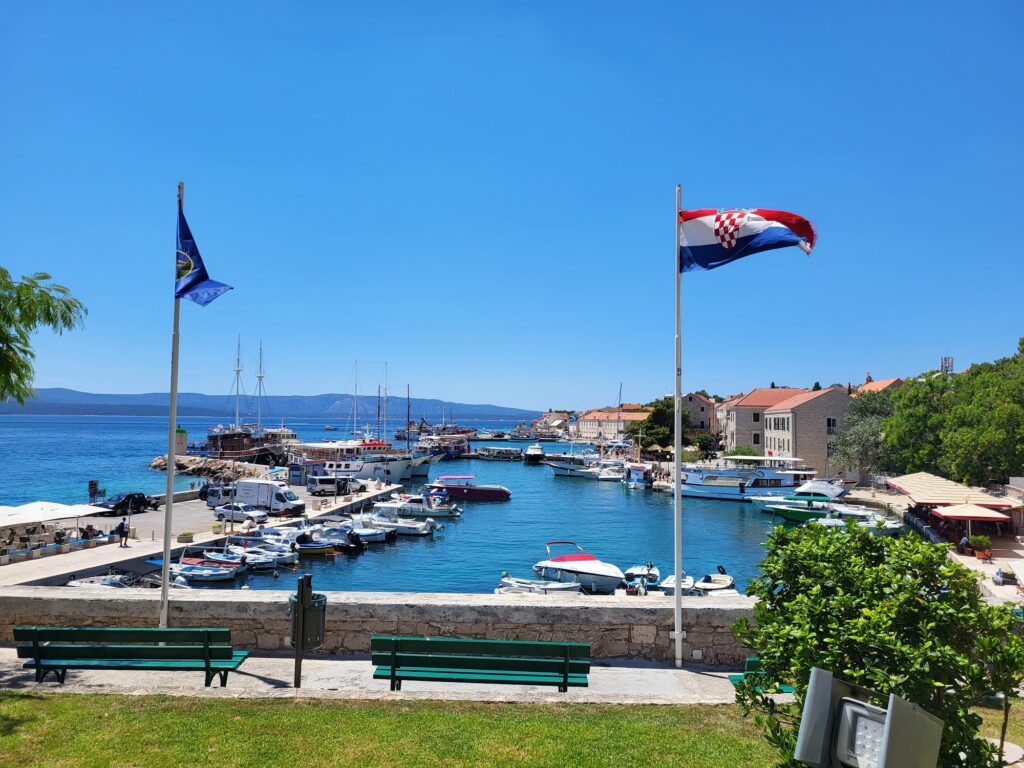
Bol Port Beach sits on the eastern side of Bol’s historic harbour, reachable on foot from any point in the town in minutes. It is not a destination you navigate toward so much as one you encounter as part of moving through Bol — the harbour is the town’s natural orientation point, and the beach occupies its eastern edge with the easy belonging of something that has always been there.
The stone architecture of Bol old town forms the backdrop of the beach in the most direct possible sense. Fifteenth-century buildings line the harbour immediately above the pebbles — their facades warm-coloured limestone in various states of weathered beauty, their windows overlooking the same water you are swimming in. The harbour wall curves around the western edge of the swimming area, providing the partial shelter that keeps the water calm and gives the bay its pool-like quality. Bougainvillea in several colours trails over walls and balconies above the shore with the exuberant density that only Mediterranean summer produces at full intensity.
The first time you stand on the pebbles at Bol harbour and look up at that architectural backdrop — and then look down into the water and register that the transparency is entirely equal to what you find at the island’s more celebrated beaches — the combination produces a particular and rather satisfying sense of the unexpected.
Getting There
Getting to Bol Port Beach requires, by the standards of Dalmatian coastal travel, almost no effort at all.
For visitors already staying in Bol, the beach is a short walk from any accommodation in the town centre — follow the stone lanes toward the harbour and the eastern shore presents itself without navigation. For those arriving by catamaran from Split or Hvar, the main pier sits within a five-minute walk of the beach, making it entirely possible to swim before finding your accommodation. I have followed that sequence on more than one arrival and recommend it without reservation as a way to begin a stay on the island.
The bus from Supetar — the main ferry port on the northern coast of Brač Island — arrives at the top of the town, from which a short downhill walk reaches the harbour and the water. Flat paved access points throughout make Bol Port Beach one of the more practically accessible swimming locations on the island for visitors with limited mobility or significant luggage.
Driving to the beach is unnecessary — Bol old town is navigated on foot, and the harbour is close enough to all central accommodation to make a car irrelevant for this particular destination.
The Shore and Setting
The physical character of the beach is less immediately dramatic than the geological formations of Zlatni Rat or the cliff-enclosed coves elsewhere on the Dalmatian coast, but it possesses a quality those locations do not — the integration of the shore with the built environment of the town produces a setting that feels inhabited rather than merely visited, shaped by centuries of use rather than purely by geology and weather.
The shoreline is a mixture of fine light-coloured pebbles and clean stone plateaus at the water’s edge. The plateaus warm through the morning in the particular way of flat Mediterranean rock and are well-suited to the half-submerged lounging position — half on stone, feet in the water — that is one of the more comfortable arrangements a beach can offer and that no sunbed adequately replicates. The pebbles are fine enough to be manageable barefoot, though water shoes are useful near the harbour wall where the stone becomes irregular.
The harbour arm on the western side of the bay provides the shelter that keeps the water calm and the entry gentle — a protected environment that functions more like a large natural pool than an open sea swimming spot, particularly in the first several metres from the shore where young children and less confident swimmers find the conditions most accessible.
The Water
The water quality at Bol Port Beach is the detail that most surprises visitors arriving with reduced expectations — the assumption being that a harbour beach must compromise on the transparency that makes Croatian coastal water so consistently extraordinary. The assumption is wrong.
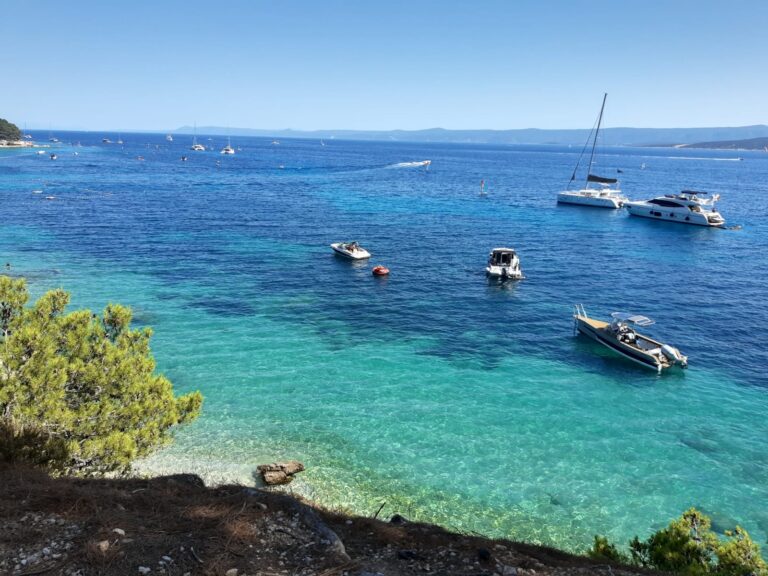
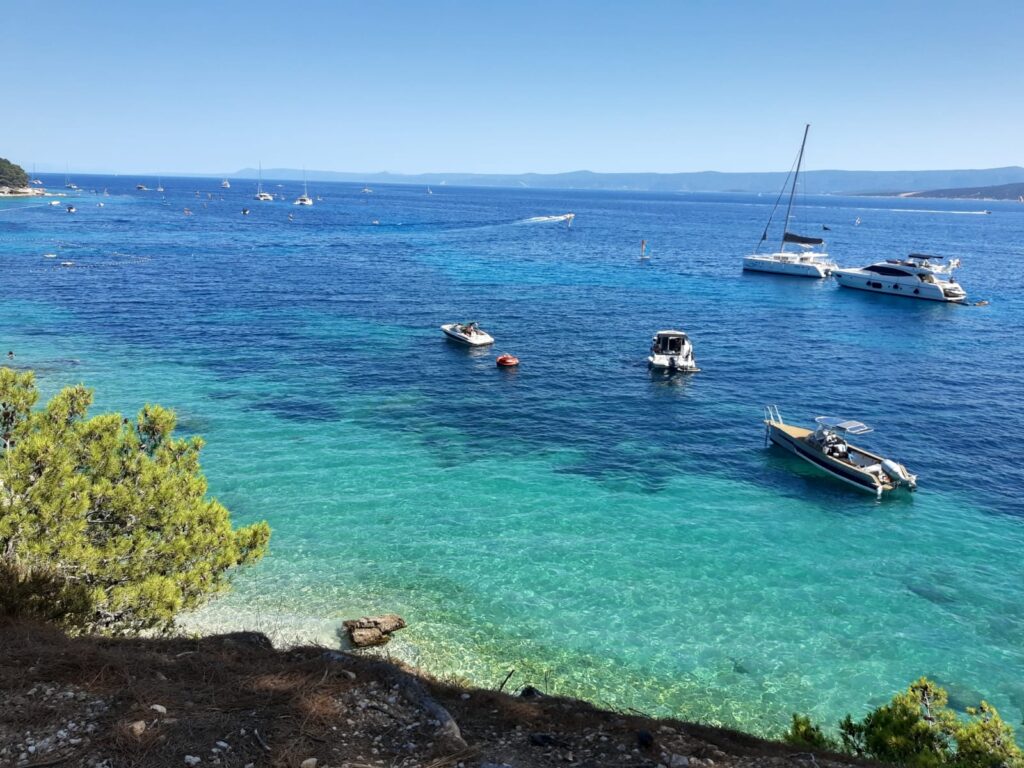
The deep-water currents of the Brač Channel circulate freely around the harbour, keeping the sea at the beach clean and well-oxygenated regardless of the harbour activity nearby. The transparency when I waded in on my first visit was the same quality I had encountered at Zlatni Rat the previous day — the underwater limestone visible in detail several metres down, the colour shifting from pale emerald at the shallows to a deeper cobalt further out, the water carrying the particular coldness of Adriatic deep-water circulation that makes entry on a hot morning feel genuinely restorative.
Snorkeling at Bol harbour beach is most productive along the harbour wall and the stone breakwater, where the structural underwater complexity — limestone formations, accumulated marine growth on harbour stone — supports a varied population of small fish and creates the kind of varied underwater landscape that repays focused observation with a mask. It is compact snorkeling rather than expansive, suited to an hour of careful exploration rather than a long open-water session, but the water quality makes what is there clearly and rewardingly visible in a way that murkier harbour environments in other countries simply do not permit.
Atmosphere: The Town as the Beach
The atmosphere at Bol Port Beach is unlike any other beach on Brač Island, and the difference is architectural rather than natural. While Zlatni Rat draws its character from the extraordinary geometry of the cape and the open channel surrounding it, and the island’s wilder coves draw theirs from the limestone formations and the clear water, Bol harbour beach draws its character from the town that surrounds it on three sides — and that produces an experience different in kind rather than degree.
The sounds of the beach are the sounds of the harbour — boat engines starting and quieting, the clink of rigging in the morning breeze, conversations drifting from café terraces immediately above the waterline, the particular ambient quality of a small Dalmatian town conducting its day within a few metres of where you are lying on warm stone. None of this is intrusive; it is the texture of the place, and it is precisely what makes swimming here feel different from swimming anywhere else on the island.
Local families use the beach with the ease of people who have been doing so for generations. The morning crowd tends toward residents swimming before the heat of the day builds. The afternoon brings visitors from the surrounding accommodation. The early evening sees a quieter return to the water as the temperature eases. Each shift in the day produces a different character at the beach, and the cumulative effect is of a place that functions as part of the living organism of the town rather than as a separate attraction.
For Families
Bol Port Beach with children works particularly well for families whose day in Bol involves the town as much as the water — those who want to combine swimming with the old streets, the Dominican monastery visible on the headland west of the harbour, and the harbour-side restaurants and cafés, without committing to the full logistical undertaking of a day at Zlatni Rat.
The calm harbour-protected water makes the shallows genuinely safe for young children. The flat paved access throughout eliminates the pushchair difficulty that uneven pebble shores present. The proximity of every practical necessity — cold drinks, ice cream, pharmacies, shaded café seating — within a two-minute walk means that the transitions between swimming, eating, and exploring the town happen without friction. The harbour setting provides a visual and spatial interest for children beyond the water itself — the boats, the stone buildings, the activity of a working harbour in summer — that keeps the full day engaging rather than beach-monotonous.
While the pine shade of Zlatni Rat’s central grove is absent here, the town’s own shade — the narrow lanes, the café awnings, the cool interiors of the old buildings that are never more than a short walk from the waterfront — provides an adequate and considerably more interesting substitute.
Food and Drink: The Bol Harbourfront
The restaurants and bars of Bol town are at their most atmospheric along the harbourfront immediately adjacent to the beach, and the transition from water to terrace requires ten steps rather than a decision about where to go.
I ate at a waterfront restaurant on my first evening in Bol — fresh Adriatic prawns prepared simply with local Brač olive oil from the island’s award-winning production and a glass of Plavac Mali from the Bol vineyards — and ate the same combination on my second evening at a different table with identical satisfaction. The cooking along this harbourfront applies quality ingredients with appropriate restraint and allows the setting to contribute what it is uniquely positioned to contribute. The harbour view, the stone buildings, the boats, the evening light on the Hvar Channel — these do not substitute for good food, but they make good food considerably better.
Coffee at the harbourside bars in the morning, with the boats moving in the early light and the old town walls catching the first direct sun of the day, is a ritual that rewards the early riser consistently. It is one of the finest ways to begin a day anywhere on the Dalmatian coast — and it sits twenty steps from the water.
Bol Port Beach and Zlatni Rat: Two Beaches, One Town
Since both beaches share the same town, the practical question of how to use them together is worth addressing for visitors planning their time in Bol.
Zlatni Rat deserves a full day — the walk out along the promenade, the full use of the cape and both sides of the water, the pine grove, the afternoon Maestral wind building across the channel. Bol Port Beach works best for the hours that frame that day, or for the days when a full excursion to the cape is not what the morning or afternoon calls for. Morning swim before breakfast, quick dip on the return from a town walk, an evening in the water before dinner at the harbour — these are the rhythms that the port beach supports naturally.
If you have two days in Bol, one at each beach is the obvious and entirely satisfying allocation. If you have one day, the port beach in the morning and Zlatni Rat for the main event — or the reverse — uses the geography of the town and the promenade to produce a coherent and varied single-day itinerary that neither beach alone could provide.
Final Thoughts
Bol Port Beach on Brač Island does not compete with Zlatni Rat and does not need to. It occupies a different position in the Bol experience entirely — the beach that belongs to the town rather than the beach the town belongs to, the place where the quality of the water is inseparable from the quality of the stone architecture above it, the harbour wall beside it, and the café terrace ten steps behind it.
For a certain kind of traveler on a certain kind of day, it is the better choice. For all travelers on all days, it is worth an hour of a morning or an evening regardless of what else the day holds.
The catamaran from Split docks fifty metres away. The water is exactly as clear as it is at the cape. The fifteenth-century stone is warm in the morning sun.
It is, in the most compact and immediately accessible sense, exactly what Bol has to offer — before the walk, after the walk, or instead of it.
Map
Sorry, no records were found. Please adjust your search criteria and try again.
Sorry, unable to load the Maps API.
Near by places: