
Prassa Beach Kimolos: White Chalk Sand and Thermal Springs
Profile
Prassa Beach (Agios Georgios), Kimolos: The White Sand Shore Where Chalk Quarries Made the Water Turquoise, Thermal Springs Come Up Through the Sand, and Mediterranean Monk Seals Shelter in Winter
Greece | Prassa | Kimolos, Cyclades
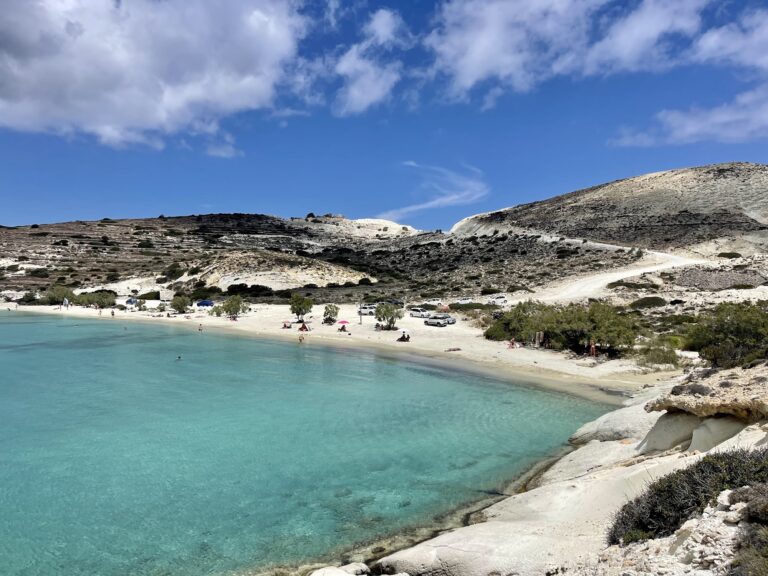
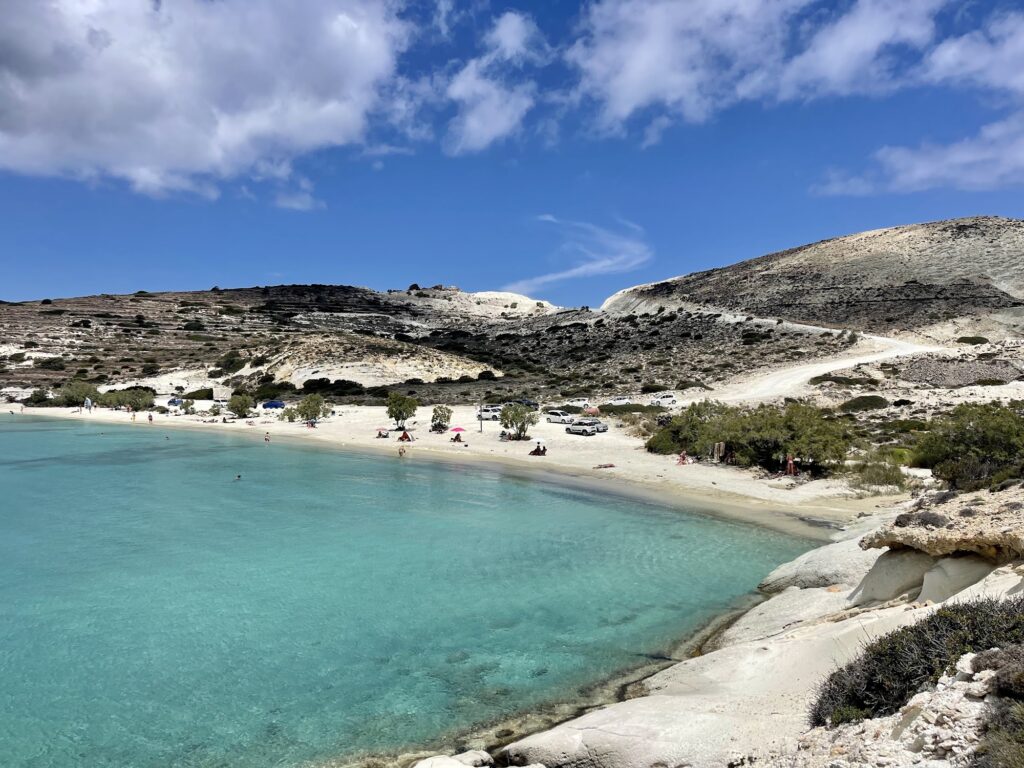
The white sand at Prassa comes from the chalk. Kimolos takes its name from the Greek word kimolia — chalk — and the island’s geology has been its economy for millennia. Fuller’s earth from the chalk deposits was exported across the ancient Mediterranean to clean wool. Perlite and bentonite mining continues today. The chalk hills that surround the northeast coast are white, and the runoff from them into the sea colours the water in the specific way that produces the turquoise that makes Prassa look like a Caribbean beach in photographs. The comparison is not marketing language — visitors who have been to both genuinely describe it this way. The white sand and the turquoise water are a direct consequence of the chalk geology, not a coincidence.
The thermal springs add a second geological layer. At the entrance to the Prassa settlement, thermal springs with therapeutic properties emerge from the ground — the geothermal activity under the sea floor at this part of the Milos–Kimolos channel, the same activity that produces the famous Paliochori springs on Milos, surfaces here too. More unusually, thermal springs also emerge directly from the beach sand at Prassa — a specific sensation that swimmers and sunbathers notice: a patch of warm mineralised water rising through the sand under your towel or feet.
In winter, when the summer visitors have gone, Mediterranean monk seals (Monachus monachus) use Prassa and the surrounding sea caves as a refuge. The monk seal is one of the most endangered marine mammals in the world — the eastern Mediterranean population is estimated at around 350 to 450 individuals. The sea caves below the Church of Agios Georgios on the headland above the beach are specific monk seal habitat. The small islet of Prassonisi directly offshore is another refuge. Swimming to Prassonisi is possible and the snorkelling around the islet’s rocks is excellent — the fish and coral concentration is consistently described as the best snorkelling in the Prassa area.
Getting There: 20-Minute Ferry From Pollonia (Milos), Then 5km From Chora by Dirt Road — 4WD or ATV Recommended
Kimolos is reached from Milos by the small ferry from Pollonia port — 20 to 30 minutes, multiple daily crossings in summer. Kimolos is also accessible by the main Cyclades ferry network from Piraeus (approximately 4 to 5 hours) but the Milos–Kimolos crossing is the standard practical approach for most visitors.
From Psathi (the Kimolos port), Prassa is approximately 8 kilometres northeast. From Chora (the island capital, 2km from the port), it is approximately 5 kilometres. The road is paved to the Agios Minas area and then transitions to a dirt track for the final section. A 4WD vehicle, ATV, or quad bike is the consistent recommendation — standard rental cars can manage in dry summer conditions but struggle on the rougher final stretch. Taxis are limited on Kimolos; booking in advance in peak season is advised.
Parking is near the beach. The beach can fill in peak July and August — arriving early secures a position.
The Beach: White Coarse Sand, Turquoise Water, Gradual Shallow Entry, Thermal Springs in the Sand, Sea Caves for Snorkelling
The sand is coarser than the fine powder of many Cycladic beaches — this is chalk and perlite sand rather than fine quartz, and the texture reflects it. The water is extraordinarily clear and turquoise, the seabed gradual and shallow for a considerable distance. The characteristic of the water at Prassa is that its colour is as vivid close to shore as further out — the chalk reflection works across the full shallow section.
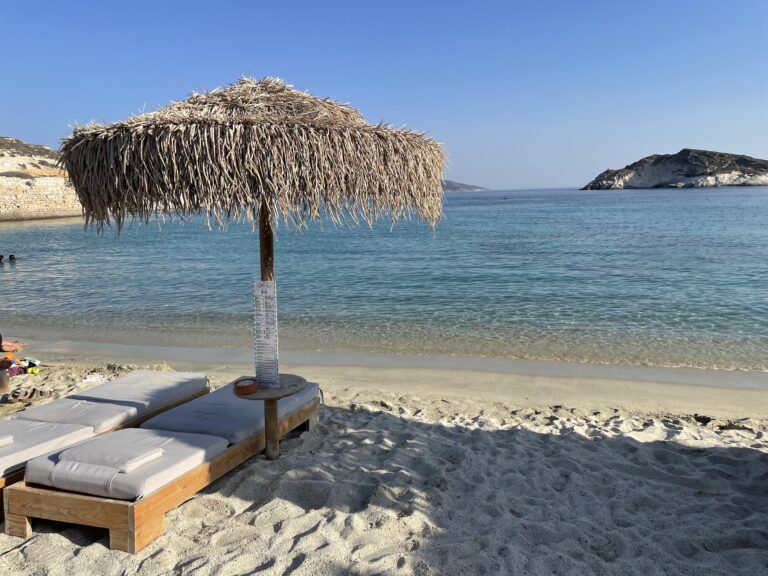
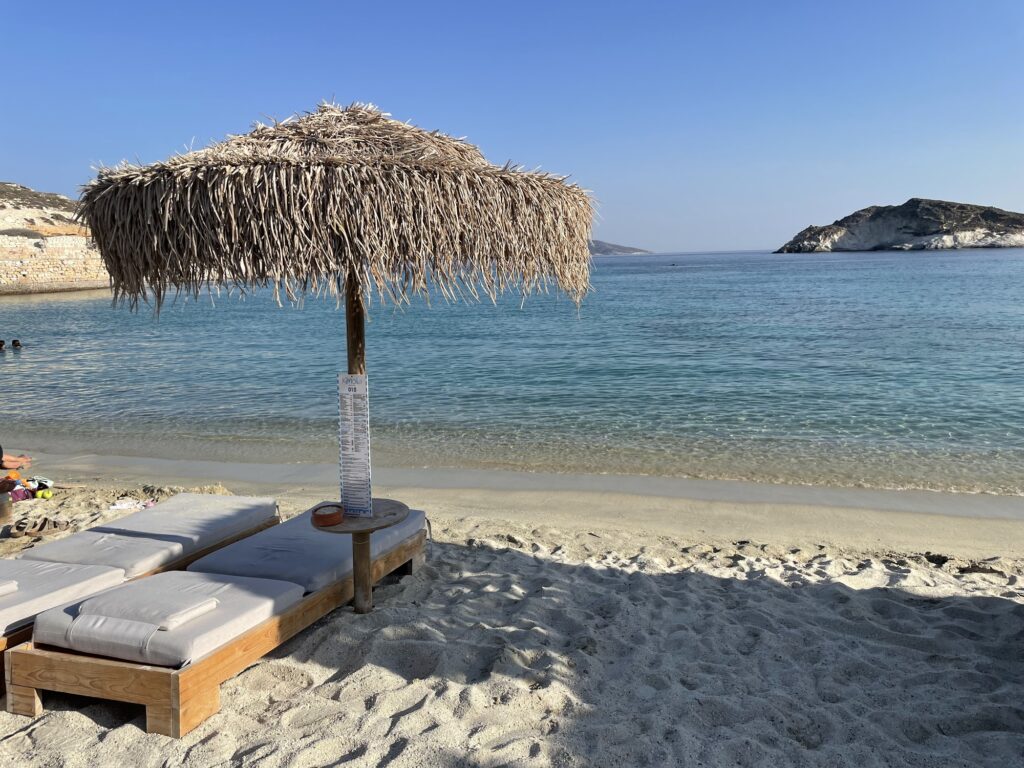
Sunbeds and umbrellas are available from the beach bar. Tamarisk trees at the right edge of the beach provide natural shade. The beach can get crowded in peak season — this is not the secret it once was, and the day-tripper boats from Milos bring visitors in summer.
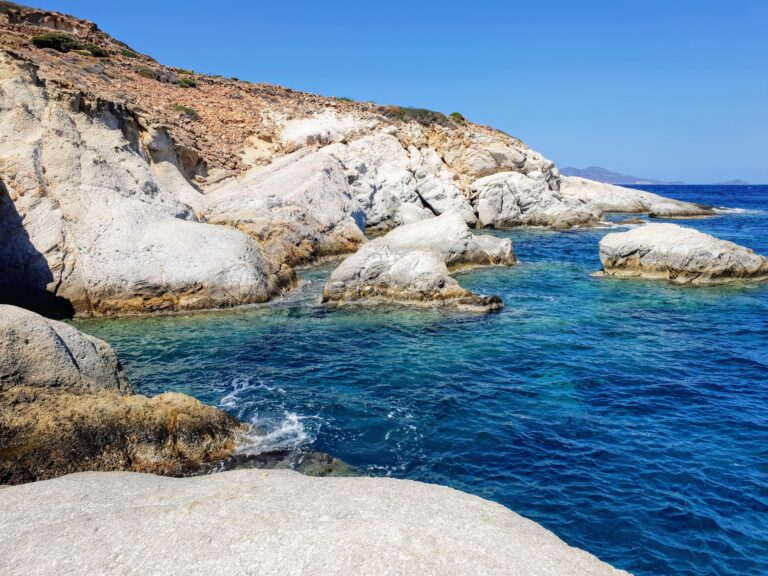
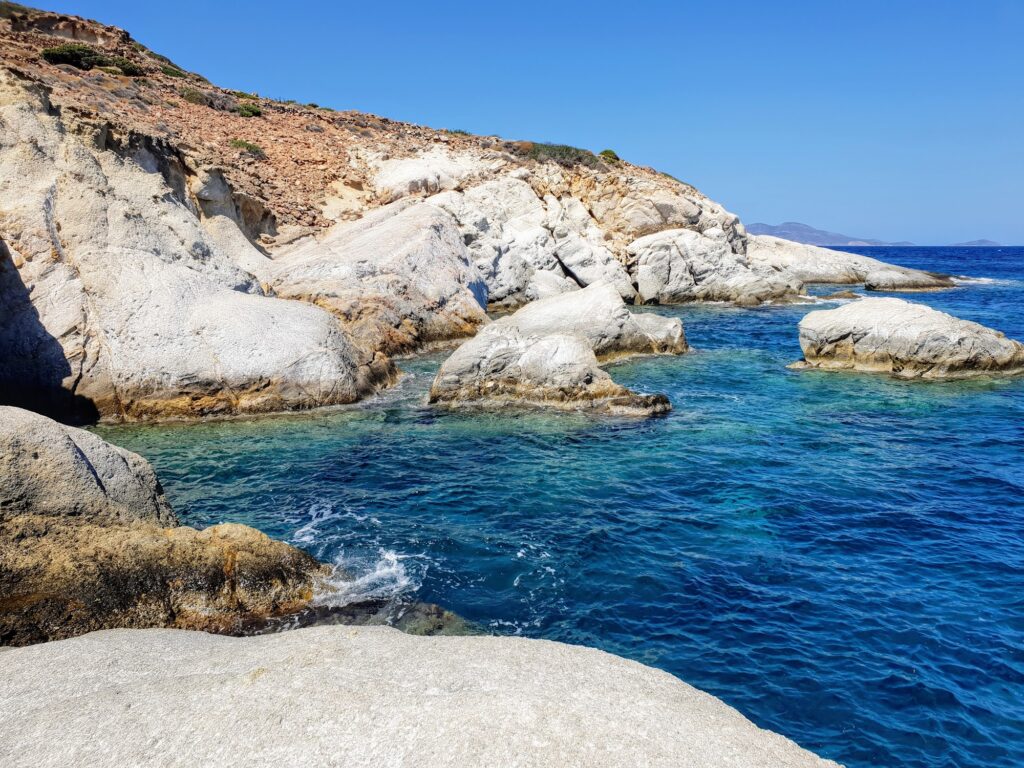
The sea caves below the Church of Agios Georgios on the headland are the snorkelling destination. The chapel sits above the water and the caves below it are accessible by swimming along the base of the cliff.
The Thermal Springs: In the Sand and at the Settlement Entrance
The thermal springs at the Prassa settlement entrance are accessible from the road — warm mineral water that locals and visitors use informally for the therapeutic qualities. The geological explanation is the same as at Paliochori on Milos: the Milos–Kimolos channel sits above active volcanic geology and the geothermal heat rises through faults in the seabed and coastline.
The experience of warm water emerging from the sand while you are lying on a beach is specific to very few places in Greece. Prassa is one of them.
Prassonisi Islet: Snorkelling, Monk Seal Habitat, Swim or Boat
The small islet of Prassonisi sits directly offshore from the beach. The snorkelling around it — fish, corals, rock formations — is the best in the immediate Prassa area. Swimming to the islet is straightforward in calm conditions. In autumn and winter, monk seals use the island as a rest site.
The boat excursion from Pollonia (Milos) that includes Prassa as a stop also visits Polyaigos and other northeast coast locations — the same channel that produces the thermal geology here extends east toward Polyaigos, where the monk seal population is at its largest.
The Book Library: The Boat-Shaped Bookcase at the Beach
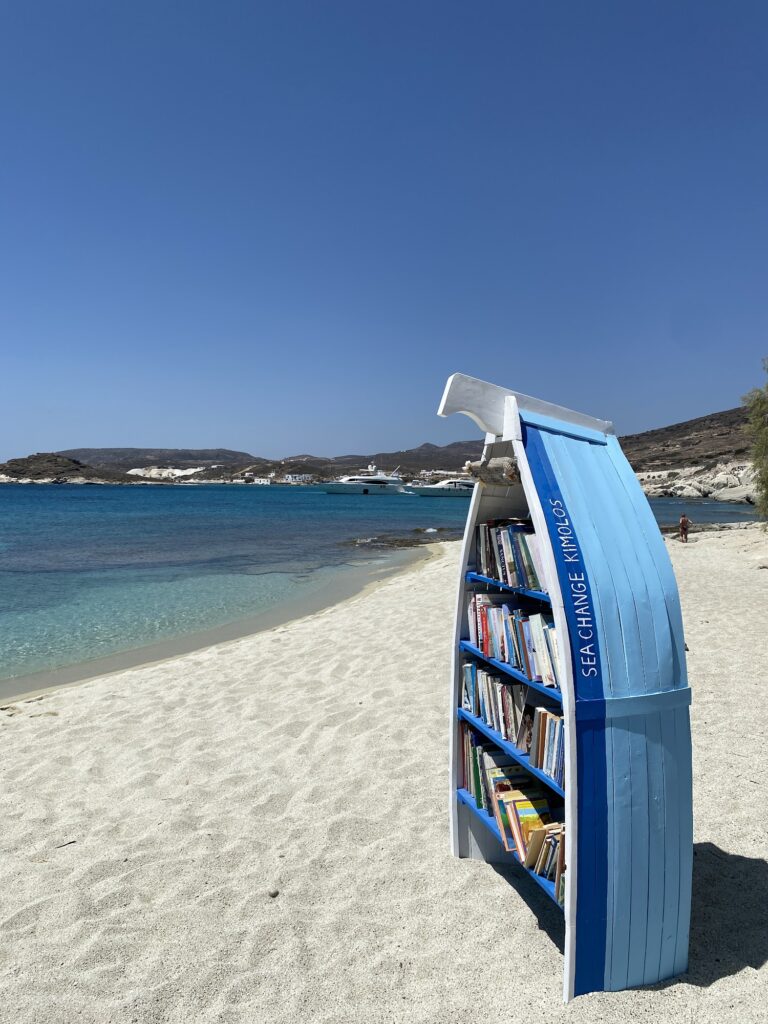
The “Open Mall” — a small boat-shaped bookcase at Prassa beach where visitors can borrow and leave books — is the specific unusual amenity that appears in every article about the beach alongside the chalk geology and the monk seals. It is a small but genuine feature that reflects the specific character of Kimolos as an island that has attracted thoughtful independent travellers rather than mass tourism.
Kimolos Island: 800 Residents, 36 Square Kilometres, More Authentic Than Milos
Kimolos has approximately 800 permanent residents on 36 square kilometres. The capital Chora has the typical Cycladic hilltop architecture, the Venetian castle (Kastro) within which the village was originally built for protection from pirates, and a specific unhurried atmosphere that the island’s limited tourist infrastructure preserves. There are no large hotels. There are a few tavernas in the village serving the ladenio flatbread, fresh fish, and local Kimolian cheese. The island has managed to retain authenticity that Milos — despite being only 800 metres away — has partly lost to mass tourism.
Prassa Beach (Agios Georgios) on Kimolos is the most beautiful beach on the island — white coarse sand from the chalk and perlite geology, extraordinary turquoise water, thermal springs emerging from the sand and at the settlement entrance, sea caves below the Church of Agios Georgios for snorkelling, Prassonisi islet directly offshore (monk seal refuge in winter, best snorkelling in summer), book library at the beach, 5km from Chora on a partly dirt road (4WD or ATV recommended), arrives from Pollonia on Milos by 20-minute ferry, peak season crowded (arrive early), and Kimolos island itself — 800 residents, 36 square kilometres, more authentic than its famous neighbour.
Take the ferry from Pollonia. Hire an ATV in Psathi. Drive to Prassa early.
Map
Sorry, no records were found. Please adjust your search criteria and try again.
Sorry, unable to load the Maps API.