
Komitsa Beach: Sand Beside an Ancient Border
Profile
Komitsa Beach: The Last Stretch of Sand Before a Thousand-Year Border
Greece | Halkidiki | Aristotelis | Athos Coast
Walking east along Komitsa Beach eventually brings you to a fence that runs directly into the sea, the physical edge of one of the strangest borders left anywhere in the world. Mount Athos has operated as a self-governed monastic republic for over a thousand years, and since 1045, under a law enacted by the Byzantine emperor Constantine Monomachus, women have been barred from setting foot on its territory entirely. I stood at that fence line for a while on my first visit to Komitsa, watching the water lap against both sides of a boundary that predates most modern nations by centuries, and found myself thinking about how strange it is that a stretch of ordinary golden sand simply stops being a stretch of ordinary golden sand at some arbitrary point along the shore.
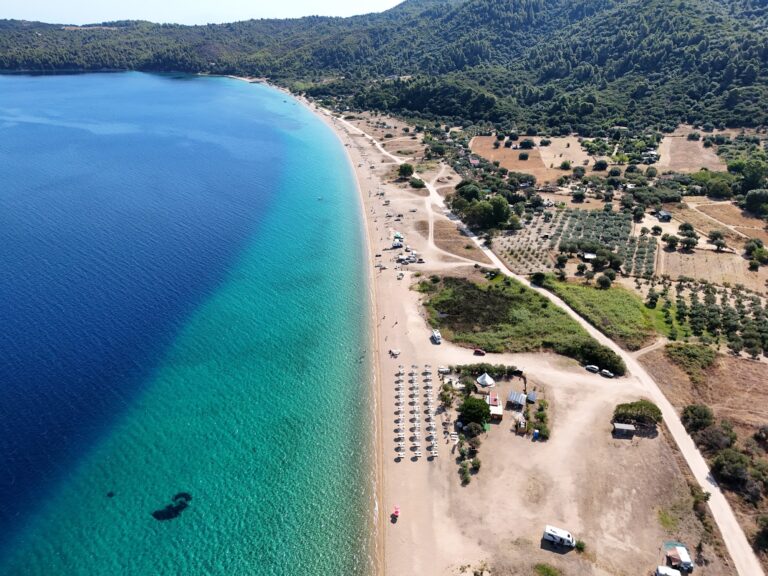
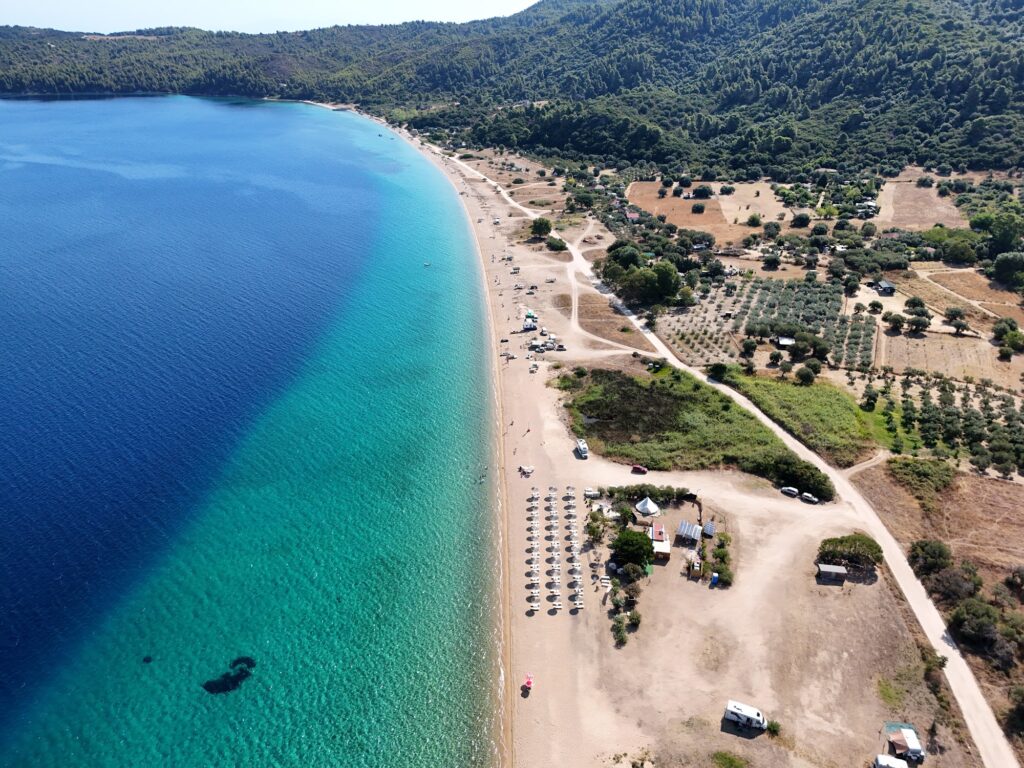
Komitsa runs for a genuine distance along Halkidiki’s eastern peninsula, close to the village of Nea Roda, and it holds the distinction of being one of the last proper swimming beaches before the Athos border takes over the coastline entirely.
An Organized Side and a Wild Side, Divided by Choice
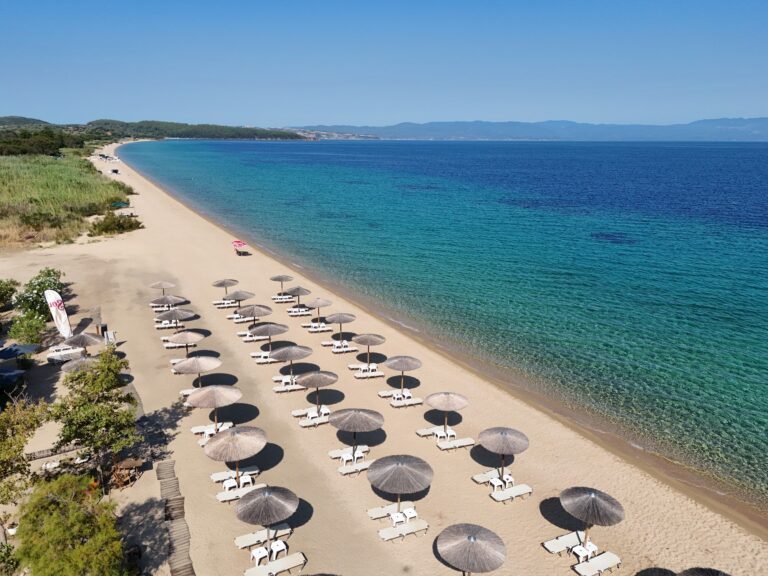
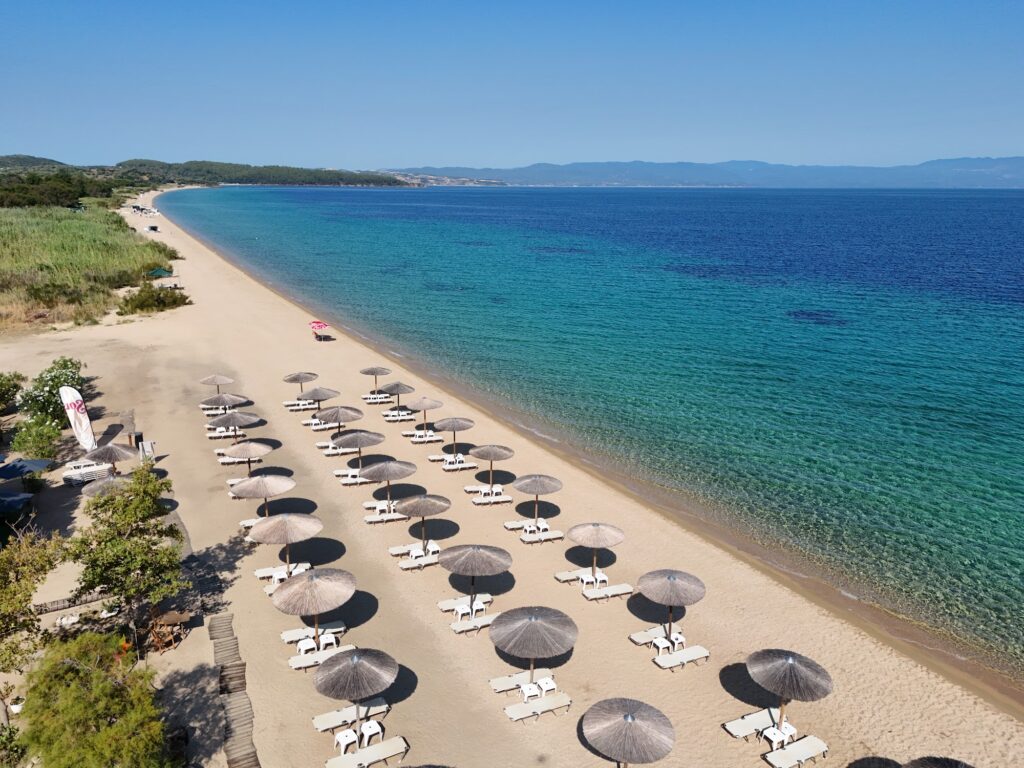
What makes Komitsa distinctive is its clean split into two genuinely different characters. One stretch runs fully organized, sunbeds and umbrellas managed by a local resort and beach bar with attentive, unhurried service, while the other remains deliberately undeveloped, a wild zone for anyone who’d rather experience this coastline without any infrastructure at all. I spent time on both over separate visits and found the contrast genuinely useful, a single beach offering two entirely different kinds of day depending on the mood.
Fine Sand, Clear Water, and Room for Everyone
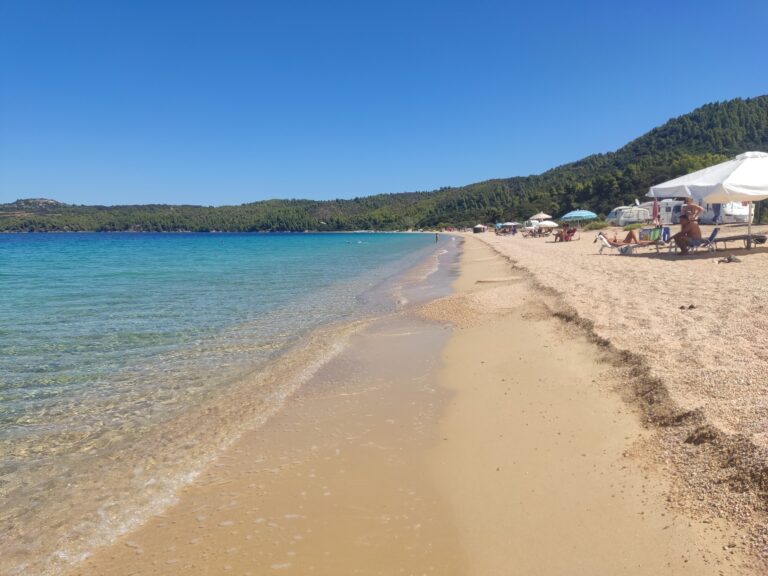
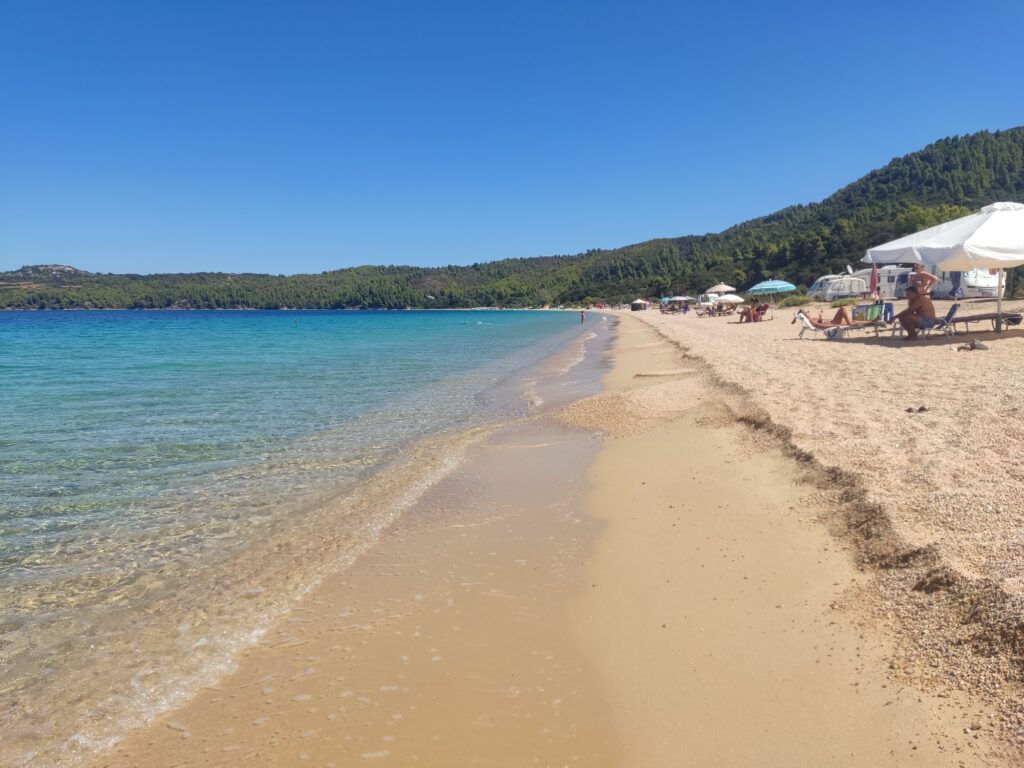
The shoreline blends fine, light-colored sand with tiny pebbles, and I found the water consistently transparent, good enough for casual snorkeling near the rockier sections. Given the sheer length of Komitsa, I never once felt crowded here, even in the middle of August, a genuine rarity for a Greek beach this accessible from Thessaloniki. The seabed slopes gently enough that I’d call this a reasonably safe choice for supervised swimming with children, and the wide sandy stretch gives kids plenty of room to play without needing to stay within sight of a single umbrella. Given the beach’s mostly unorganized character beyond the managed section, dogs would likely be fine on a leash along the wilder stretches, following the standard rule for unorganized Greek beaches, though the resort-managed section would need its own permission.
Nea Roda, the Xerxes Canal, and a Village at the Peninsula’s Narrowest Point
The village of Nea Roda sits at the narrowest point of the entire Athos peninsula, close enough to the route that the Persian king Xerxes reportedly had cut through the isthmus in 480 BC, a two-kilometer canal built so his fleet could avoid sailing around the treacherous cape during his invasion of Greece. The canal has long since silted over and is really only visible from the air today, but I found the story added real weight to a village that otherwise presents itself simply as a quiet fishing town, its promenade lined with tavernas and its small port crowned by the old church of Agioi Theodoroi. Nea Roda’s own church also keeps an old icon of the Virgin Mary, painted with the crucifixion on its reverse side, that locals consider capable of miracles, a detail that sits interestingly alongside the fact that this same coastline eventually reaches a religious community that has spent a thousand years excluding women entirely.
Seafood Tavernas With a View Toward the Holy Mountain
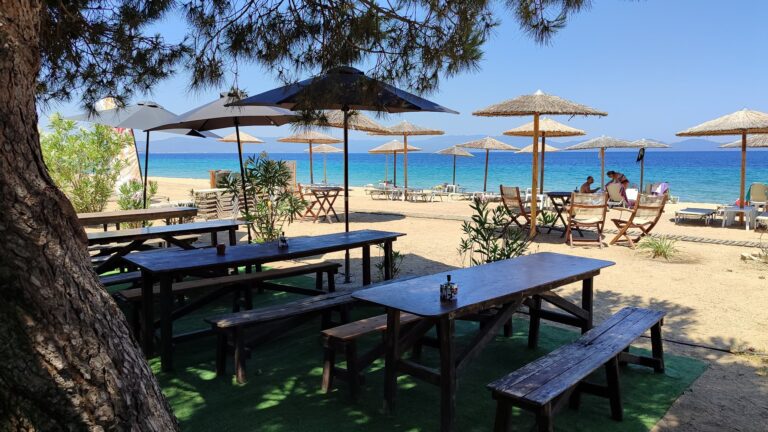
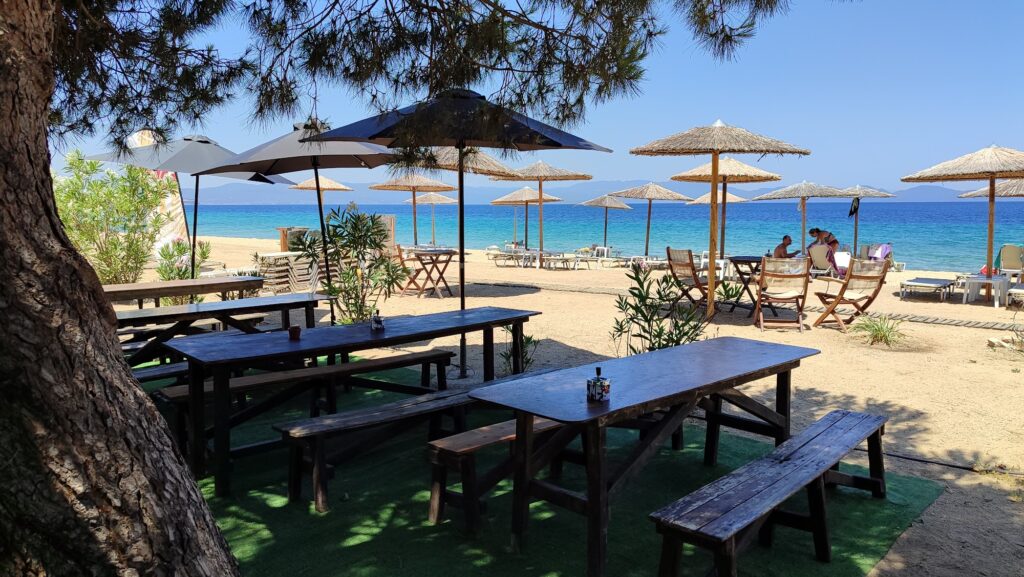
Behind the organized section of Komitsa, a handful of contemporary beach bars and a taverna serve fresh local seafood and classic Mediterranean dishes on shaded terraces, and I ate well at more than one, the sea view stretching toward the Athos peninsula’s outline on a clear day. Changing cabins, outdoor showers, and restroom facilities cover the essentials along the managed stretch.
Getting There and Settling In
Komitsa sits roughly 115 kilometers from Thessaloniki, a drive of about an hour and forty-five minutes following the main road toward Arnaia and Ierissos before continuing to Nea Roda, where a well-marked coastal road leads directly to the beach; KTEL Chalkidikis buses run to Ierissos and Nea Roda from Thessaloniki’s terminal, with a short taxi ride covering the final stretch to the shore, and I found parking genuinely stress-free even on peak summer weekends, ample space available in lots and along the access roads behind the beach bars.
Watching the Fence Line as the Light Drops
By the time I made my way back from the eastern end of the beach on my last evening, the fence marking the Athos border had gone dark against a sky still holding some color, and I stood there a while longer, thinking less about the monasteries I’d never see behind it and more about how quietly this particular stretch of Greek coastline holds two entirely different worlds side by side, one built for an ordinary beach day, the other still running, more or less unchanged, on rules a thousand years old.
Map
Sorry, no records were found. Please adjust your search criteria and try again.
Sorry, unable to load the Maps API.