Seitan Limania Beach Crete: The Devil's Harbour Guide
Profile
Seitan Limania Beach (Stefanou Beach), Crete: The Ottoman Devil’s Harbour with the Handrails Installed After Three Serious Injuries in One Season
Greece | Akrotiri Peninsula | Chania Prefecture, Crete
There is a roadside shrine at the top of the path to Seitan Limania Beach. The kind you see everywhere in Greece along the side of treacherous mountain roads where people died in accidents — a small glass cabinet with a candle and a photograph. It was put there before the three serious injuries in one season, before the local council installed the handrails in August 2021, and before the Chania Mountaineering Association declared its readiness to help build a safe descent. It is still there.
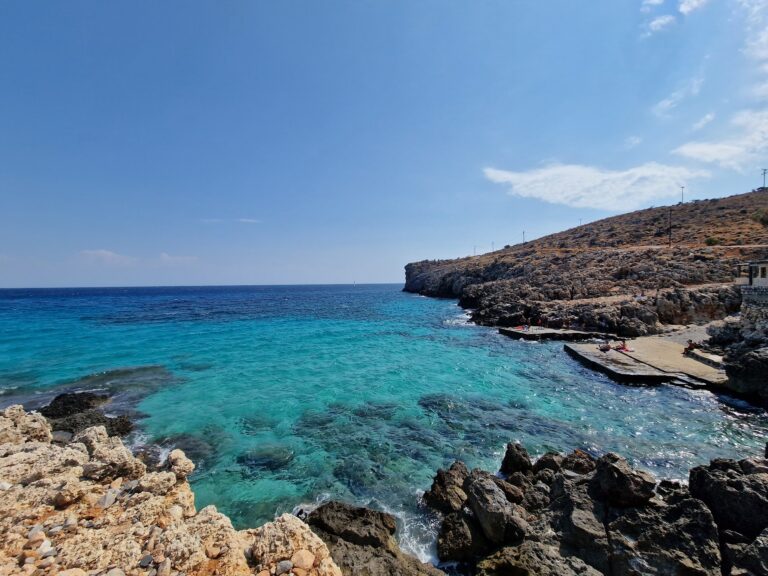
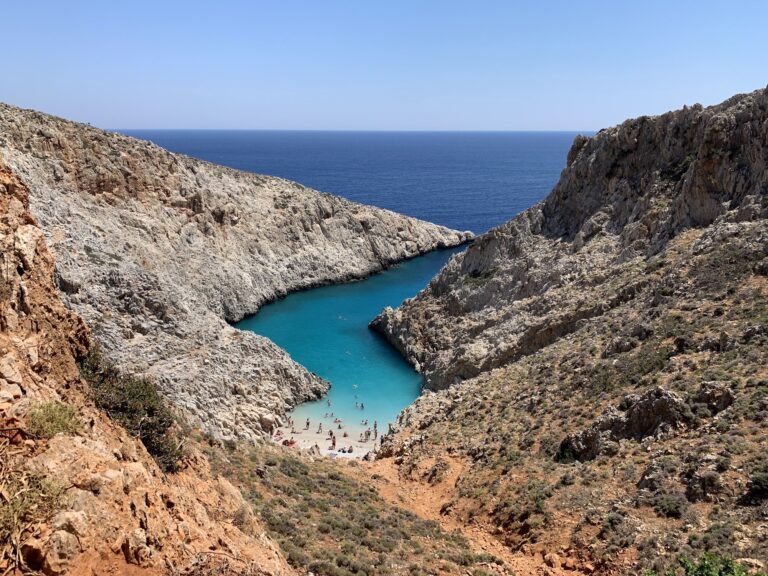
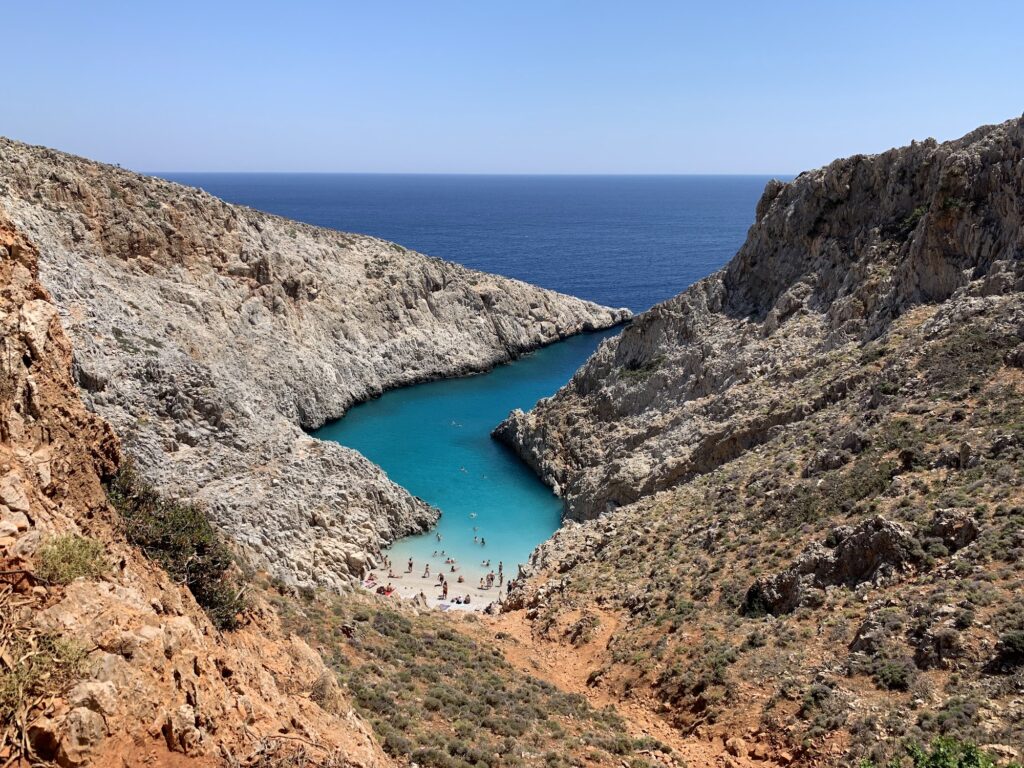
Seitan Limania means “Ports of Satan” — seitan from the Turkish word for devil, a linguistic remnant of the Ottoman period of rule on Crete, limania from the Greek word for harbours. The formal name of the beach is Stefanou (after the small chapel of Agios Stefanos at the base of the inlet), but the Ottoman name has outlasted the period that produced it by several centuries. The name likely refers to the bare rocks surrounding the bay and the wild currents that once made the inlet treacherous for boats. Both remain: the rocks are the path down, and the current in the inlet can be powerful when conditions allow.
The beach is on the Akrotiri Peninsula, approximately 20 kilometres northeast of Chania city centre — the narrow peninsula northeast of the city, which also holds Chania International Airport. Seitan Limania is on the east side of the peninsula, reached by a narrow winding road from the village of Chordaki that descends 2.7 kilometres from the main road with an elevation change of 198 metres and an average gradient of 7.33%. This is the road that required courage from drivers before the paving improvements, and which still requires careful navigation in the final hairpin section.
Getting There: The Narrow Road from Chordaki, the Church of Agios Spyridon Parking, Before 9am
From Chania, follow the signs toward the airport, then take the left turn-off toward Chordaki village before reaching the terminal. Pass through the village and continue as the road descends to the coast. The road ends at the small parking area near the Church of Agios Spyridon at the cliff edge above the beach.
The parking fills completely by 10am on summer days in July and August. Cars park along the road leading down when the lot is full, with large stones placed behind wheels to prevent rolling on the gradient. The practical advice from visitor accounts is consistent: arrive before 9am for parking; after 11am, the area is typically gridlocked and turning back without reaching the beach is the realistic outcome.
By boat, departures from Marathi harbour (the nearest harbour on the Akrotiri coast) or from Chania port allow visitors to approach the inlet from the sea. The view from the water looking into the narrow channel is the specific arrival quality that the land approach cannot replicate — the fjord walls visible at their full height, the turquoise water filling the channel, the small beach at the far end.
The Path Down: Handrails Since August 2021, Left Path Descending, Right Path Back Up
The path from the parking area to the beach descends steeply for approximately 15 to 20 minutes. The path is steep, slippery, and rocky. Wear comfortable shoes. This is not navigable in flip-flops.
Following incidents including three serious injuries in a single season, the council installed handrails alongside sections of the path in August 2021 to make it safer. The handrails are present on the most dangerous sections. The infrastructure improvement reduces but does not eliminate the risk — the path is still steep, the surface is still loose rock in sections, and the descent in full sun with beach equipment in a backpack is physically demanding.
The established route from visitor accounts: take the left path when descending (follow the other visitors in peak season), use the right path with chains for the return climb. The return ascent in afternoon heat is the part most accounts describe as more demanding than the descent. Packing all beach items into a backpack before starting reduces the risk of losing balance from carrying equipment at the sides.
The Beach: Small Sand-Pebble Crescent, No Facilities, No Sunbeds, No Toilets, No Shade
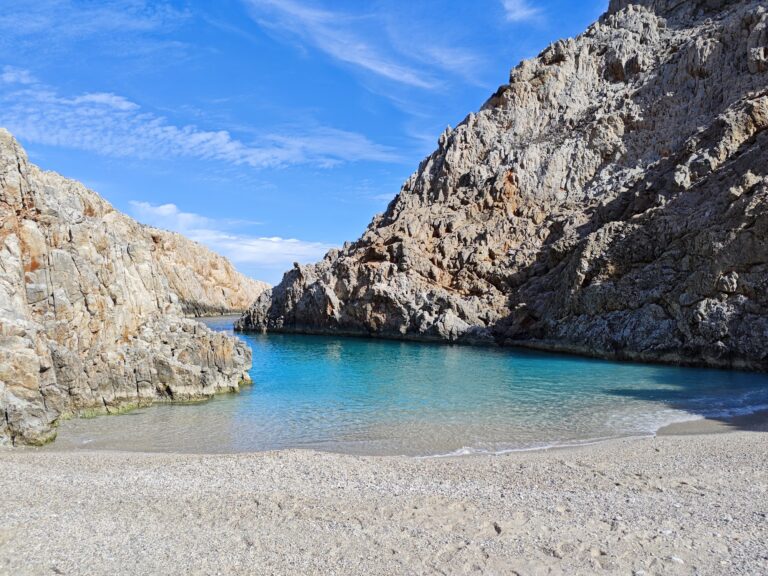
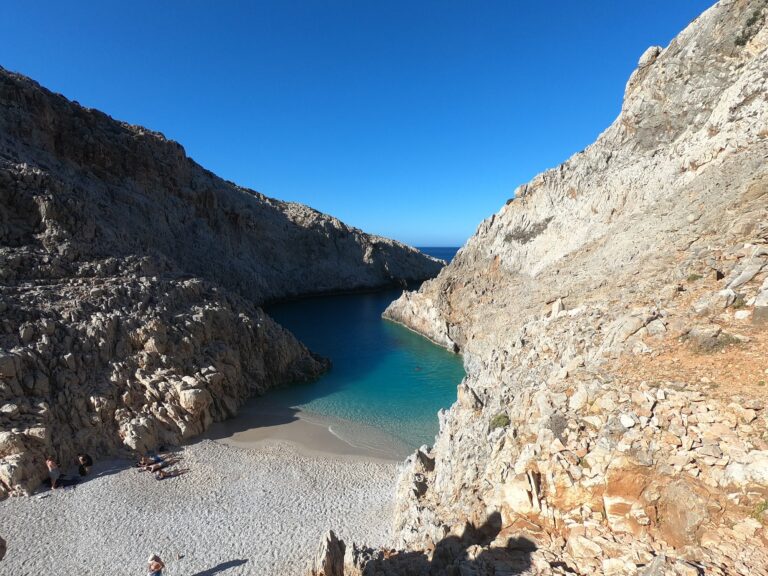
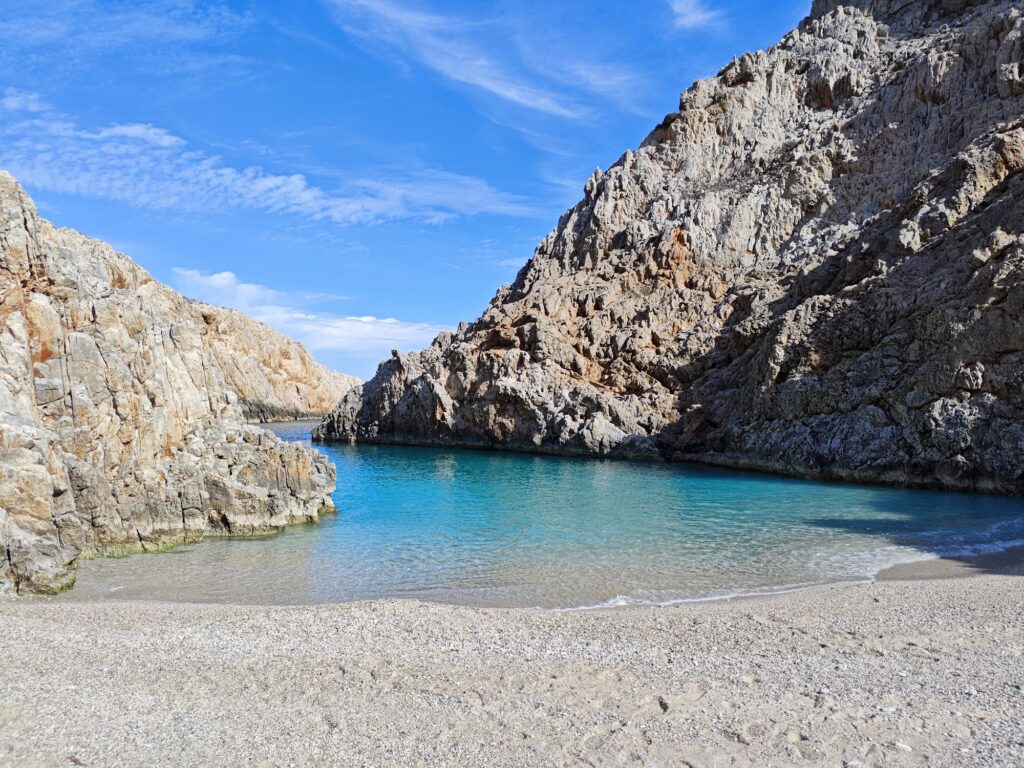
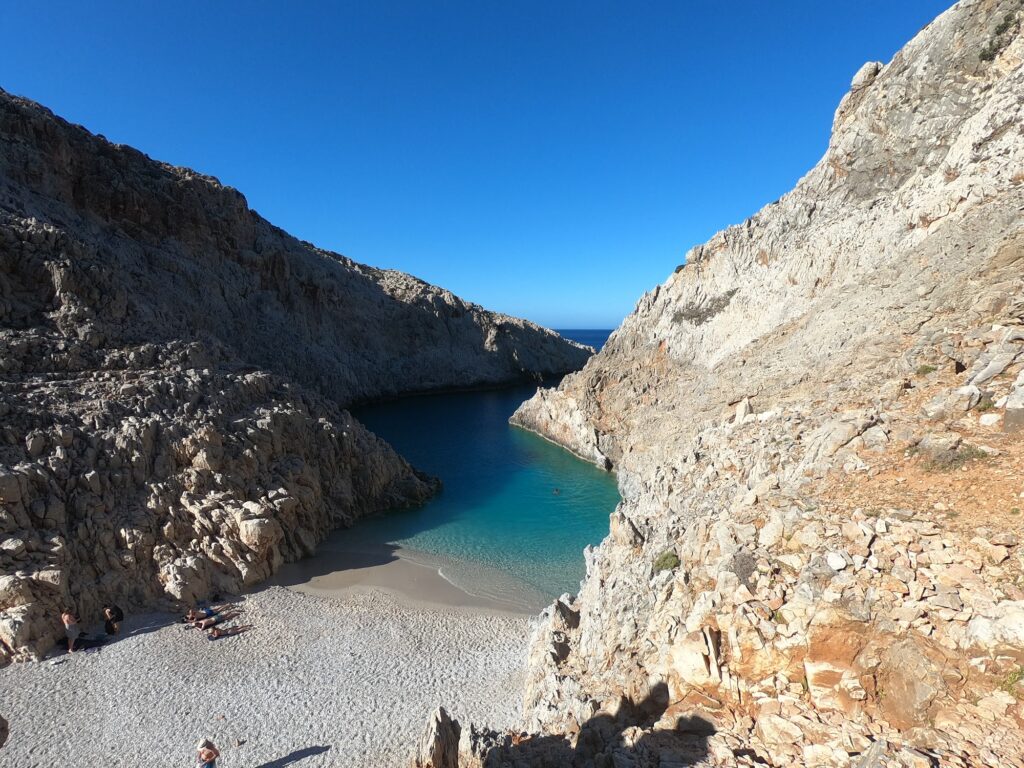
At the base of the path, the inlet opens to reveal the narrow fjord-like channel — white limestone walls on both sides, turquoise water filling the space, the small sand-and-pebble beach at the entrance. The starting point of the beach contains small pebbles, but as you approach the waters, the beach becomes sandy.
There are no sunbeds, no umbrellas, no restrooms, no lifeguard station, and no bar at the beach. A seasonal canteen is sometimes located near the parking area at the top, and one source notes this canteen can deliver to the beach. The practical preparation is the standard for unorganised Greek beaches at this level of remoteness: bring enough water (the descent and the heat consume more than expected), food, sun protection, and accept that toilet facilities require the ascent.
The cliff shade from the high walls provides some cover in the very early morning and late afternoon. At midday in summer the sun is directly overhead the narrow channel and the heat inside the canyon can be intense.
The Goats: They Will Eat Your Sandwich
Seitan Limania is a goats’ paradise. They are found everywhere — scattered along the cliffs, on the path, and on the beach. They will eat your sandwich, your apple, and your pack of crackers if left unattended. The goats are the specific wildlife encounter that visitor accounts describe as both charming and practically annoying, and that the source article accurately characterises as one of the beach’s unique features. Cretan goats love pears and apples if you want to bring provisions for the social exchange.
Cliff Jumping: People Have Died
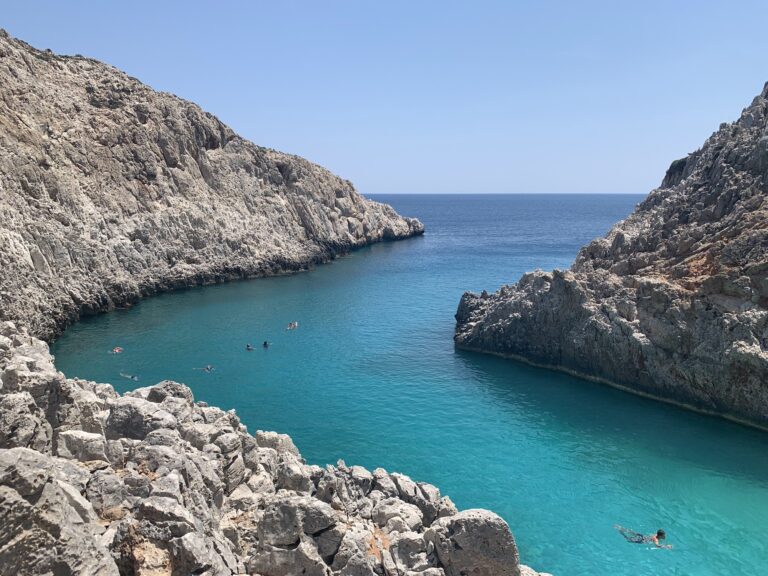
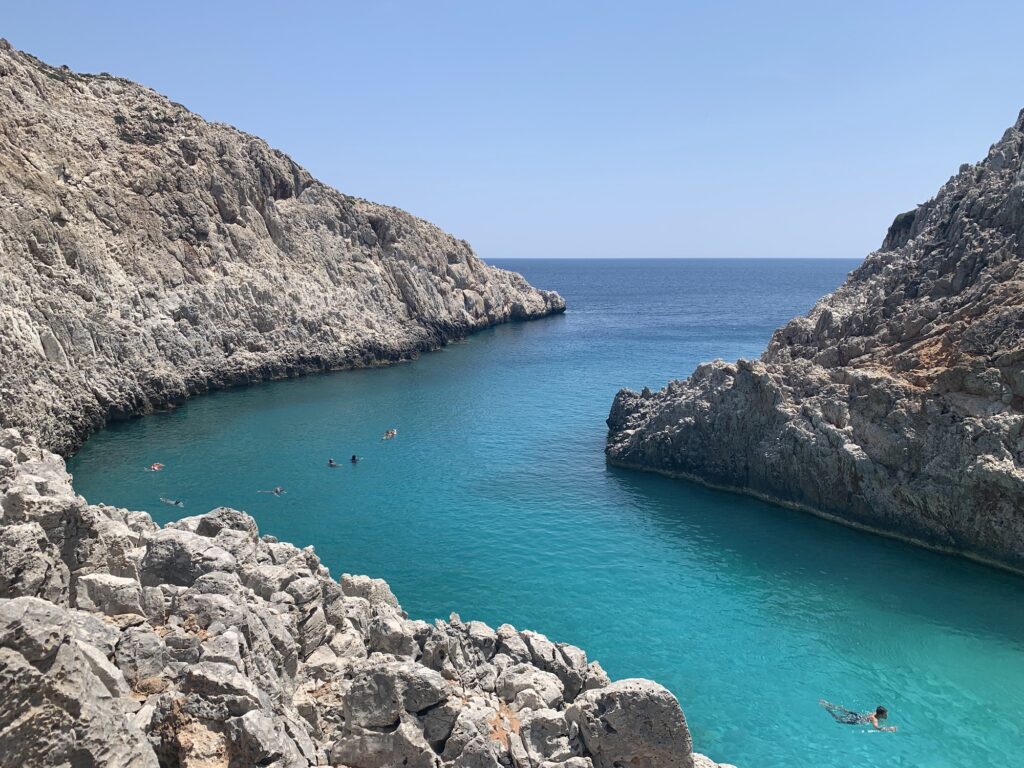
Lots of young people jump off the cliffs into the natural wave pool created in this cove. The source article frames this as an adventure activity worth flagging. It is: people have died cliff-jumping at Seitan Limania. The specific hazard is the combination of the deep water, the wave action that the inlet creates when sea conditions change, and the specific underwater geometry of a narrow canyon whose walls are not uniformly safe for all entry points.
The honest assessment: the water is deep in the channel. Before jumping from any point, the visitor must personally verify the water depth and the absence of underwater obstacles at the specific point of entry — not read about it in a review, not assume the point is safe because others have used it. The council’s handrails and the existing incident record reflect a location where poor judgement about conditions has resulted in serious harm.
The Two Inaccessible Canals to the South
Next to Seitan Limania, southwards, there are two more sea canals, but they are not accessible and they are not beaches. They can be seen from above by taking the path to the right of the parking lot, but the place is not safe and looking over the edge is not recommended. The visual of three parallel fjord-like channels carved into the limestone cliff face — only one of which is accessible — is the specific aerial or cliff-top view that drone photographs of the location capture.
The Akrotiri Peninsula and Nearby Beaches
Marathi Beach — east of Seitan Limania on the same Akrotiri coast — is the calm, shallow, family-friendly alternative with tavernas and beach bars and water that is safe for toddlers. It is the specific contrast beach for visitors who bring family members who cannot manage the Seitan Limania descent.
Stavros Beach — northwest of Seitan Limania — is where Zorba the Greek (1964) filmed its famous beach scenes, including the final dance sequence. The zorba dance on the beach of Stavros is the specific filming location that gives the beach its cultural identity.
Seitan Limania Beach on Crete’s Akrotiri Peninsula is the Ottoman “Devil’s Harbour” — narrow fjord carved in white limestone, turquoise water filling the channel, handrails installed in August 2021 after multiple serious accidents, no facilities, arrive before 9am, no flip-flops on the path, goats eat unattended food, cliff jumping has caused deaths, and the road down requires careful driving.
Park near the Church of Agios Spyridon. Use the left path down. Use the right path with chains on the way back up.
The shrines are reminders, not decorations.
Map
Sorry, no records were found. Please adjust your search criteria and try again.
Sorry, unable to load the Maps API.
Near by places: